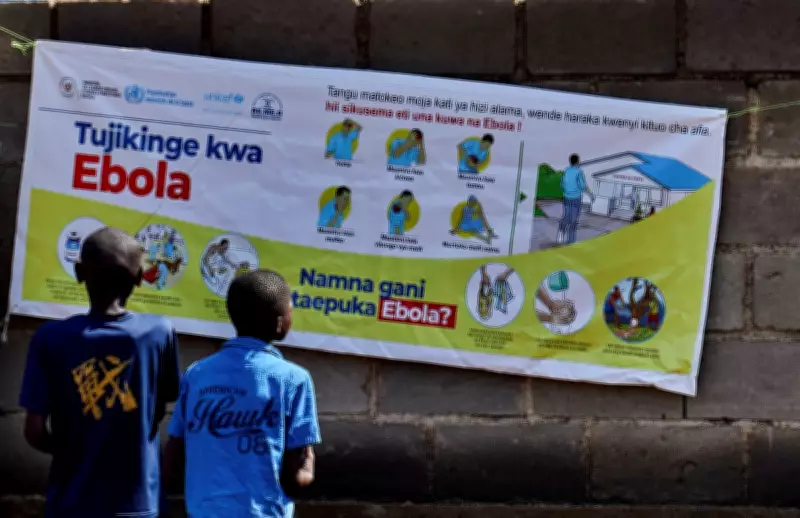
A previously undetected outbreak of the rare Bundibugyo variant of Ebola is spreading across central Africa, with experts accusing the United States of failing to assist due to massive cuts to global and domestic public health efforts. There is no cure or vaccine for this strain, which has caused two prior outbreaks in recent decades.
Outbreak Details
Since April, the Democratic Republic of the Congo (DRC) has reported 482 suspected cases and approximately 116 deaths. Two cases and one death have been confirmed in Uganda, with potential spread to South Sudan. The World Health Organization (WHO) declared a Public Health Emergency of International Concern on 20 May 2026, before even convening its emergency committee. Officials warn the outbreak may last for months.
US Withdrawal of Support
The US Agency for International Development (USAID) has been dismantled over the past year, with thousands of staff laid off and key research canceled. US foreign assistance to the DRC fell from $1.4 billion in 2024 to $431 million in 2025, and only $21 million so far in 2026. Aid to Uganda dropped from $674 million to $377 million in 2025, with a negative $1.2 million this year. The US also announced its withdrawal from the WHO, ending $130 million in funding and resulting in 2,371 job losses at the organization.

Matthew Kavanagh, director of the Center for Global Health Policy and Politics at Georgetown University, called the cuts a "self-inflicted wound" and said the outbreak was "deeply foreseeable when you gut public health surveillance and capacity." He noted that the DRC, one of the most vulnerable health systems, was the second-largest recipient of USAID funding.
Impact on Response
An Ebola lab in Frederick, Maryland, operated by the National Institutes of Health (NIH), was shuttered last year, ending work on monoclonal antibodies and vaccines for this strain. The CDC has no director, no surgeon general, and no FDA commissioner. Only 25 to 30 staff remain in the DRC country office, with one additional person being deployed.
Kristian Andersen, professor of immunology at Scripps Research, stated: "It's not just that we're leaving the table, we are completely cutting ourselves out of the conversation. We are upending the table." He emphasized that global health investments are "pennies compared to what you get in return" and that prevention is far cheaper than response.
Criticism of Travel Bans
The US announced travel bans for noncitizens who recently traveled to the region, which Kavanagh described as "public health theater" that punishes affected countries without stopping cases. The Africa CDC urged countries to refrain from "fear-driven" travel bans, calling for aggressive support of outbreak control at the source.
Kavanagh concluded: "At this point, this is an out-of-control epidemic that has now crossed borders... Ebola can be stopped, and if we don't mobilize the dollars and the public health efforts, then we are simply choosing not to stop the outbreak."