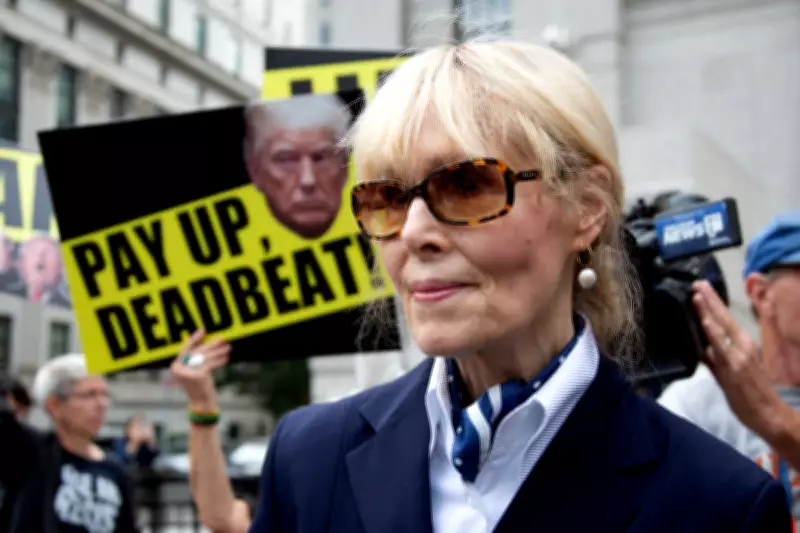
Donald Trump owes E Jean Carroll nearly $90 million after losing two defamation cases against the former Elle magazine columnist who accused him of sexual assault. The president, who has made a crusade against the “weaponization” of the federal government against him and his allies a central part of his administration, now appears to be turning his Department of Justice against her.
A criminal inquiry from the Trump administration against his most well-known accuser amounts to a “disturbing” and unprecedented escalation of a politically motivated retribution campaign against his enemies, legal experts and advocates for sexual abuse survivors tell The Independent.
Trump has spent years labelling Carroll’s allegations a “hoax” and has repeatedly branded her a liar whom he has never met. A jury found Trump liable for sexually abusing Carroll and then another determined he lied about never knowing her, repeatedly. Those juries awarded her a combined $88.3 million, verdicts that Trump has appealed to the Supreme Court with the Justice Department’s backing. The administration’s criminal case against her appears designed to derail her victories — and silence others, experts say.

Justice Department resources diverted
“Every time the Department of Justice devotes resources to such an endeavor … it pulls resources — lawyers and agents — from real cases with real victims whose cases do not get the attention they deserve and whose access to justice is denied,” according to former federal prosecutor Mary Graw Leary, a criminal law scholar at the Catholic University of America whose work has examined sexual abuse cases.
Advocates for survivors of sexual violence argue the investigation is a striking example of why survivors often don’t come forward at all. “She came forward. She endured the scrutiny, the smears, the death threats,” Rachel O’Leary Carmona, executive director of Women's March, said. “And now the government run by the man she beat in court is reportedly opening a criminal investigation into her.”
Focus on deposition statement
The alleged criminal investigation appears to focus on Carroll’s 2022 videotaped deposition statement in which she said that she did not get any outside funding for her lawsuit against Trump. During her deposition, Carroll told Trump’s then-personal attorney Alina Habba that no one else was paying her legal fees. But two weeks before the trial, her attorneys wrote a letter to the court to inform the judge and Trump’s lawyers that the team received support from Rein Hoffman’s nonprofit American Future Republic.
Neither Carroll nor her legal team ever met or spoke with anyone at the nonprofit, they told the judge, and representatives for Hoffman denied ever communicating with her. Dmirtri Mehlhorn, one of Hoffman’s philanthropic advisers, said in a statement at the time that Hoffman and his associates have provided third-party funding to legal efforts to “protect our citizens from violent threats,” adding that recipients “generally do not know our identity.” Carroll had “no prior knowledge that our funding would go to support her in particular,” he said.
The judge overseeing the case determined there was no issue with Carroll’s credibility and blocked Trump’s lawyers from questioning Hoffman’s funding during the trial. Lawyers for Carroll declined to comment to The Independent and could not confirm whether any investigation is underway, but they stressed that the statements allegedly at the center of the investigation have already been litigated.
Previous litigation and appeals
Trump’s issues previously were raised in court, and federal judges rejected them. “There was no evidence” to suggest Carroll was “personally involved in securing the funding, interacted with the funder, received an invoice showing the arrangement before or after her counsel received the outside funding, or had discussed the arrangement with anyone” after learning about it, a panel of appeals court judges wrote in 2024. Carroll “simply was not involved in the matter of who was or was not funding her litigation costs,” judges wrote.

“If we were to just look at the case in isolation, it is disturbing,” Graw Leary told The Independent. For the Justice Department to investigate a “specious allegation” in a civil case “in which the United States was not a party and a jury found a defendant liable for engaging in [sexual abuse] against a woman and then defaming the victim is troubling,” she said. The Justice Department typically does not second-guess a jury’s verdict in such a case, “nor would it devote resources regarding a civil case such as this,” she said. But in the context of Trump’s campaign of retribution against his perceived political enemies who mounted cases against him, the case against Carroll “is even more disturbing,” Graw Leary said. The case not only sets out to “exact revenge on a successful plaintiff but also to silence any others,” she told The Independent.
Carroll's accusations and trial details
Carroll is among at least 28 women who have accused Trump of sexual abuse, which he has vehemently denied. In 2019, she wrote in New York magazine that Trump forced himself on her in a department store in the 1990s. The president said she was “totally lying” and “not my type.” She then sued for defamation, resulting in a $5 million verdict finding the president liable for his defamatory statements and for sexual abuse. Judge Lewis Kaplan wrote that while Carroll had failed to prove that she was “raped” within the meaning of New York Penal Law, that “does not mean that she failed to prove that Mr. Trump ‘raped’ her as many people commonly understand the word ‘rape.’” “Indeed, as the evidence at trial recounted below makes clear, the jury found that Mr. Trump in fact did exactly that,” Kaplan wrote. Evidence “convincingly established” and the jury “implicitly found” that Trump had “deliberately and forcibly penetrated Ms. Carroll’s vagina with his fingers, causing immediate pain and long lasting emotional and psychological harm.”
After a second lawsuit and trial, Carroll was awarded $83.3 million for smearing her sexual assault allegations as a lie in the aftermath of the previous ruling. O’Leary Carmona said the Justice Department’s message in the wake of those victories is “unmistakable”: “Tell the truth, win in court, have a jury validate you, and the powerful will still come for you with vengeance,” she said. “Donald Trump has spent his whole life shielding the powerful men around him while survivors get harassed, vilified and discredited,” according to O’Leary Carmona. “He has lifted not one finger to investigate Jeffrey Epstein or the wealthy men in his orbit. But he has found all the time in the world to come after a woman who did nothing but tell the truth. That tells you exactly whose interests this Justice Department serves.”
Broader context of DOJ actions
The Carroll case reportedly emerges from the U.S. District Attorney’s Office in the Northern District of Illinois — days after the district’s top federal prosecutor Andrew Boutros was forced to drop a high-profile indictment against several protesters at the center of Trump’s blitz of federal immigration agents into Chicago. That case collapsed, and lawyers and federal judges across the country are taking note, warning that the Justice Department under Trump faces a mounting credibility crisis. A case against the “Broadview Six” case fell apart days before trial, after a judge discovered damning mistakes in a grand jury process that forced Boutros to apologize in open court and then release a statement announcing “reforms” to ensure “the same mistakes don’t happen again.” “I put even more reliance on Department of Justice attorneys. Your sole goal is to do justice. Your client is justice itself,” District Judge April Perry told prosecutors last week. “I do believe deeply in the presumption of regularity and that most government attorneys are doing the best they can to do the right thing. That trust has been broken.”