
In The Fall of the West, journalist and Guardian columnist Owen Jones charts a quarter century of geopolitical hubris and economic overreach, from the certainties of the early 2000s to their collapse amid economic failures, foreign policy disasters and political crises.
Jones, like many Britons born in the 1980s, came of age with Tony Blair's platitudes ringing in his ears. Politics at the turn of the millennium was a story of temporary dispensations mistaken for eternal truths: the definitive triumph of free market ideology, US military supremacy, and a rules-based global order.
Wars and their consequences
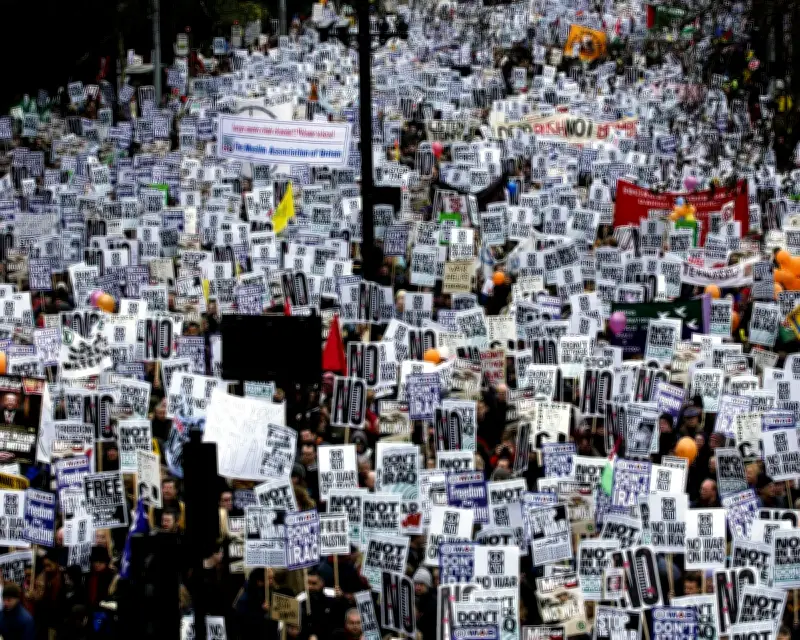
Revisiting the US-led wars in Afghanistan and Iraq, Jones reminds readers not just of their horrific death tolls (totalling half a million, by conservative estimates) but also their total strategic failure. The 2021 evacuation of Kabul airport, he writes, was "among the starkest images of American decline yet broadcast to the world".
These interventions also weakened the foundations of the international legal system. As Jones points out, a precedent was set when Nato bombed Yugoslavia without UN security council authorisation in 1999; the 2003 invasion of Iraq, also without authorisation, further undermined the UN. So when Vladimir Putin subsequently invaded Ukraine on his own dubious pretext, western objections could be dismissed as hypocrisy. Perhaps the most ignominious example of western indifference to the international rule of law was Keir Starmer's limp assertion that Israel had the "right" to cut off water and electricity to 2 million civilians in Gaza – a war crime – in retaliation for Hamas's attacks on 7 October 2023.
Domestic decline and the rise of the far right
Alongside these geopolitical catastrophes, Jones tells a story of domestic decline, of western economies built on chronic insecurity and precarious employment. In the 2000s, Thatcherite policies pursued by New Labour fleeced the public: "Essential services [were] turned into assets designed to generate returns. Passengers paid more for overcrowded trains. Rivers and seas were fouled while water companies loaded themselves with debt and paid out dividends." Then came the 2008 financial crisis and the bankers' bailout, paid for by austerity. In Britain and elsewhere, Jones notes a "correlation between the inability of centrist governments to tackle economic decline in any meaningful way, and the rise of the far right".
The book is interspersed with snippets of interviews with an assortment of eyewitnesses, journalists, scholars and activists. They include the director of Iraq national museum in Baghdad, a former Lehman Brothers employee, a former head of the Afghan Red Crescent, the Greek economist Yanis Varoufakis, and the conservative commentator Andrew Sullivan, a repentant cheerleader for the Iraq war, who admits: "I was wrong on the major issues, on the morality of it and the practicality of it and the reason for it."
A compelling through-line
Much of this terrain – Bush and Blair's wars, the financial crash, the populist surge – has been extensively covered. The average well-informed reader will learn nothing new, but it is bracing to see what was once the news cycle take its place in the sweep of history, and Jones's focus on free-market fundamentalism provides a compelling through-line. He suggests the second Trump administration, in all its cynical venality, is "the logical endpoint" of that philosophy. And he reminds us that the aggressive privatisation of the Russian economy in the 1990s brought terrible economic hardship which ultimately fuelled Putin's revanchist nationalism.
For decades, electorates have been mis-sold a fanatical ideology: the prerogatives of the private sector must override the collective interest, and anything less is tantamount to Stalinism. This remains orthodoxy, but the rise to prominence of Zohran Mamdani, the avowedly socialist mayor of New York, offers a glimmer of hope to those who, like Jones, would prefer a society built on "common provision, democratic power, mutual obligation and the recognition that our fates are bound together".




