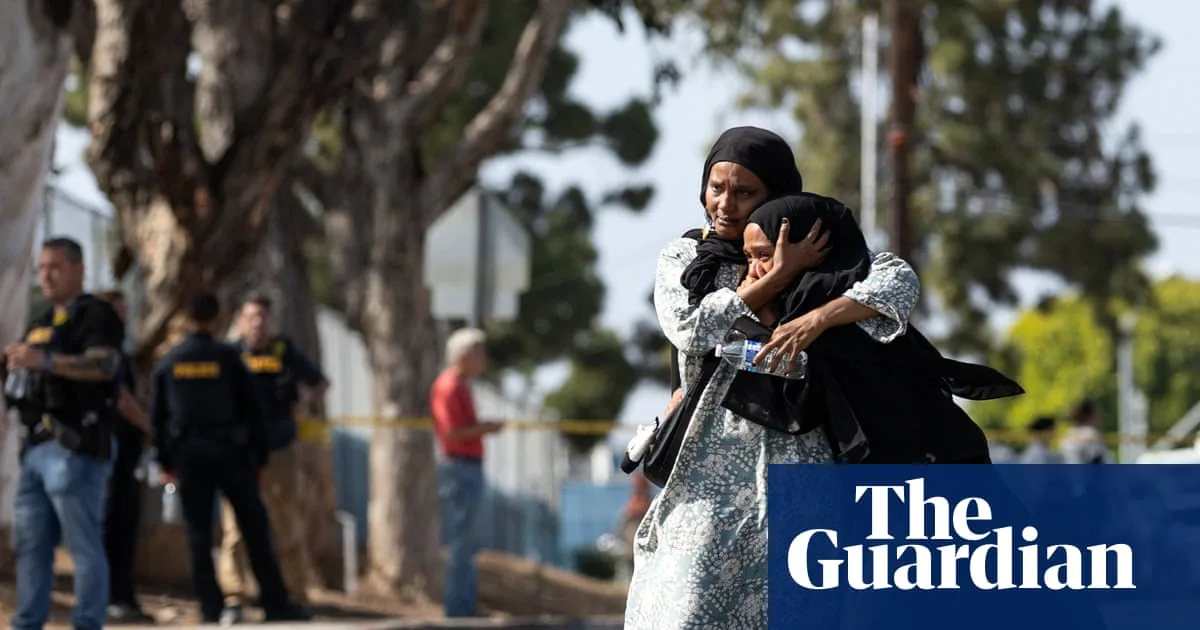
Two days after a mass shooting at the Islamic Center of San Diego (ICSD), the Muslim community is grappling with grief and trauma while striving to heal. Teacher's assistant Iman Khatib, who hid under a desk with a co-worker as gunfire erupted, expressed gratitude for survival but admitted, "None of us are sleeping. We don't want to relive the things that we saw."
The Attack and Its Victims
The shooting on 18 May 2026 left three dead: security guard Amin Abdullah, mosque store manager Mansour Kaziha, and Nader Awad, who rushed toward the center after hearing shots. Abdullah, a father of eight and a convert to Islam, was hailed as a hero for locking down the school and returning fire, preventing the teenage gunmen from reaching approximately 140 children and 20 staff members. Investigators are treating the attack as a hate crime, citing hate speech found on one of the weapons and racial ideology in a suicide note.
At a press conference, Abdullah's daughter Hawaa tearfully described him as "my role model and my best friend," noting he had recently missed her teaching credential ceremony because he was working at the center. "He was even afraid to go take meal breaks because he was afraid something would happen if he stepped away from the Islamic center," she said.
A History of Openness and Resilience
The ICSD, the largest mosque in San Diego County, has long been a model of interfaith outreach. Imam Taha Hassane, who arrived from Algeria weeks before the 9/11 attacks, responded to post-9/11 tensions by opening the mosque wider, hosting interfaith meetings, conducting Friday sermons in English, and joining civic and police advisory boards. On the morning of the shooting, non-Muslims were inside on a tour learning about Islam.
Hatem Albazian, director of the Islamophobia Research and Documentation Project at UC Berkeley, noted that while many Muslim institutions aspire to openness, "very few have committed to it as completely, as publicly, and for as long as ICSD." He added that the mosque's doors are "literally unlocked between prayers," a deliberate choice sustained for decades despite societal pressure to retreat behind security perimeters.
Rising Islamophobia and Calls for Action
The attack comes amid a surge in anti-Muslim sentiment. The Council on American-Islamic Relations (CAIR) recorded 8,683 anti-Muslim complaints in 2025, the highest annual total since 1996. After the 7 October 2023 Hamas attack on Israel and the subsequent Israeli military campaign in Gaza, Imam Hassane reported increased bullying of Muslim and Palestinian students. In 2023, anti-Muslim fliers were posted across the ICSD campus.
Albazian observed that the nature of Islamophobia has shifted since 9/11, with hateful rhetoric now spoken openly in Congress and radicalization accelerated by the internet. "Two teenagers exchanged manifestos and turned ideology into a mass shooting," he said.
At a press conference, a woman interrupted San Diego Mayor Todd Gloria, shouting, "This is a direct result of your leadership. Our Muslim brothers and sisters have been talking to you for how long?" The outburst reflected frustration over perceived inaction after Gloria's statement that "San Diego stands with the people of Israel" following the 7 October attacks, which Muslim advocates said ignored rising Islamophobia.
Tazheen Nizam, executive director of CAIR San Diego, reported that other mosques in the county have received threatening voicemails and hate messages. She called for elected officials to provide not just physical security but also human and manpower support. She also noted that San Diego mosques received no funding in the last cycle of the Department of Homeland Security's grant program, and CAIR has demanded a briefing on steps to protect mosques.
Community Healing and Vigil
Two days after the shooting, staff returned to the mosque to retrieve personal items, walking past broken doors and scattered school supplies. They later gathered at the home of the kindergarten teacher whose husband was killed, where Abdullah's sister—a police officer who had worked security at the mosque—joined them. "Being together was exactly what we needed," Khatib said. "We didn't realize it until we were just hugging each other."
That night, hundreds attended an interfaith vigil at a nearby park. Faith leaders, Imam Hassane, and elected officials honored the three victims. "Hate and bigotry arise from ignorance," said Nizam. "Come to an Islamic center. Learn about Muslims. We're just your neighbors."
On Wednesday, the mosque resumed its five daily prayers, though the school and administration office remain closed. A community fundraiser has raised over $3 million. Khatib said staff are committed to reuniting children with their belongings and ensuring positive closure for the school year. "The ones who pay the ultimate price are the children," she said. "This is not a world that children should have to live in."