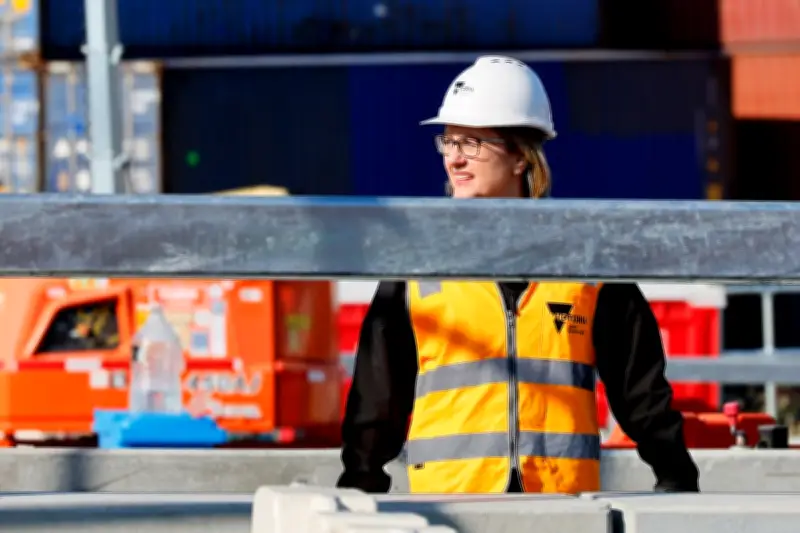
Former Victorian ombudsman Deborah Glass has called for a royal commission to investigate mounting allegations of misconduct on the state's Big Build infrastructure projects, arguing that existing integrity agencies are not equipped to handle the scale of corruption.
Allegations of Organized Crime and Corruption
Recent revelations have linked organized crime gangs, underworld figures, and other unsavory characters to construction sites on Victoria's massive infrastructure program, known as the Big Build. Evidence of intimidation, extortion, fraud, and bribery has emerged, all on government-funded projects at escalating costs to the public.
Glass, who served as Victorian ombudsman from 2014 to 2024, wrote in a Guardian Australia opinion piece that Premier Jacinta Allan's response has been to blame inflation rather than corruption, and to claim that existing agencies have the matter under control. Glass disputed this, stating that no Victorian integrity agency is empowered or resourced to deal with misconduct on this scale.

Limitations of Ibac
Glass highlighted the limitations of the Independent Broad-based Anti-corruption Commission (Ibac), which cannot investigate 'grey corruption'—misconduct that is not necessarily criminal but involves bending or breaking rules to benefit mates, political organizations, or networks, and misusing public funds. Every Ibac commissioner since its inception in 2013 has called for reform in this area, but successive Victorian governments have resisted.
Premier Allan recently announced plans to give Ibac broader powers, but not until the end of 2027, after the next state election. Glass described this as 'decisively too late.'
Political Expediency and Secrecy
Glass criticized the government's focus on delivering big projects at any cost for political gain, citing the Suburban Rail Loop as an example. Announced just before the 2018 election, the project was developed in excessive secrecy, without the knowledge of the secretary of the responsible department. Its business case was 'proved up' by consultants, and the announcement blindsided the agency set up to remove short-term politics from infrastructure planning.
The project, with an estimated cost over $200 billion, was presented to the electorate as a mandate, but voters were not told it had been developed in secrecy or that its cost would crowd out better uses of funds.
Financial Impact on Victorians
Thanks in large part to the Big Build, Victorians are paying some $24 million a day in interest on the state's debt, impacting public services including health, housing, and education. Glass concluded that only a royal commission can provide the transparency needed to answer key questions: how the CFMEU gained a monopoly on government building sites, how much this has cost the public, what those in power knew, and what is needed to stop the rot.