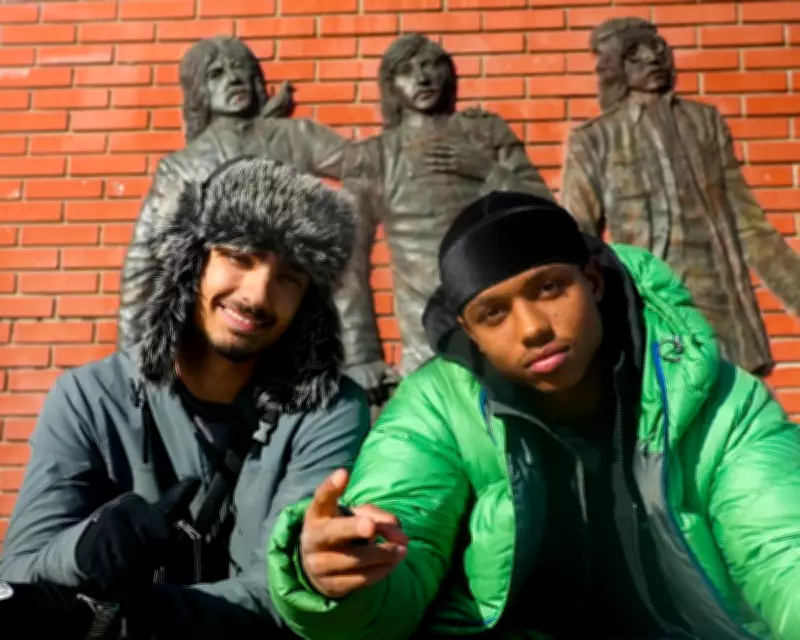
Kush Burman and Jo Diop, the breakout stars of the latest series of the BBC's Race Across the World, have been hailed as a much-needed antidote to toxic masculinity. The two 19-year-olds from Liverpool captivated audiences with their unwavering mutual support and emotional openness throughout the 7,500-mile journey from Sicily to Mongolia.
A Friendship That Resonates
In a touching moment captured during the show, Kush reflected on his bond with Jo while searching for walnuts in Kyrgyzstan's ancient Arslanbob forest. 'I think it's only in the past couple of days that I've realised how much I value having Jo here,' he said, his eyes welling with tears. 'I just really appreciate the fact that Jo's always up for sort of looking after me. I don't think Jo will understand the difference it makes.' He added, 'Yeah, he's my best mate.'
The duo, who initially described their adventure as a final 'side quest' before adulthood, unintentionally became symbols of positive masculinity. Their kindness and emotional intelligence stood in stark contrast to the friction and cruelty often seen in reality TV.

The Making of Feelgood Television
The show's uplifting tone was no accident. Producers undertook an exhaustive casting process, involving background checks, interviews, and meetings, to find pairs with genuine relationships. Fatima Salaria, an executive producer who has worked on shows like The Apprentice, explained: 'Casting producers are really looking for that little story that makes them different – and honestly, that is such hard work.'
Ben Wicks, creative director at Expectation TV, noted a growing demand for feelgood content. 'There just hasn't been enough joyous, funny television being commissioned for a while,' he said. 'The joy of operating in the real world in this way is that you tell stories that really aren't told anywhere near enough on television – working-class stories that just get ignored.'
Authenticity Over Fame
Unlike many reality shows, Race Across the World attracts participants who value the travel experience over fame. Michelle Singer, an executive producer of The Assembly, another acclaimed feelgood show, emphasised the importance of letting cameras roll to capture genuine moments. 'The joy comes from watching people be themselves,' she said. 'There is time and space to listen to one another and to enjoy each other's company.'
Jo and Kush: A Study in Contrasts
Jo and Kush's temperaments could not be more different. Kush openly struggles with anxiety and the impact of his stepfather's death, while the zen-like Jo knows when to let his friend vent and when to boost his morale. Their quiet moments of tenderness resonated deeply with viewers. In one scene, Kush thanks Jo for staying up with him as he struggled to calm his mind. In Turkey, Kush spots a basketball court, a perfect spot for Jo to decompress, saying, 'I can tell Jo needed this.'
Political Praise
The pair's friendship has also drawn praise from politicians. Jess Phillips, the former safeguarding minister, said: 'I am the mother of two young men and this is my experience of young men's relationships – we don't see that enough. There are nasty influencers we need to worry about, but men and boys need to see this. Being kind and looking after each other – that's real masculinity.'
Amanda Martin, co-chair of Labour's men and boys parliamentary group, added: 'It's that lads' friendship: it's real support and it's not weakness. Representation matters. Programmes like this really do remind us that there are other ways for men to be.'
Whether Jo and Kush won the race is a question best answered on BBC iPlayer. But for many, their victory was already sealed through the joy and humanity they brought to screens.