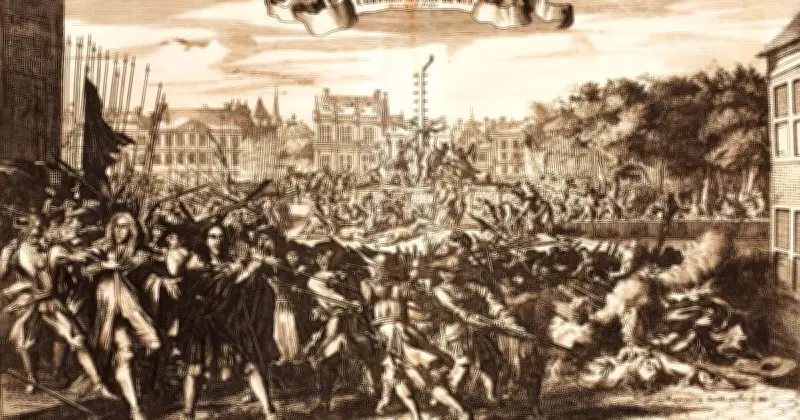
In 1672, the Dutch Republic found itself at war with England, France, and the two German cities of Cologne and Münster. The period became known as 'Disaster Year', or the Rampjaar, and even has its own slogan: "the people were irrational, the government helpless, and the country beyond salvation."
The Prime Minister's final days
It proved most catastrophic for one individual - the Prime Minister himself. Johan de Witt had served as one of the few non-royal rulers in Europe for two decades, according to The Dutch Review, reports the Daily Star. This enraged the Dutch populace, who desired the renowned William III of the House of Orange-Nassau, the nearest equivalent the nation possessed to a royal dynasty, to assume power.
Johan belonged to an affluent merchant class, and his family had administered the city of Dordrecht. His brother Cornelis de Witt held the position of a senior naval officer and governor of Dordrecht.
The attack and its aftermath
On 21 June, an assailant stabbed the leader, inflicting fatal wounds. A terrified De Witt stepped down, but this proved insufficient for his countrymen. His brother Cornelis was detained on charges of treason, transported to a prison in The Hague and subjected to torture. Torture was routine practice and employed to extract a confession, whether accurate or false. Cornelis declined to confess and received a sentence of banishment.
Johan travelled to the prison where his brother was being held in order to assist him in his preparations, whereupon both men were seized by an armed militant mob, which opened fire on them before leaving their bodies to the gathered crowds. Yet the baying masses remained unsatisfied. The brothers were stripped bare, mutilated, and had their livers removed and consumed. Their desecrated remains were subsequently strung up on the nearby public gibbet. According to some accounts, portions of the corpses were even roasted and eaten by those present.
Legacy and remembrance
The assault was remarkably well-coordinated and sustained throughout, prompting speculation as to whether it had been premeditated, or even orchestrated by the House of Orange. In that era, crowds were known to take gruesome mementos from public executions, be it teeth or fingers.
Today, visitors can tour Gevangenpoort, the very prison where Cornelius was subjected to torture. It stands adjacent to the square where both brothers met their grisly end. A statue of Johan now marks the very spot where he was slain and devoured by his own countrymen.