Thousands of people lined up for a memorial service for the 'Butcher of Bosnia' Ratko Mladic - the man behind Europe's worst genocide since World War Two. The Bosnian Serb commander died aged 84, on August 27, while serving a life sentence in The Hague for war crimes. Mladic was found guilty of orchestrating the massacre of more than 8,000 Muslims in Srebrenica in 1995 among other horror war crimes that shocked the world.
Hero's send-off in Belgrade
Despite his crimes against humanity and unleashing one of Europe's most deadly conflicts, the war criminal was given a hero's send off in Belgrade, Serbia. Hoards of people gathered both in and outside of the church to watch the church service ahead of a planned procession towards the Topcider Cemetery, for his burial.
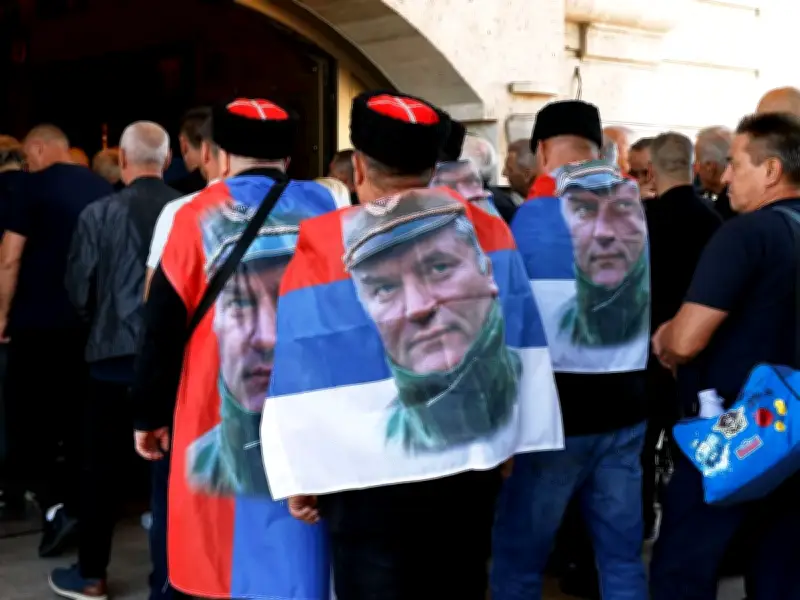
Thousands of mourners arrived early on Monday morning at the small Serbian Orthodox Church of St. Luke in Belgrade to honour Mladic, who is still viewed as a hero by many Serbs. Mourners were seen holding up images of the genocide-committing commander while other kissed his coffin and wept as they walked past.

Military honours and funeral plans
Parents even brought their young children to the church as the commander laid in state, while his coffin was flanked by military men. Mladic's son, Darko Mladic, carried the criminal's military cap and sabre into the small church before it was placed on his coffin.
Pro-government media in Serbia reported that Mladic will receive full military honours while the head of the Serbian Orthodox Church, Patriarch Porfirije, will lead the funeral service - expected to start at around midday UK time. Images from inside the small Belgrade church showed a group of Orthodox priests as they prayed for the dead war criminal responsible for the deaths of thousands.
While the funeral arrangements were formally made by Mladic's family, the Serbian government sent a plane last week to bring his remains to Belgrade, and soldiers carried his coffin wrapped in the national flag. A military commemoration was held Saturday at an official Serbian army venue.
EU diplomatic row
Serbia has found itself in a diplomatic spat with the European Union over following Mladic's death. Serbia is a candidate nation for EU membership but Marta Kos, the enlargement commissioner for the bloc, cancelled an upcoming visit to the Balkan nation in protest. Kos argued that "the glorification surrounding his death is incompatible with the values on which the EU path is built".
Serbia's populist President Aleksandar Vucic, a former extreme nationalist who supported Serbia's expansionist policies during the war, has dismissed EU criticism, accusing Kos of "lying". Vucic, who is not attending the funeral, has stepped up his anti-Western rhetoric ahead of a high-stakes early parliamentary election expected next month.
War crimes and legacy
Mladic and his troops committed their crimes during the Bosnian war in 1992-95 but he evaded the authorities for nearly 16 years, until he was found living in a remote village in northern Serbia in 2011. He was sentenced in 2017 for orchestrating the massacre in Srebrenica; the years-long siege of the Bosnian capital of Sarajevo and other war crimes, including setting up concentration camps for detained non-Serb civilians and enemy soldiers.
Serbia, which backed Bosnian Serb forces during the war, remains defiant over its wartime role and accuses the West of anti-Serb bias. Since Mladic died, his nationalist admirers have held vigils, painted a series of murals with his image in Belgrade, lit flares in his honour and football club Red Star Belgrade fans even displayed a huge tifo at a match on Sunday. Serbia has refused to recognise that genocide was committed in Srebrenica, calling the massacre a "horrific crime" instead.
Srebrenica had been a UN "safe haven" for Bosniaks (Bosnian Muslims) during the war. It ended up being overrun by Serbs who forced men and boys to strip, killed them and bulldozed their bodies into mass graves. The war started after the breakup of the former Yugoslavia - after the death of leader Josip Broz Tito - when ethnic Serbs in Bosnia took control over swaths of Bosnian territory to form a country of their own and unite it with Serbia. The conflict left more than 100,000 people dead and over 1 million homeless before it ended in 1995 in a US-brokered peace agreement.