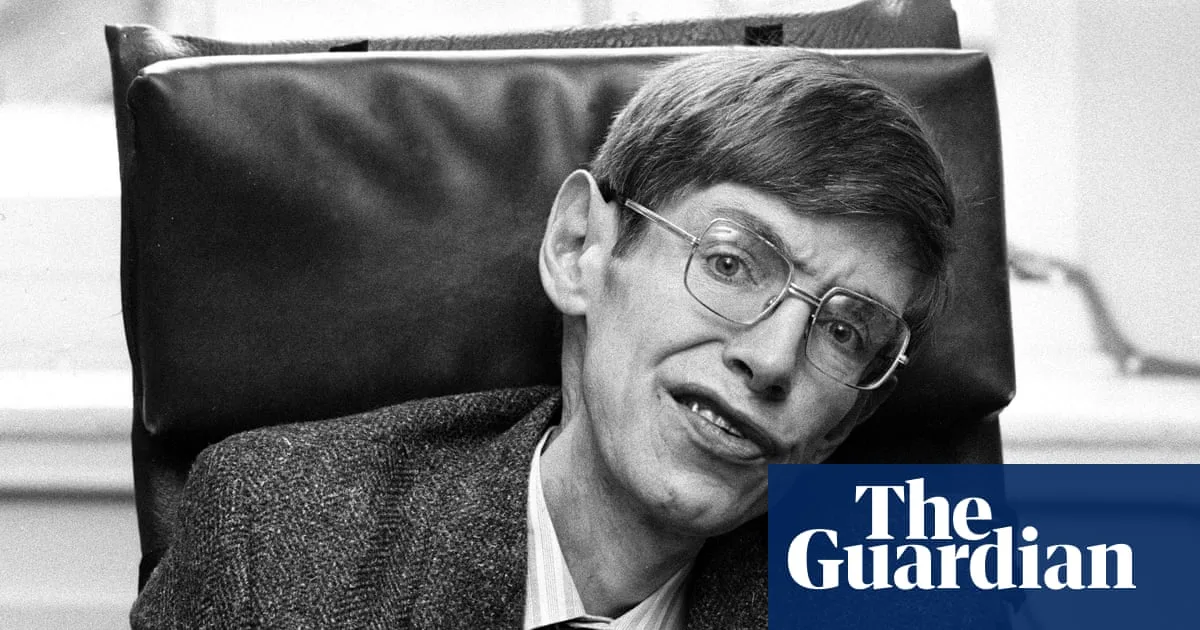
Stephen Hawking's Father Worried He 'Does Not Study Much', Diaries Reveal
Hawking's Father Worried He 'Does Not Study Much'

Stephen Hawking defied medical expectations that he would die within two years after his diagnosis of motor neurone disease. He passed away in 2018 at the age of 76, having established himself as one of the most brilliant minds of our time. However, during his student years and as he approached adulthood, his father, Frank Hawking, harboured deep concerns about his son's future. Frank lamented in previously unknown diaries, written partly in code, that Stephen "hangs round the house with little initiative and does not study much."

Exclusive Access to Family Papers

These diaries are among family papers and photographs to which Costa award-winning biographer and physicist Graham Farmelo has been granted unprecedented access. In September, Farmelo will publish the first definitive biography authorised by the Stephen Hawking estate, titled Hawking, with publisher John Murray. As part of his research, Farmelo examined previously unknown material, ranging from the diaries of Hawking's father to the letters and journals of his mother, Isobel, which had been kept in the home of Hawking's sister Mary.

Farmelo described the access as a "wonderful, completely unexpected bonus," calling the documents a "24-carat source of information" about Hawking's life, particularly his formative years and the harrowing months following his diagnosis at age 21. He noted that the material offers a "raw and honest insight" into Hawking's upbringing and the devastating impact of his degenerative disease.

Wide Pickt banner — collaborative shopping lists app for Telegram, phone mockup with grocery list

Defying Medical Prognosis

Hawking defied the medical expectation that he would die within two years of his diagnosis in 1963. Instead, he lived until 2018, becoming a world-renowned pioneer in black hole theory and cosmology. He authored the bestselling book A Brief History of Time, which sold over 13 million copies, and inspired people to "look up at the stars and not down at your feet." Despite being almost completely paralysed and communicating only through a computer and voice synthesiser, he achieved groundbreaking work, exploring the mysteries of space, time, and black holes.

Hawking once said, "Life would be tragic if it weren't funny. My expectations were reduced to zero when I was 21. Everything since then has been a bonus." He encouraged curiosity and perseverance, stating, "Remember to look up at the stars and not down at your feet. Try to make sense of what you see and wonder about what makes the universe exist. Be curious. And however difficult life may seem, there is always something you can do and succeed at. It matters that you don't just give up."

Father's Concerns and Code-Written Diaries

In 1961, Frank Hawking, an expert in tropical diseases, could not have imagined his son's later achievements. He wrote in his diary: "We are a little worried at the way Stephen is turning out. He hangs round the house with little initiative and does not study much. [Isobel] says he has an inferiority complex to me (he has no need to) and he has lost faith in physics at Oxford, thinking it is inferior to arts. This is a great pity if so. At his age I had a burning ambition to get on, and if only I had had half his advantages, I should have done much better."

Frank kept a diary for over 60 years, writing many entries in a secret code using Greek script that Farmelo managed to crack, translating more than 200,000 words relating to his son's childhood, illness, marriages, and career. Frank explained the code: "This journal was originally written in Greek script to form a simple secret code and so secure greater privacy, which is essential for a journal which may fall into the hands of enemies or easily wounded intimates." He adapted the Greek alphabet to accommodate English letters like H, V, QU, W, and J.

The diaries reveal Frank's struggle with his son's declining health. In 1967, he wrote: "I find it a slow and ghastly experience with [Stephen]. Everything is so dreadfully slow and long drawn out. And his speech is so slow and difficult to understand that conversation is very difficult. I am very sorry for him and will do all I can for him. But I don't enjoy being with him."

Pickt after-article banner — collaborative shopping lists app with family illustration

The Biography

Farmelo's previous book, The Strangest Man: The Hidden Life of Paul Dirac, Quantum Genius, won the Costa biography prize and LA Times book prize in 2009. Dirac was a personal hero of Hawking's. For his latest work, Farmelo interviewed Hawking's closest family members, including sisters Mary and Philippa, first wife Jane, and children Robert, Lucy, and Tim. The biography, Hawking, will be published on 24 September by John Murray, described as "the definitive portrait of an exceptional life and intellect."