On a bleak December day in 2010, a police officer named John Mallia took his dog, Blue, to a desolate scrubland along the coast at Gilgo Beach in Long Island. Several months earlier, a young woman named Shannan Gilbert had disappeared a few miles away; on the same night, she had made a frantic 911 call while running through a nearby neighbourhood, crying that “someone is after me”. Blue led his handler to a body buried in the undergrowth – but that body did not belong to Shannan. It was another woman, 24-year-old Melissa Barthelemy, who had vanished in 2009 after telling a friend she was heading out to meet a man. Like Shannan, Melissa had worked as an escort to earn extra money. Over the next few days, police found the bodies of three more missing women: Maureen Brainard-Barnes, Amber Lynn Costello, and Megan Waterman. All were physically slight, 5ft or under, and had been involved in sex work before their deaths. They became known as the “Gilgo Four” – though the number of bodies found along Ocean Parkway would later rise to 11 (nine women, one man, and one toddler). A lonely stretch of coastal scrub, not far from one of Long Island’s plush gated communities, had become a de facto graveyard for victims of one of the most prolific serial killers in American history.
Despite media attention – much of it salacious, focusing on the women’s status as sex workers – and the best efforts of their families, the case went cold for nearly a decade. It wasn’t until the early 2020s that detectives made a breakthrough, linking the crimes to local architect Rex Heuermann through burner phone data, vehicle records, and DNA testing. Heuermann maintained his innocence until, in a shocking U-turn, he changed his plea to guilty at the start of this month. His lawyer said it was to spare both the victims’ families and his own from a long trial.
Heuermann’s Confession and Its Aftermath
He admitted responsibility not only for the seven murders he had been charged with (including the Gilgo Four, Sandra Costilla, Jessica Taylor, and Valerie Mack) but also an eighth killing, that of Karen Vergata. Some of his crimes dated back to the 1990s. Another man, Andrew Dykes, has since been charged with the deaths of the ninth woman, Tanya Denise Jackson, and her toddler daughter Tatiana Dykes, and has pleaded not guilty. Heuermann has not been named as a suspect in the death of the unidentified man. The confession shocked director Emma Cooper, who spent years immersed in the case while working on the four-part Amazon documentary Killing Grounds: The Gilgo Beach Murders. The series was set to air later this year, but Heuermann’s confession brought the release date forward. He is scheduled to be sentenced in June and faces multiple life sentences.

Cooper, who has directed and produced films for the BBC, including various Louis Theroux shows, and more recently directed Depp v Heard for Netflix, spent time in court with the victims’ families. She saw first-hand how difficult it was for them to hear the case. Not having to go through a trial, she says, will be a “relief” for them. But she notes this won’t necessarily give them immediate closure. “It’s a double-edged sword, isn’t it?” she says. “It’s the sense that there’s relief, that there’s some closure, there’s some justice, but equally, nothing’s going to change for them. They’re just left with exactly what they will always be left with, which is a deep sense of sorrow and trauma and grief. On the one hand, they’ve been spared a trial. On the other hand, they’ve just got to carry on.”

Victim Blaming and Police Bias
For a decade, the investigation was blighted by police biases. In one harrowing news conference clip featured in the documentary, an official tells the media that the women’s deaths were “a direct result of their business as prostitutes”. For British viewers, there are undeniable parallels with the so-called “Yorkshire Ripper” case, in which serial killer Peter Sutcliffe initially targeted sex workers in the North of England – and officers only started paying attention when more “respectable” women were attacked. Victim blaming was “central” to the way the case was handled, Cooper says. “I think it is systemic. I think it is a huge problem, and it continues to be a problem.” Perpetrators like Heuermann, she adds, “count on the fact that there will be victim blaming” and that crimes against sex workers will not be taken seriously. “In the past, people have really judged those women, and I just felt absolutely that there should be no judgement on them at all. What happened to them was horrific, but it was nothing that they brought on themselves.”
Cooper wanted her series to present a rounded portrait of the women, shaped by the people who actually knew them. “I just wanted to know what they would have been doing now. They would have been a great parent, they would have had this job. Most of these women were getting money to set up a business, they were getting money to support their children, they were getting money to educate themselves. They were hustlers. We have a culture where people love a hustler – make your life better, better yourself. But you can’t be a sex worker? That judgement really annoyed me.”
The Investigation’s Turning Point
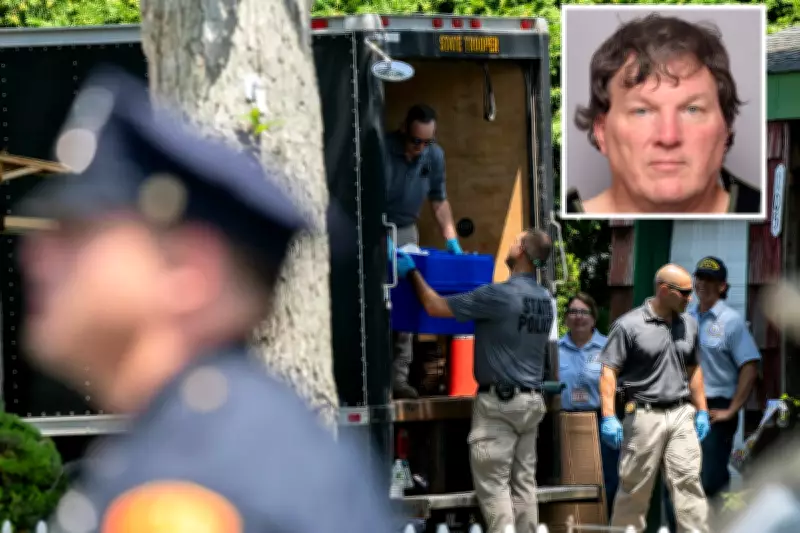
Allegations of corruption in the Suffolk County police force under now-disgraced former police chief James Burke also slowed down the investigation. In 2016, Burke was sentenced to three years and 10 months in prison after pleading guilty to assaulting a suspect in custody and attempting to cover up the crime. It wasn’t until veteran New York detective Rodney Harrison joined the case at the start of 2022, shortly after a new district attorney, Ray Tierney, was elected, that meaningful progress was made. After sifting through interviews and testimonies, detectives linked the attacker to a distinctive Chevrolet Avalanche pick-up truck. Searching vehicle registrations led them to Heuermann. Analysis of phone calls made to the victims also placed the killer in Manhattan, near Heuermann’s architecture firm. Officers even retrieved Heuermann’s discarded pizza box from a bin to match DNA with a hair found on a victim’s body. When they later searched Heuermann’s home, they found a harrowing “manual” for murder saved on his computer, detailing his method for killing and covering up the crime.
“The defendant walked among us play-acting as a normal suburban dad when all along he was targeting these women for death,” Tierney said shortly after the confession. “He appeared an affable oath, a dad, a simple guy,” Cooper agrees. One haunting scene from the show features footage from an interview with Heuermann from a dusty corner of YouTube, in which he cheerily discussed his architecture work. “The [interviewer] had filmed it and not realised that he was recording a serial killer,” Cooper says.
The Victims’ Families and Unanswered Questions
Cooper is full of praise for Tierney, who was one of the first people to sit down for an interview with her. “He was very open with me, and I really valued my time with him. I thought he was a bit of a hero, and I hope that he comes across in the series as a bit of a hero.” He helped her to “get introductions to the victims’ families”; so too did Gloria Allred, the legendary feminist lawyer who has represented some of them (“she’s a total firebrand, someone to look up to,” Cooper says). Not all of them were keen to take part initially. “These women have been messed about, and people don’t necessarily want to talk to me. I have an amazing team of women and we spent a long time winning trust.” It took “several trips and lots of meetings” to make sure they felt comfortable talking about this traumatic experience.
In some of the series’ most affecting scenes, we hear some of the victims’ mothers talk about the strong friendship that has developed between them amid such an appalling tragedy. “It’s a sisterhood, isn’t it? It’s a sisterhood that you don’t want, but you’re very grateful to find it available to you.” Their “shared fight to be heard and fight for justice when no one was listening”, she says, has made them “fiercely protective of one another. And so they should be – they are the only people that have any idea what they are going through”.
There are still question marks hanging over the case despite Heuermann’s confession. Detectives have been looking into whether he might be linked to other unsolved disappearances and murder cases across the United States. And the identity of the male victim discovered on Gilgo Beach still remains unknown. “I think this case is going to go on and on, unfortunately. But if it does mean that there’s closure for some… There are still families who don’t know what happened to their loved ones.” Before she started filming, she headed out to Gilgo Beach on a “freezing” January day. “I just couldn’t think of a more awful place for my bones to be, or a loved one’s bones to be.” She and Adrienne Corson, an FBI agent who worked on the case and features in the documentary, went and laid flowers on the sites where the bodies were discovered. “It made me really immerse myself in the fact that this could be anybody – it could be me and it could be you.”
‘Killing Grounds: The Gilgo Beach Murders’ is streaming on Prime Video now.