Europe should be worried by the scenes of thousands of people mourning and weeping for an unapologetic criminal who showed no sympathy for the genocide he led.
Ratko Mladic was the evil mastermind behind Europe's worst genocide since World War Two - the Srebrenica massacre. The infamous military leader capitalised on the fall of the unified Slavic nation of Yugoslavia to help wage a campaign of ethnic and religious cleansing that scars the Balkans to this day.
Mladic's father fought the Nazis
Mladic's father was a member of the Yugoslav Partisans, a communist-led anti-fascist resistance group to the Nazis in WW2 Yugoslavia. Nearly a decade on, the world today saw horror scenes of people rejoicing a son who rejected his father's fight to commit his own ethnically-charged genocide.

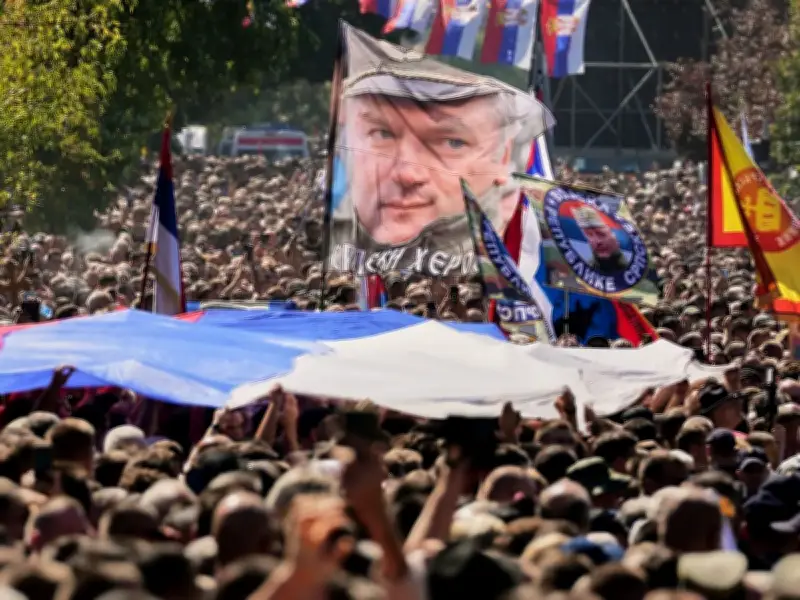
Crowds gathered as military members carried Mladic's coffin after a religious ceremony.
The Siege of Sarajevo
Mladic led the Bosnian Serb Army from 1992-1995 where he spearheaded his army to two of the most shocking and deadly war incidents of modern memory - the Srebrenica genocide and the Siege of Sarajevo. The general led the longest military siege of a capital city in modern history when his forces surrounded Sarajevo for 1,460 days and killed more than 11,000 people.
Innocent civilians were cut off from food and medicine while they lived their lives in terror from constant shelling and attacks from snipers, who attacked from the mountains surrounding the Bosnian capital. Decades on, the deadly siege has made its way to the courts in Italy where an investigation was opened last year into claims rich people travelled to Bosnia on "sniper safaris" to allegedly shoot and kill helpless civilians.
The other henchmen
While the siege continues to be probed, the death of Mladic is the end of the second of three henchmen behind the horrors inflicted by the Serbian government and army in the 1990s. Slobodan Milosevic, Serbian president between 1989 and 1997, like Mladic was tried at the International Criminal Tribunal for the Former Yugoslavia (ICTY) and imprisoned until his death in 2006.
Radovan Karadzic, a psychiatrist turned president of the autonomous Bosnian Serb entity of Republika Srpska, was arrested in 2008 also convicted of genocide by the ICTY, in relation to his role in Srebrenica. Karadzic was also sentenced found guilty of crimes against humanity and war crimes by the ICTY. Karadzic, aged 81, is alive and still serving his sentence.
Evading justice for 16 years
Unlike Karadzic and Milosevic, Mladic evaded justice for 16 years after the end of the horror war that shocked the world. He was protected by his family and elements of the security forces before he was eventually tracked down at his cousin's house in rural northern Serbia, in 2011.
The tragic reality of Mladic's ethnic hatred will also be hidden from many for as long as the heroization of his character continues in scenes like those at his funeral. Parents in Serbia took their kids to church, on Monday, to pay their respects to a man who led the murder of more than 7,000 Muslim men and boys. Women and men cried as the 'Butcher of Bosnia' was given a hero's funeral.
They wept for the same man that stared at the families of his Srebrenica victims and drew a finger across his throat at the start of his trial. When Mladic was eventually sentenced he shouted: "This is all lies, you are all liars."
Serbia and the EU
The Serbian government has refused to recognise that a genocide was committed in Srebrenica, calling the massacre a "horrific crime" instead. Today's worrying funeral scenes show how thousands are still gripped by a blind ultra-nationalism that fought against everything Mladic's own father stood for - Slav solidarity and anti-genocide.
Mladic has even appeared to pull Serbia backwards even in death, with his funeral triggering a diplomatic spat between the nation and the European Union. Serbia is a candidate nation for EU membership but EU's foreign service said in a statement that "any glorification of war criminals, genocide denial and revisionism contradict the most fundamental European values and have no place in the EU or in EU candidate countries".

While the funeral arrangements were formally made by Mladic's family, the Serbian government sent a plane last week to bring his remains to Belgrade, and soldiers carried his coffin wrapped in the national flag.
The genocide general is still viewed as a hero by many Serbs. The mourning of the Serb chauvinist's life and positive memory of a recent bloody war between neighbours - that killed 100,000 people and saw over one million displaced - will leave the dream of a unified Europe in tatters.