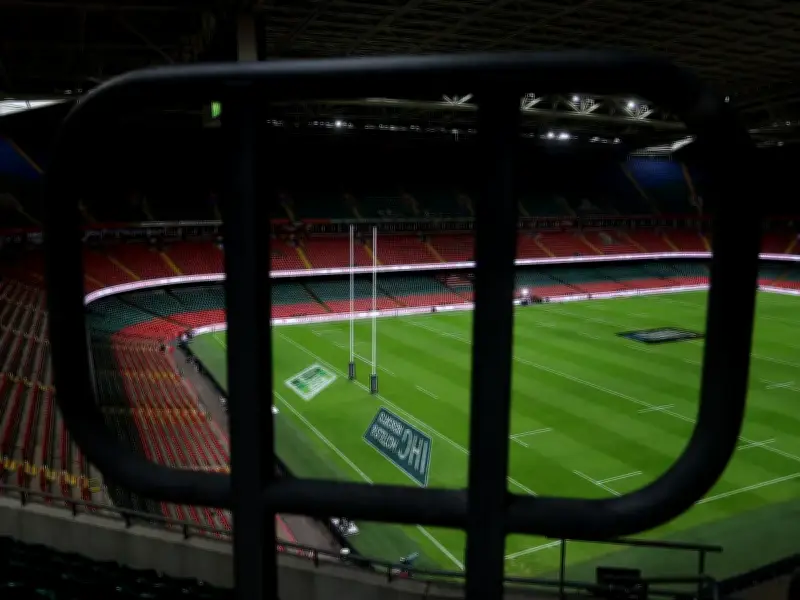
Welsh rugby's latest civil war is not being fought on the pitch, on the streets, or even in the boardroom. Instead, the battleground this time around is LinkedIn, where posts and comments on the networking site are dominating the infighting. Battle lines are drawn and political points are scored through the prism of corporate talk.
A brutal, emotional blow
Nothing about the current situation is palatable. Potentially losing a professional club is a brutal, emotional blow. There is no easy answer for Welsh rugby's ills, and everyone agrees something has to change. It is just that nobody wants change laid at their door.
A year on from the initial proposals of going down to two teams, the exact path to reduced teams is still awaited. The pace of everything has felt glacial at times. The Welsh Rugby Union (WRU) has been accused of not listening enough, yet the governing body has had a knack of listening a little too intently, then taking forever to craft a reply.

Coalition of the willing
Abi Tierney, the WRU chief executive, had not faced the media since April before speaking to ITV this week. The 'coalition of the willing' has gathered momentum, filling the vacuum left by the WRU's fearful paralysis. Former Principality chief operating officer Rob Regan, Swansea businessman Glenn Melford-Colegate, GoCompare founder Hayley Parsons, and Wales dual-code legend Jonathan 'Jiffy' Davies are the faces of this group.
Over the course of a few weeks, they have called for the WRU board to step down en masse. But cracks are already beginning to show. What exactly do they want? To mark the WRU's homework or start again from fresh? To take temporary power or install themselves as the new overlords?
Flaws in the plan
Melford-Colegate offered up a plan that would see four clubs working on £5.5m per year, which is lower than what they are on now and lower than the vast majority of the United Rugby Championship. It proved the WRU right that there is not enough resources for four competitive clubs.
Rob Regan told ITW this week that he felt Welsh rugby is ungovernable, pointing to Amanda Blanc's departure from the WRU years ago as evidence that great businesspeople are unable to change the body from the inside. However, he recently said on LinkedIn that he felt the pendulum had swung too far the other way from the Rafferty report, even though Blanc was a pivotal figure in unearthing the cultural issues that led to that report.
Parsons is set to meet with the Welsh Government over unsubstantiated claims of more cultural problems within the WRU. That led to the governing body's most robust rebuttal to date, accusing the coalition of actively trying to damage the game in Wales.
Civil war purgatory
The cracks are appearing on both sides of this civil war. The coalition's alternative plan does not appear to hold a great deal of water financially, but there is clearly a lack of confidence in the current WRU hierarchy to deliver these plans safely. Is three the end-game, or is it two and a crack making it into an Anglo-Welsh league? A cross-border league with England has been a dream chased for a quarter of a century with no luck so far.
There is no love lost on either side. An unstoppable force unwilling to provide the full evidence or roadmap is up against an immovable object unable to stump up an alternative. As such, Welsh rugby is stuck in civil war purgatory, left to circle back to recent statements and corporate lingo on LinkedIn.