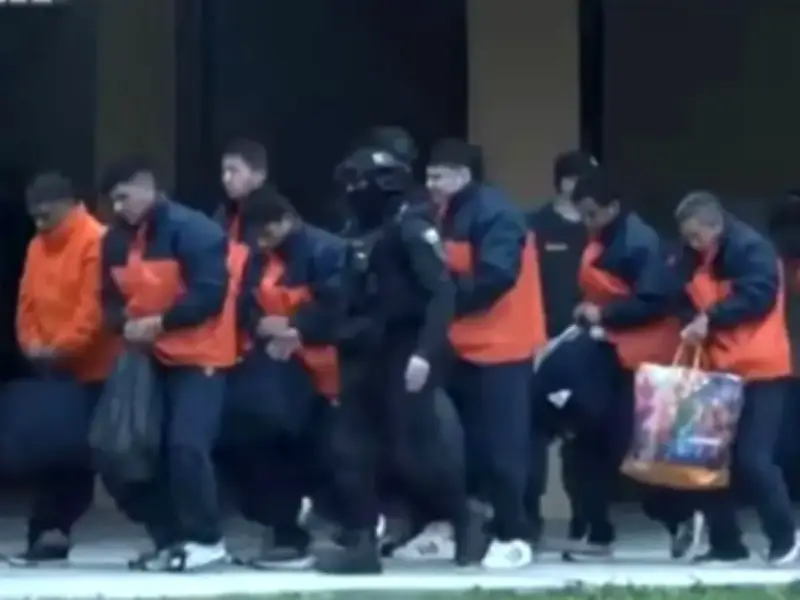
Chile's government is facing backlash after a viral video showed the transfer of some of the country's most dangerous prisoners, including reported leaders of Tren de Aragua and the Albanian Mafia, to a new high-security prison. The footage, posted on social media, was accompanied by the 2000s pop hit "Bye Bye Bye" by NSYNC, with the Ministry of Public Security of Chile captioning it "Goodbye, crime. Welcome, maximum security."
Operation Cerberus and the Transfer
The Chilean government transferred 687 prisoners from around the country to the new La Laguna Prison on Thursday (August 13), as President Jose Antonio Kast seeks to regain momentum on his core campaign pledge to combat organised crime. Kast personally travelled to the recently opened La Laguna Prison, which is now among Chile's biggest, to oversee the transfer, described as an effort to ease overcrowding in prisons and prevent incarcerated gang leaders from remotely running their criminal enterprises behind bars.
Dubbed "Operation Cerberus", the footage showed dozens of inmates in rows with their heads bowed and shackled by their feet as they headed from the Justice Center in Santiago to the new prison. The transfer itself was not what sparked the outrage, but the choice of music.
Social Media Reaction
Some users on social media said the video showed "no respect" and others believed the official government account was a "parody". One user commented: "BUT THEY USE NSYNC, THEY SHOW NO RESPECT." Another wrote: "I had to check carefully to make sure if it was a joke or the official government account." A third added: "Is this an official government account? What a disgrace, such a lack of professionalism."
Some made comparisons to US President Donald Trump and the White House use of videos on social media, as others tagged NSYNC asking if this was an "inappropriate use of your music". Some recalled images from El Salvador, where President Nayib Bukele has made a point of broadcasting his security crackdown on social media, with some saying Kast gave a "Bukele-style" performance. Bukele's mass incarceration campaign has sharply reduced violence but drawn allegations from human rights groups of arbitrary detention, abuse and the erosion of civil liberties.
Kast's Security Agenda
Like other right-wing presidential contenders across Latin America, most recently in Colombia and Peru, Kast has invoked Bukele as a model for his own promises to fight organized crime. While campaigning last year, Kast visited El Salvador to study Bukele's security policies and tour the country's notorious mega-prison where visitation, recreation and education are not allowed.
"It's a way of sending criminals a clear message that things have changed: We are going to come after you, we are going to find you, you will be prosecuted and we are going to lock you up," Kast said in a press conference about the transfer. Hundreds more prisoners are slated to arrive at La Laguna in stages as the government moves to fill the facility to its expected capacity of 2,097 inmates across over a dozen units, including maximum-security wings. It's equipped with 1,500 surveillance cameras, body scanners and technology designed to block mobile phone signals.
The prison, billed as Chile's most modern and secure facility, opened last year under Kast's predecessor, left-wing President Gabriel Boric, and began receiving inmates months before Kast, an ally of U.S. President Donald Trump, took office. Kast's bid to publicize the move comes as he seeks to make good on his flagship security pledges after a bumpy start. "If there is one issue on which the public is demanding action from all of us, it is greater security," Kast said Thursday. "And that is what we are delivering now: a secure transfer and a clear message to organized crime and terrorism."