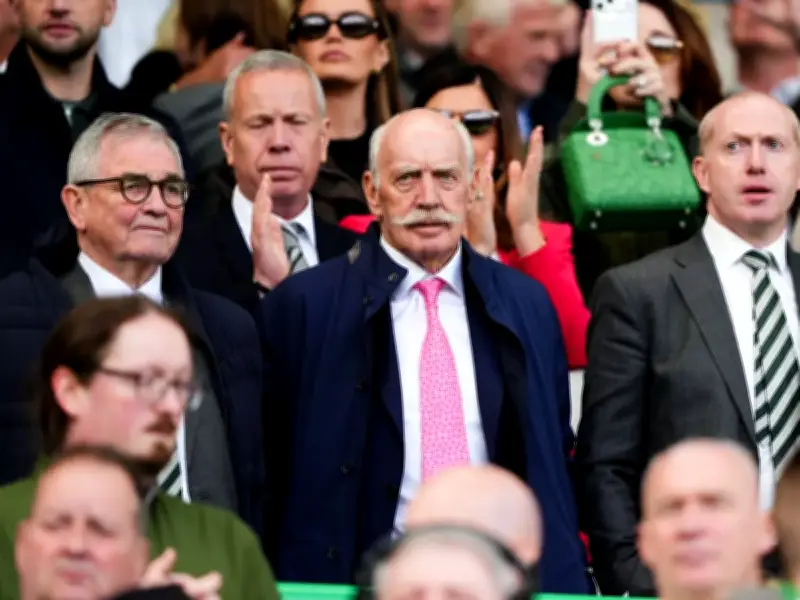
The question of how successful Celtic could be if the people who run the club were ambitious occurred while looking at the occupants of the directors box during the Champions League qualifying round against LASK. The usual suspects were assembled, appearing as if they were trying to work out which way Celtic were shooting.
There was no sign of Dermot Desmond, the club’s principal shareholder and, to all intents and purposes, Celtic’s owner. Even on a European night of superlative entertainment punctuated by stunning goals, Desmond was where he always is when Celtic play: somewhere else.
Absent owner, present fans
Martin O’Neill was there, aged 74 and lately discharged from hospital after a procedure to deal with two medical issues. Sir Rod Stewart was also present, aged 80 and still recovering from a recent heart operation. The manager and the celebrity fan were there because of a smouldering affection for the club. Desmond, meanwhile, was absent, with the suggestion that a cold, rainy Wednesday night in Glasgow was not to his liking.

If Celtic had greater dynamism in the corridors of power, their progress might not be so erratic and more in keeping with a side O’Neill thinks should “aspire” towards winning the Champions League.
Contrast with last year
Look back at the dismantling of LASK and compare it to the second leg of the Champions League qualifier against Kairat Almaty a year ago. Brendan Rodgers’ Celtic, bereft of new signings in spite of the manager’s pleas, missed three penalties in a shoot-out in Kazakhstan and were demoted to the Europa League. In midweek, a team changed by the multi-million pound arrival of Kasper Hogh, Camilo Duran, Mika Baur and Hasseim Hassan scored three goals in open play that will live long in the memory of the Celtic supporters. Desmond will have no recollection because he wasn’t there.
Celtic being Celtic, someone might have to serve a restraining order on the board before they try to sell the immediately impressive Duran for a vast profit before the transfer window closes on September 3. What they need to do is sign a back-up keeper, full-back cover on both flanks and a central defender as a matter of urgency to help with domestic as well as European football.
Slow and lazy directorate
The problem successive managers and faithful supporters have learned to live with is that Celtic’s directorate is slow of thought and lazy in movement. That is why emphasis on the absence of Arne Engels before Celtic played LASK drew laughter. The club knew in January, when they rejected Nottingham Forest’s offer of £25million for the player, that Engels was going sooner rather than later. And they did nothing about it.
The manager has had to cope with this kind of ineptitude since Desmond decided Rodgers was a “self-serving” individual for whom he no longer had any time. What other institution of Celtic’s size has to be coerced into doing business by a fan base who boycott matches, merchandise and anything else that denies the club money until moves are made to sign new players?
Warning for the second leg
O’Neill wasn’t playing the devil’s advocate in his post-match press conference when he said a three-goal start over LASK was an insufficient advantage to assume safe passage into the Champions League proper. His comments about the team having “rode their luck” and the tie still being “in the balance” because LASK play “fantastic stuff” were an accurate account of what took place.
Celtic can’t go to Austria and fight fire with dire. There was some Herculean defending at Celtic Park in the first leg, and the same will no doubt be required when the second leg is decided on Tuesday night. Quality players up front are negated by questionable performers at the back. Cameron Carter-Vickers and Auston Trusty have been exposed as vulnerability personified by the team standing between Celtic and the Champions League. There will be long periods played, and watched, in a state of nervous anxiety.