

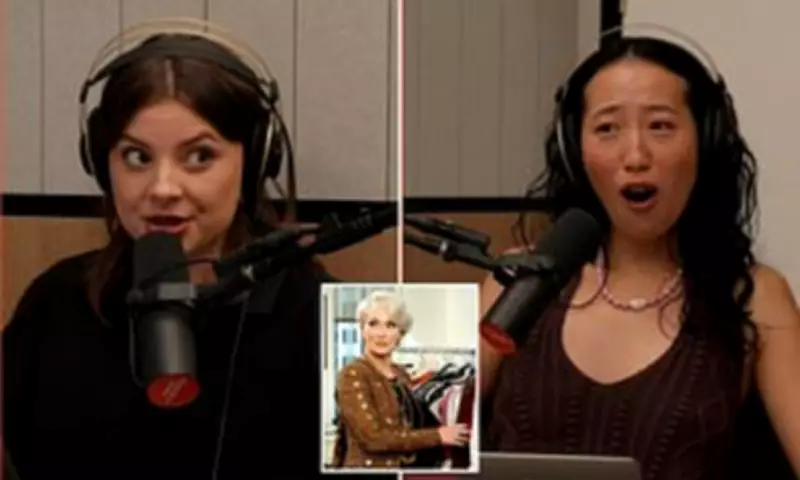
A young Australian worker has revealed she was left 'soul crushed' after working under a boss she likened to a real-life Miranda Priestly, in a story that has reignited conversations about toxic leadership in the fashion and art worlds.
Speaking on the podcast Everybody Has a Secret, hosted by Ruby Hall, Annabelle Lee and Charlotte White, she recounted her experience working as a gallery assistant in a commercial art space - a role she said quickly turned from a dream job into a daily source of anxiety.
'I watched The Devil Wears Prada three months into my position,' she said. 'Turns out the world of art and publishing is shockingly similar to fashion.'

Her boss - referred to only as 'Miss P' - allegedly swung wildly between praise and criticism, creating an environment where nothing felt stable or predictable.
'One day I was the best employee she'd ever had. The next, I was deliberately ruining her business,' she said.
The graduate described being scrutinised over minor actions, from how quickly she closed a drawer to whether she had copied her boss into emails - only to then be criticised for sending too many.
'She had this overwhelming sense that everyone around her was lying to her. If I closed a drawer too quickly, she'd make me show her what was inside so she could check that it was workplace approved.'
The constant monitoring left her too anxious to take even a single sick day.
'I never took time off out of fear I'd miss something important. A sick day just felt like a burden.'
Despite what she described as ongoing intimidation, the boss would periodically apologise - often accompanied by gifts like flowers or even artwork - a pattern many listeners recognised as a hallmark of emotionally inconsistent leadership.
'It seemed like she knew what she was doing was inappropriate,' the woman said. 'But the apologies didn't change anything.'
A year into the role, she finally decided to leave - only for her boss to pre-empt the conversation.
'I sat her down to tell her I wanted to go and she interrupted me to say the intern position was no longer available. I wasn't even an intern,' she said.
In her final days, she said a small mistake with an art purchase triggered a final, devastating outburst.
'She told me, "Every night I lie awake thinking of what on earth I'm going to say if someone calls me to be your reference. You are like a lead chain around my neck."'
The experience, she admitted, was 'soul crushing' - particularly as a high-achieving graduate entering the workforce with optimism. 'I never even put that job on LinkedIn,' she said. 'I was so traumatised.'
Yet in a reflection that resonated with many listeners, she added that she didn't entirely regret the experience.
'I'm so much stronger for it,' she said.
Her story has struck a chord, with others sharing eerily similar experiences - particularly within creative industries like art, fashion, and publishing.
'As someone who worked in the NYC art world, this is accurate,' one commenter said. 'My boss would swing from nice to mean so fast - she once told me how bad I was doing, then gave me a raise in the same meeting.'
Another worker described being blamed for a travel booking mishap that was, in reality, the result of their boss's indecision.
'He went off on me about how my lack of action caused it. Despite the fact he'd refused to make a decision for two weeks.'
Experts say these stories point to a broader issue within high-pressure creative industries - where blurred boundaries, prestige, and personality-driven leadership can create the perfect conditions for toxic behaviour.
Fields like fashion and art often operate on tight deadlines, subjective taste, and high financial stakes, where reputation is everything and hierarchies are rigid but informal.
Jobs are competitive, often underpaid at entry level, and fuelled by passion - meaning employees may tolerate poor treatment in exchange for experience or proximity to influence.
'There's an expectation that you should feel lucky to be there,' one worker noted on social media. 'And that makes it easier for bad behaviour to go unchecked.'

Unlike more structured corporate environments, where HR processes and formal reporting systems can act as a buffer, smaller galleries, studios, and independent publishing houses often lack those safeguards - leaving power concentrated in the hands of a single figure.
That dynamic can lead to what many describe as 'hot and cold' management styles, where praise and punishment are used unpredictably, keeping employees off balance.
The result is a culture where overwork becomes normalised and basic workplace respect can feel optional.
At the same time, conversations around 'work ethic' are shifting - particularly among younger workers who are increasingly questioning whether enduring toxic environments is a rite of passage or simply poor leadership.
While older narratives often framed difficult bosses as character-building, many now argue that professionalism should not come at the expense of mental health.
'There's a difference between high standards and being treated badly,' a Gen Z worker argued on TikTok.
For those who have lived through it, the distinction is clear.
Because while the image of the impossibly demanding creative director or gallery head may still carry a certain cultural mystique, the reality behind closed doors is often far less glamorous.
And, as this woman's story shows, sometimes the most lasting impression a 'dream job' leaves behind isn't the work itself - but the boss you had to survive to do it.





