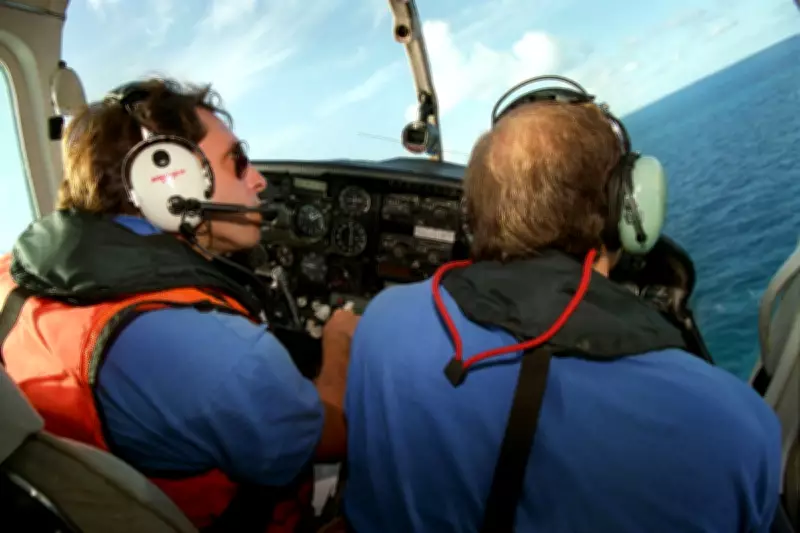
Thirty years ago, Cuban government fighter jets shot down two small planes piloted by members of a Cuban exile group from Miami. The Associated Press was there to document the event, and now republishes the original story from Saturday, Feb. 24, 1996, written by AP correspondent Nicole Winfield.
Shootdown Over International Waters
Cuban fighter jets shot down two small aircraft belonging to Brothers to the Rescue, a Miami-based Cuban exile group, on Saturday, according to the U.S. Coast Guard. The Coast Guard initiated a search in international waters off Havana for the four occupants of the downed planes. Two U.S. Navy vessels also joined the effort. Officials reported no debris or signs of survivors.
The pilot of a third plane in the formation safely returned to Miami and claimed to have seen survivors in the water. His wife stated that he denied entering Cuban airspace.

U.S. Response
President Bill Clinton condemned the shootdown of what he termed "two American civilian airplanes" and ordered the U.S. military to protect search-and-rescue operations. He also directed the U.S. Interest Section in Havana to demand an immediate explanation from Cuban authorities.
In Washington, a Pentagon official speaking anonymously said details remained unclear but early indications suggested the planes might have been heading to Cuba to land, pick up individuals, and fly them out of the country.
The Cessna 337 Skymasters had departed from Florida after filing flight plans listing the Bahamas as their destination, said White House press secretary Mike McCurry. However, spokeswoman Mary Ellen Glynn later corrected McCurry, stating the flight plans indicated a takeoff from Miami, a southward flight, and a return without any landing.
The search took place in international waters 8 miles (13 kilometers) north of Cuban territorial waters, according to Coast Guard Petty Officer David French. The first Coast Guard jet on the scene observed two oil slicks in the area. Assets deployed included a C-130 cargo plane, a helicopter, and two cutters from Key West, approximately 90 miles (150 kilometers) north of the incident site.
Cuban Silence and Exile Reaction
Official Cuban state media made no immediate mention of the shootdown. Roberto Gutierrez, who answered the phone at the Cuban Interests Section in Washington, claimed ignorance of the report.
Members of Brothers to the Rescue convened with the returned pilot, Arnaldo Iglesias, and his one-man crew at the group's headquarters at Opa-Locka Airport, according to his wife, Mirta Iglesias. "He told me they were definitely in international waters," she said. "He saw Cuban planes. He didn't tell me anything else."
Brothers to the Rescue, which in 1995 operated five planes on a $1.2 million annual budget derived entirely from donations, is an organization of Cuban exiles dedicated to assisting Cuban rafters attempting to flee the island. The group estimates it has saved approximately 6,000 lives through surveillance and life vest drops.
The group's planes had previously flown over Cuba in January and July 1995, dropping anti-government and human rights pamphlets. The Cuban government had warned it would not tolerate such flights.
Every Saturday, Brothers to the Rescue flew to the Bahamas to drop supplies to refugees in camps. However, Mrs. Iglesias said Bahamian officials denied permission for Saturday's mission, prompting the group to fly over the Florida Straits in search of rafters.
She identified the four missing individuals as Armando Alejandre, Mario de la Pena, Pablo Morales, and Carlos Costas.
Brothers to the Rescue is a member of Concilio Cubano, a coalition of dissident organizations that postponed a meeting scheduled for Saturday in Havana following the arrest of at least 50 members of human rights groups. Most were released within hours or days.
Cuban exile groups in Miami have been faxing daily releases drawing attention to the arrests, which the U.S. State Department has condemned.
Sergio Ramos, president of the Puerto Rico chapter of Concilio Cubano, said Iglesias claimed to have seen survivors in the water.

Jorge Mas Canosa, head of the powerful Cuban American National Foundation in Miami, condemned the attack, stating, "For two warplanes from the Castro government to shoot down two unarmed civilian planes with American flags on a humanitarian mission should be considered an act of war against the United States."