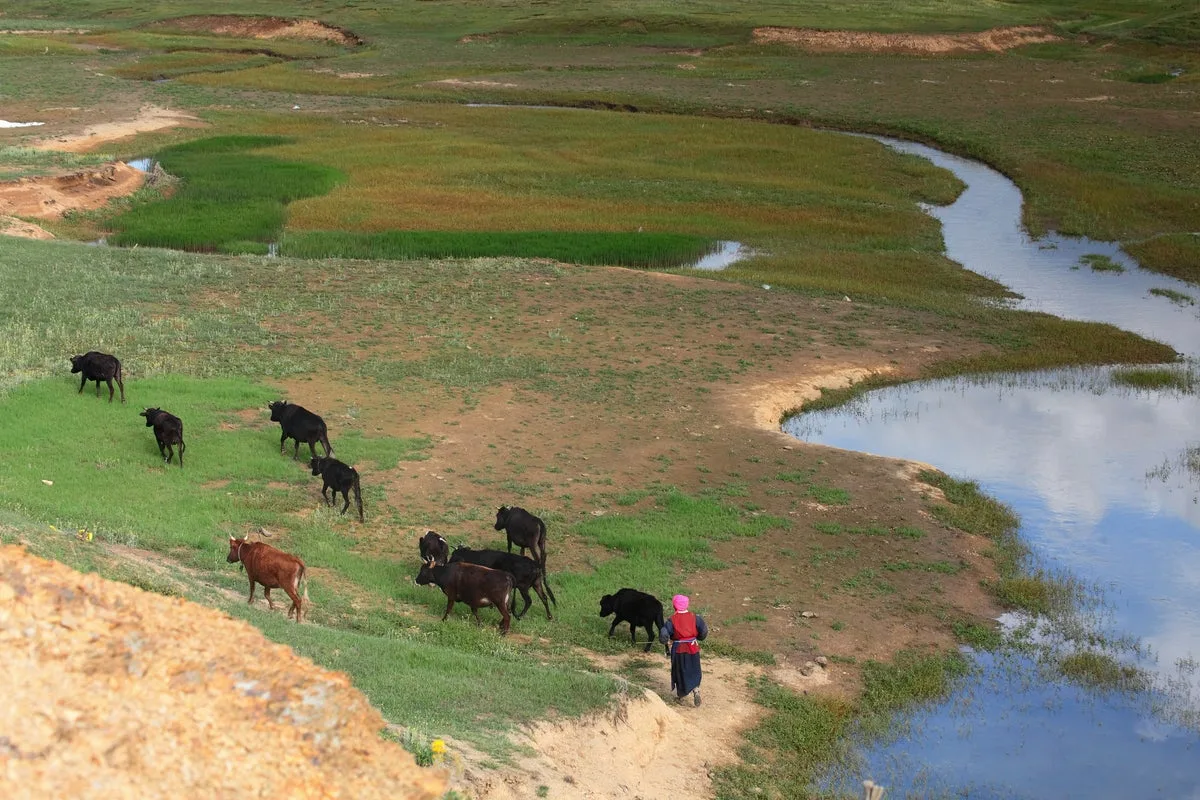
A job advertisement for shepherds in China's remote grasslands has unexpectedly become a viral sensation, drawing hundreds of applications and highlighting mounting pressures within the nation's job market. Zuo Xiaoyong, the farm owner behind the ad, was astonished when his call for two shepherds to work in the rugged terrain south of Mongolia became the day's top trending post on Weibo, China's equivalent of X.
Within hours, it garnered 59 million views and sparked 21,000 discussion threads. Over 700 people, ranging from white-collar professionals in megacities like Shanghai and Chongqing to factory workers and recent university graduates, vied for the two positions. Mr Zuo said that a tenth of applicants were fresh out of university, while others cited debt, demanding industrial roles, or workplace politics as their motivation.
While headline unemployment has hovered just above 5 per cent, underemployment in China is rising, and private sector incomes have lagged economic growth for most of the past decade. Blue- and white-collar workers alike complain about the '996' culture of working 9am to 9pm, six days a week. Analysts expect the labour market to worsen in coming months, as factories face higher costs due to the Iran war, while AI adoption accelerates, and a record 12.7 million university graduates this summer begin job hunting.
The reaction to Mr Zuo's ad was 'symptomatic of what continues to be a highly competitive and often low-rewarding labour market,' said Lynn Song, chief China economist at ING. James Guo applied for the job because he was exhausted by his work at a factory making shipping containers. 'You have no idea what it's like to work more than 13 hours a day, fastening screws until your hands are swollen and covered in blisters, without even having time to go to the bathroom,' the 21-year-old said.
Mr Zuo was looking for shepherds, preferably a couple, to take 3,000 sheep out to graze on a 2,000-hectare pasture in the summer, and undertake strenuous indoor feeding and cleaning during the winter when temperatures can drop below minus 30C. For that, the shepherds would each get 8,000 yuan (£877) per month, well above the national urban average in private companies of roughly 6,000 yuan (£657), and have accommodation and groceries provided.
In the end, Mr Zuo hired four shepherds – two couples – who were all born in the 1980s and had previously worked on a farm. While he has kept 40 more couples on a shortlist, he says he will not consider singles or young urbanites for the roles. 'In our place, you might not see people for a whole year,' Mr Zuo said. 'Whether someone can endure such loneliness, I don't know.'