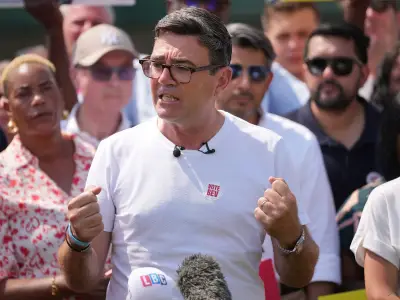
Andy Burnham, the Mayor of Greater Manchester, has delivered his first major speech since returning to Westminster, outlining an economic vision that includes establishing a No 10 in the North as part of broader plans to devolve power and redistribute resources across the country. The proposals aim to regenerate towns and prioritise areas that have been left behind, a concept reminiscent of the 'levelling up' agenda pursued during Boris Johnson’s premiership.
Burnham’s Key Proposals
In his speech, Burnham called for a fundamental shift in how power and funding are allocated, arguing that the current centralised model has failed many communities. He proposed creating a 'No 10 in the North'—a physical base for the Prime Minister’s office in the north of England—to ensure that decision-making is not solely concentrated in London. This, he said, would help spread economic opportunities more evenly.
Burnham also emphasised the need to invest in transport, housing, and skills training in towns that have experienced decades of decline. He cited statistics showing that the North of England receives significantly less public spending per capita than London and the South East, despite having higher levels of deprivation.

Comparison with Levelling Up
The proposals echo the Conservative government’s 'levelling up' agenda, which was a central plank of Boris Johnson’s platform but has faced criticism for lack of tangible progress. Burnham acknowledged the similarity but argued that his plan goes further by insisting on genuine devolution of powers, not just funding. 'Levelling up cannot be a slogan; it must be a reality,' he said. 'That means giving communities the tools to shape their own futures.'
According to political analysts, Burnham’s speech is seen as an attempt to position himself as a key figure in the Labour Party’s future, potentially as a candidate for national leadership. His focus on regional inequality taps into widespread discontent with the current economic model.
Impact and Reactions
The speech has drawn mixed reactions. Supporters argue that Burnham’s vision could revitalise struggling towns and reduce the North-South divide. Critics, however, question whether such proposals are feasible without significant increases in public spending or tax reforms. Some have also pointed out that similar promises under the Conservatives have yet to yield measurable results.
Burnham’s plan includes specific targets, such as increasing the number of high-skilled jobs in the North by 10% over the next decade and ensuring that transport infrastructure projects receive funding proportional to population needs. He also called for a 'devolution revolution' that would give metro mayors more control over education, health, and policing budgets.
Broader Political Context
The speech comes at a time when the Labour Party is refining its economic policies ahead of the next general election. Burnham’s emphasis on devolution and regional equality aligns with the party’s broader agenda, but his specific proposals may set him apart from other senior Labour figures. Some commentators have noted that Burnham’s approach could appeal to voters in 'red wall' constituencies that switched to the Conservatives in 2019.
Ultimately, whether Burnham’s economic vision makes the UK better off will depend on its implementation and the political will to see it through. As he stated, 'The status quo is not an option. We must build a country that works for everyone, not just a privileged few.'