

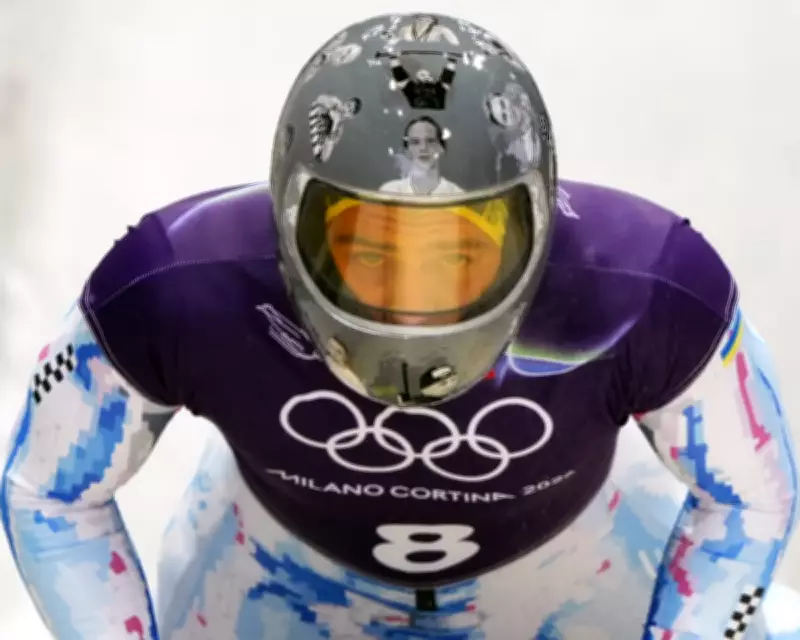
Ukrainian Skeleton Racer Condemns IOC Over Banned Memorial Helmet
Ukrainian skeleton athlete Vladyslav Heraskevych has launched a scathing attack on the International Olympic Committee, accusing it of "betrayal" after officials banned his racing helmet from the Winter Olympics. The helmet featured poignant images of Ukrainian athletes and friends who have been killed since Russia's full-scale invasion began in 2022.
Helmet of Memory Sparks Controversy at Winter Games
Heraskevych, who made history as Ukraine's first skeleton competitor, had designed what he called his "helmet of memory" to honour fallen members of the Ukrainian sports community. The helmet displayed photographs of weightlifter Alina Peregudova, boxer Pavlo Ishchenko, and ice hockey player Oleksiy Loginov, among others killed during the ongoing conflict.
In emotional social media posts, Heraskevych expressed his profound disappointment with the IOC's decision. "A decision that simply breaks my heart," he wrote. "The feeling that the IOC is betraying those athletes who were part of the Olympic movement, not allowing them to be honoured on the sports arena where these athletes will never be able to step again."

Ukraine Launches Formal Appeal Against Ban
The National Olympic Committee of Ukraine formally appealed the decision on Tuesday morning, arguing that Heraskevych should be permitted to wear the memorial helmet during competition. Ukrainian officials maintained that the helmet represents a tribute rather than a political statement.
"The helmet was created to honour Ukrainian athletes who died defending Ukraine or became victims of Russia's full-scale war against Ukraine," the Ukrainian NOC stated. "The NOC of Ukraine states that it fully complies with the security requirements and rules of the IOC, does not contain advertising, political slogans or discriminatory elements."
IOC Cites Olympic Charter Rule 50.2
According to Heraskevych, IOC representative Toshio Tsurunaga visited the athletes' village to inform him of the ban, citing rule 50.2 of the Olympic Charter. This regulation prohibits "any kind of demonstration or political, religious or racial propaganda" at Olympic venues and sites.
The Ukrainian athlete contrasted this decision with what he perceives as inconsistent enforcement by the IOC. "Now, at the Olympics, we have already seen a large number of Russian flags in the stands, on the helmet of one of the athletes – and for the IOC, this is not a violation," Heraskevych noted.
Historical Context of Peaceful Protest
Heraskevych reminded the Olympic community of his previous peaceful demonstration at the 2022 Beijing Olympics, where he displayed a "No War in Ukraine" sign just days before Russia's invasion. At that time, the IOC interpreted his action as a call for peace and imposed no sanctions.
"Unfortunately, over these years this call for peace has only become even more relevant," Heraskevych reflected. "Also over these four years, the IOC has changed dramatically."
Contrast With Russian Athlete Participation
The controversy emerges as the IOC has cleared thirteen athletes from Russia to compete as Individual Neutral Athletes in the Milan-Cortina Winter Olympics. This decision has drawn criticism from Ukrainian officials and athletes who argue that Russian participation undermines Olympic principles while tributes to war victims face restrictions.
"The truth is on our side," Heraskevych declared. "I hope for a fair final decision from the IOC."
The International Olympic Committee has yet to publicly confirm whether it has officially banned the memorial helmet, and has not responded to requests for comment regarding this developing controversy at the Winter Games.






