

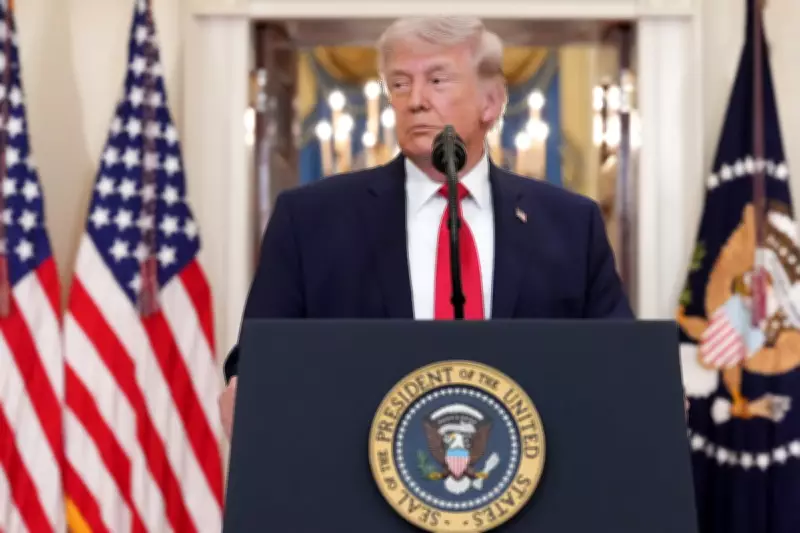
President Donald Trump has formally signed a sweeping executive order designed to address the escalating instability within American college athletics. The directive, issued on Friday, empowers federal agencies with the authority to potentially withhold crucial funding from educational institutions that fail to adhere to new mandates concerning athlete transfers, eligibility standards, and the contentious issue of pay-for-play compensation.
A Federal Intervention in a Changing Landscape
The order arrives amidst a period of profound transformation for college sports, a landscape once defined by pure amateurism but now reshaped by a monumental $2.8 billion legal settlement. This federal intervention outlines a series of proposed regulatory fixes, many of which have been championed by lawmakers and university administrators seeking clarity and consistency.
Key Provisions and Potential Conflicts
Among the order's most notable components is a directive to establish "clear, consistent and fair eligibility limits," explicitly suggesting a five-year participation window for athletes. This measure is viewed as a potential defence against the numerous lawsuits recently faced by the National Collegiate Athletic Association (NCAA).

Furthermore, the executive order calls for the implementation of "structured transfer rules," though it provides no specific details for a system that currently allows players significant freedom to move between schools, sometimes mid-season—a practice criticised for creating unsustainable roster uncertainty.
Perhaps the most powerful element is President Trump's instruction for the Education Department, the Federal Trade Commission, and the Attorney General's office to evaluate whether violations of these new rules could render a university "unfit for Federal grants and contracts." This proactive enforcement mechanism is intended to compel widespread compliance, mirroring tactics used in other policy areas where universities have altered diversity, equity, and inclusion programmes to avoid federal funding disputes.
Immediate Legal and Practical Challenges
The order immediately sets the stage for complex legal confrontations. At a recent roundtable, Trump himself anticipated litigation, a prediction echoed by legal experts. Attorney Mit Winter, a specialist in college sports law, noted the order "appears to direct the NCAA to create rules that would likely violate" existing federal court orders.
These court orders currently prohibit the NCAA from enforcing rules that make athletes sit out a season after multiple transfers or that limit the involvement of collectives in athlete recruitment. Winter posed critical questions: "Will the NCAA create rules that do that? And if they do, will schools follow them? Either way, we're likely going to see litigation challenging the EO by athletes and third parties."
Additionally, the order seems to encourage schools to adhere to new revenue-sharing models. Winter highlighted a potential conflict, stating, "Most schools are paying 90-95% of their rev-share funds to men's basketball and football players. And those funds are already promised via contracts signed with those athletes. Will the order purport to make schools not adhere to those contracts?"
Mixed Reactions from Leadership
NCAA President Charlie Baker offered a measured response, stopping short of threatening legal action. He stated that Trump's order "reinforces many of our mandatory protections—including guaranteed health care coverage, mental health services and scholarship protections."
"This action is a significant step forward, and we appreciate the administration's interest and attention to these issues," Baker said. However, he emphasised that "stabilising college athletics for student-athletes still requires a permanent, bipartisan federal legislative solution." This sentiment was mirrored in the executive order itself, which calls on Congress to "quickly pass legislation"—a goal that has repeatedly stalled on Capitol Hill.
The president's mandate effectively creates a precarious situation where the NCAA and individual universities may be forced to choose between complying with a federal court order or a presidential executive order, a dilemma that promises further legal entanglement and uncertainty for the future of collegiate athletics.






