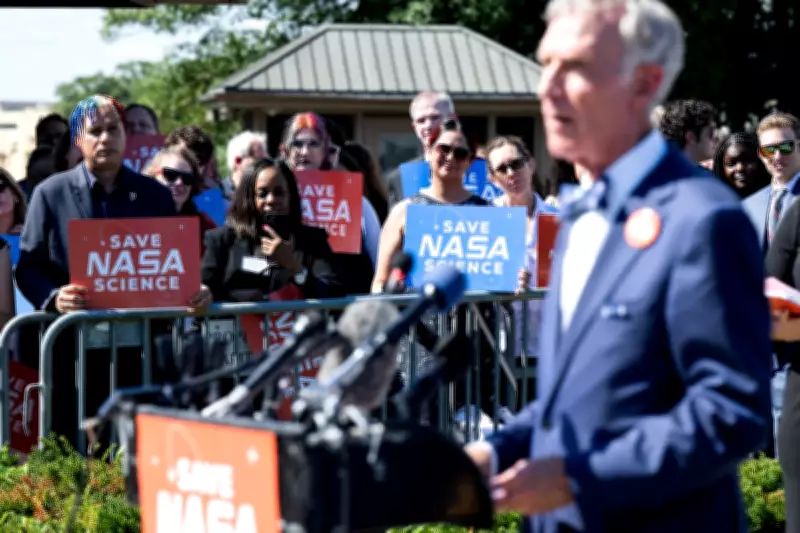
The Trump administration has unveiled a federal budget proposal that would cut NASA's science budget by approximately 20 percent, raising alarm among researchers and lawmakers about the future of key space and Earth science missions.
Proposed Reductions and Their Impact
The budget blueprint, released on Thursday, allocates $7.1 billion to NASA's science directorate, down from $8.9 billion in the current fiscal year. This reduction would significantly affect several high-profile projects, including the Mars Sample Return mission, which aims to bring Martian soil samples to Earth for the first time. The mission, a collaboration with the European Space Agency, has already faced cost overruns and delays; the new budget would likely force its cancellation or indefinite postponement.
Earth science programs, which monitor climate change, weather patterns, and natural disasters, would also see substantial cuts. The administration has proposed terminating the Plankton, Aerosol, Cloud, ocean Ecosystem (PACE) satellite mission and reducing funding for the Earth Systematic Missions program. Critics argue that these cuts would hamper the nation's ability to track and respond to environmental changes.

Reactions from the Scientific Community
Scientists and space advocates have expressed strong opposition to the proposed cuts. Bill Nelson, NASA's administrator under the previous administration, called the budget "devastating" and warned that it would undermine U.S. leadership in space exploration. The American Geophysical Union issued a statement saying the cuts would "set back decades of progress" in understanding Earth and other planets.
Senator Maria Cantwell, a Democrat from Washington, criticized the proposal during a Senate hearing, stating that "slashing NASA science is short-sighted and threatens our economic competitiveness and national security."
Shift Toward Commercial and Human Spaceflight
The budget proposal reflects the Trump administration's priority on commercial space ventures and human exploration. Funding for the Artemis program, which aims to return astronauts to the Moon, remains largely intact, and the budget includes increased support for public-private partnerships with companies like SpaceX and Blue Origin.
Jared Isaacman, a billionaire entrepreneur and close ally of the administration, has been appointed as a senior advisor on space policy. Isaacman, who commanded the Inspiration4 mission and has advocated for commercial spaceflight, is expected to push for further privatization of NASA's activities. His involvement has raised concerns among those who fear that scientific research will be sidelined in favor of profit-driven space endeavors.
Future of Mars Sample Return
The Mars Sample Return mission, already under review due to escalating costs, would be particularly vulnerable under the new budget. NASA had estimated the mission's total cost at up to $11 billion, and the proposed cuts would make it nearly impossible to proceed. Some experts suggest that the mission could be restructured as a commercial venture, but critics doubt that private companies have the capability to carry out such a complex scientific undertaking.
Thomas Zurbuchen, former head of NASA's science mission directorate, described the situation as "a tragedy for planetary science." He noted that the samples collected by the Perseverance rover could provide crucial insights into the history of Mars and the potential for past life.
Broader Implications for U.S. Science
The proposed cuts are part of a broader trend of reducing federal spending on scientific research. The budget also slashes funding for the National Science Foundation and the National Institutes of Health. Supporters of the cuts argue that they are necessary to reduce the national debt and reallocate resources to defense and infrastructure.
However, many in the scientific community contend that such reductions will have long-term consequences for innovation and economic growth. The United States has long been a global leader in space science, and any retreat from that role could open the door for competitors like China and Russia.

As Congress begins its budget deliberations, the fate of NASA's science programs hangs in the balance. While the administration's proposal is unlikely to pass unchanged, the deep cuts signal a shifting priority away from fundamental research and toward commercial and human spaceflight. The coming months will determine whether the nation's space agency can maintain its scientific edge.