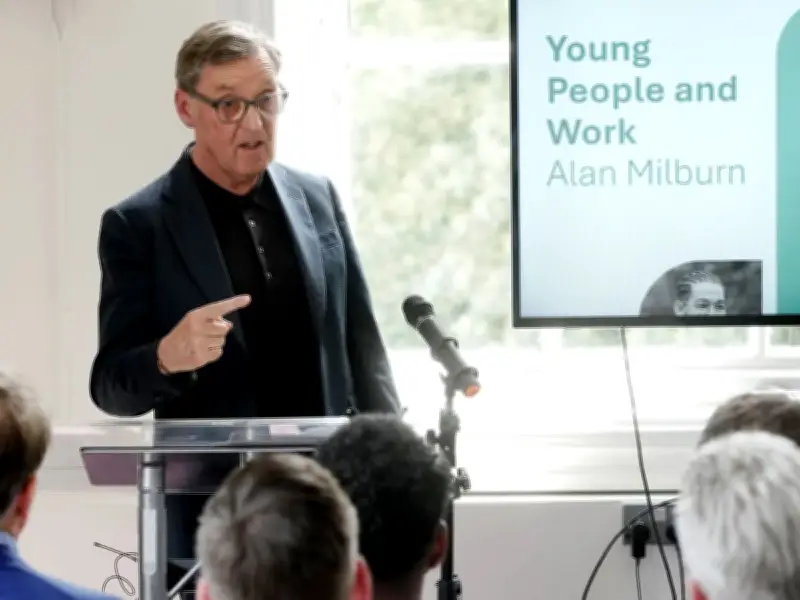
Nearly half a million young people could be helped into employment by 2036 under sweeping reforms designed to make "work not welfare the future for the next generation".
The number of young people across the UK not in education, employment or training – commonly referred to as Neets – went above one million earlier this year for the first time in over a decade.
Report to call for radical change
Former Labour health secretary Alan Milburn has previously warned that the figure could climb from one in eight to one in six by 2031 without intervention, equating to 1.25 million young people.
The crisis is estimated to be costing the UK approximately £125 billion annually – factoring in elements such as lost tax revenues alongside increased health and welfare expenditure.
Mr Milburn is set to publish his widely anticipated report on Tuesday, with expectations that he will call for radical change, arguing "youth participation has to run through public policy like a stick of rock".
He has already conceded that his proposals would not be "pain-free", frankly warning that they could result in some individuals receiving reduced financial support.
National ambition to halve Neet rate
In a speech on Tuesday, he will argue that the current youth unemployment rate represents not merely an economic crisis, but a moral one too.
His report will outline a national ambition to cut the Neet rate by more than half, from 13% to approximately 5% by 2036, which he will claim would position the UK amongst Europe's strongest performers on youth participation.
The UK rate has never fallen below 9.7% since records began in 2001. Mr Milburn's proposals for sweeping reform of the system, encompassing early years provision, schools, apprenticeships, and health and welfare support, could see 600,000 additional young people in education, employment or training annually – with approximately 440,000 in sustained employment – by 2036, according to modelling commissioned for the report.
Youth allowance and support changes
Several elements of his report have already been made public, including a suggestion for a new "youth allowance" for the under-25s, which would prevent them from claiming the disability benefit personal independence payment (Pip) and the health component of universal credit (UC).
Figures released earlier this month revealed that just under half (45.3%) of Neets were classified as disabled in the year to March – a proportion which has more than doubled in little over a decade.
Charities have expressed alarm at the notion of withdrawing benefit support currently designed to cover the additional costs associated with living with a disability.
However, Mr Milburn is expected to present the change as a shift from writing a cheque to creating genuine opportunities for young people to enter work, and has indicated that fresh investment in support, training and employment will precede any benefit modifications.
New services and guarantees proposed
His report will outline how the nation stands "at a fork in the road and half measures will not do", contending that "a complete system reset is needed".
He will say: "A lost generation is not inevitable. A work generation is possible."
Other reported recommendations include progressively reducing national insurance contributions paid by employers on staff aged under 25, beginning in the retail and hospitality sectors, alongside a "legal guarantee" of work, training or employment support for young people, with those who decline the offer potentially facing benefit sanctions.
A new so-called youth opportunity service – rolled out across England by 2029 – will seek to ensure employment, careers, health and practical support are accessible to young people, with a bespoke participation plan and a designated adviser.
An opportunity guarantee would provide a pathway into education, training or employment, while a support guarantee would deliver any health, employment and practical assistance required alongside it.
An ambition to double the number of young people completing apprenticeships over the next decade is intended to position this route as a genuine alternative to university for school leavers, while quicker access to mental health support for Neet young people, without requiring a formal diagnosis, is also proposed.
Reactions from charities and experts
At a press conference on Tuesday, Mr Milburn is expected to say: "A lost generation is not a fact of life. It is a choice. And I believe it is the wrong one.
"Not just because it is a fiscal crisis or an economic crisis. But because it is a moral one.
"We are failing as a nation to gift the next generation the opportunities they need to succeed.
"It is time for a new settlement that makes work not welfare the future for the next generation.
"Demographic change makes getting young people into work a necessity. Britain's future relies on us backing young people."
Prime Minister Andy Burnham has previously stated that the "status quo clearly isn't working" and that his Government is "ready to to grasp the nettle here and make a better system for young people".
Lisa Russell, professor of education and employment and part of the Institute of Children's Futures at Manchester Metropolitan University, said: "At a time when in-work poverty remains a reality for many young people, a strong safety net can play an important role in supporting participation in education, training and employment.
"Those working with Neet young people know that a one-size-fits-all approach rarely works. Decisions should be based on individual circumstances and needs rather than age alone."
Enver Solomon, chief executive of the Nacro charity, which operates education and skills centres across England for young people at risk of becoming Neet, welcomed the youth opportunity services recommendation as something that "could make a real difference to the life chances of young people who for too long have been left behind and rightly presents a once in a generation moment of change".
Dame Clare Moriarty, chief executive of Citizens Advice, characterised the report as "a watershed moment" and cautioned that change "must be done carefully". She said: "The government now has a huge opportunity, but with that comes risk. Young people must not be pushed into poverty as a result of changes to welfare."