

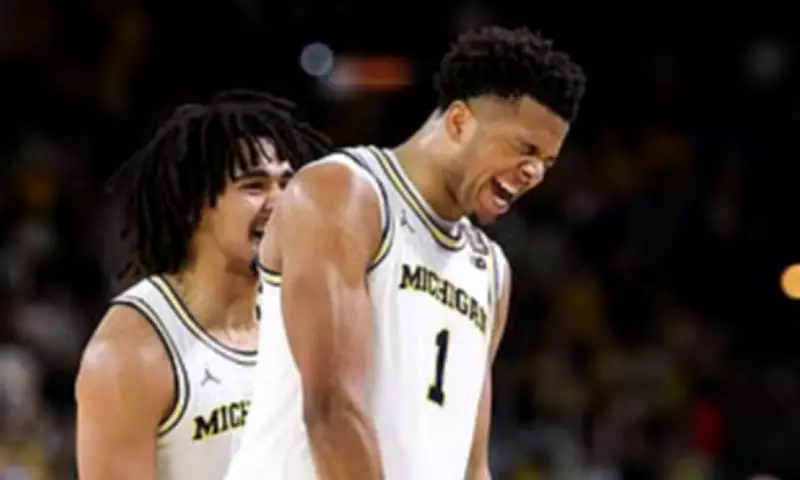
Michigan Makes History with Transfer-Led National Championship Victory
The University of Michigan basketball program has once again etched its name into the history books, this time by becoming the first team ever to start five transfer players in a national championship game. Their 69-63 victory over the Connecticut Huskies on Saturday night not only secured their second national title but also validated the modern transfer portal system at the highest level of collegiate sports.
The Flipped Five: A New Era Begins
Just thirty-four years after Michigan's legendary 'Fab Five' freshmen revolutionized college basketball by starting in the 1992 championship game, the Wolverines have pioneered another groundbreaking approach. This new squad, dubbed the 'Flipped Five', consisted of players who arrived in Ann Arbor from diverse locations across America: Los Angeles, Birmingham and Tuscaloosa in Alabama, Lubbock in Texas, Chapel Hill in North Carolina, and Urbana-Champaign in Illinois.
While the original Fab Five lost their championship matchup against Duke, they fundamentally changed basketball by demonstrating the impact first-year players could have, ultimately paving the way for today's one-and-done phenomenon. Now, the Flipped Five have proven that under the right circumstances, a team assembled entirely through transfers can achieve unprecedented success together.

Coaching Masterclass and Player Performance
Head coach Dusty May orchestrated this historic victory in a manner that solidifies his reputation among the elite coaches in contemporary basketball. The win provided personal redemption for May, who suffered a heartbreaking buzzer-beater defeat in the 2023 Final Four while coaching Florida Atlantic. His strategic acumen and game planning deserve significant recognition, yet it was his unique roster construction that truly captured the spotlight.
Michigan has become the inaugural team in the Name, Image, and Likeness (NIL) era to start five transfers in the national championship game, with the championship victory serving as the ultimate validation that the transfer portal can produce championship-caliber teams at the sport's highest level.
Game Analysis: A Battle of Styles
Credit must be given to the Connecticut Huskies, who faced significant physical disadvantages against Michigan's larger lineup yet managed to keep the contest competitive for most of the game. Despite poor matchups and inconsistent shooting, combined with some controversial officiating decisions, UConn demonstrated remarkable resilience.
Michigan's size advantage created difficult matchups throughout the evening, with Tarris Reed effectively containing Connecticut's Aday Mara from the opening tip. Rather than being intimidated, the Huskies fought tenaciously in the paint and capitalized on Michigan's defensive tendency to allow three-point shots, making four triples in the first half alone.
Controversial Officiating and Key Moments
The officiating crew consisting of James Breeding, Jeffrey Anderson, and Kipp Kissinger became a central narrative with several perplexing calls that displeased both fan bases. A questionable goaltending call against Michigan was followed by an official review of a UConn hook-and-hold that wasn't initially called, resulting in two free throws and possession for the Wolverines.
The first half concluded with Elliot Cadeau's attempted three-pointer being disrupted without a foul call, prompting loud boos from the predominantly Michigan crowd. As officials headed to the locker room, Michigan's student section directed such vocal profanities that Kissinger responded with a stern glare toward one individual.
Second Half Adjustments and Final Push
Both teams dealt with injury concerns, with UConn's Solo Ball and Michigan's Yaxel Lendeborg playing through ailments sustained during Saturday's Final Four. Lendeborg particularly struggled, telling reporter Tracy Wolfson, "I feel awful, I feel super weak right now. I can't make anything."
Connecticut managed to stay competitive despite a 10-4 foul disparity and 6-12 free throw margin, largely thanks to making five three-pointers. Michigan opened the second half missing their first eight shots, while UConn successfully slowed the Wolverines' typically fast-paced offense.

However, the Huskies committed five turnovers in the first five minutes of the second half, allowing Michigan to build an eleven-point lead that forced UConn coach Dan Hurley to call a timeout. Momentum firmly favored the Maize and Blue as Mara and Morez Johnson completely shut down Connecticut's interior opportunities.
A brief Michigan scoring drought allowed UConn to narrow the deficit to seven points at the under-eight timeout, but the Huskies couldn't capitalize as time gradually expired. A late three-pointer from Solo Ball gave Storrs fans hope for a miraculous comeback similar to their victory over Duke, but Michigan's transfer-powered lineup held firm to secure the historic championship.





