

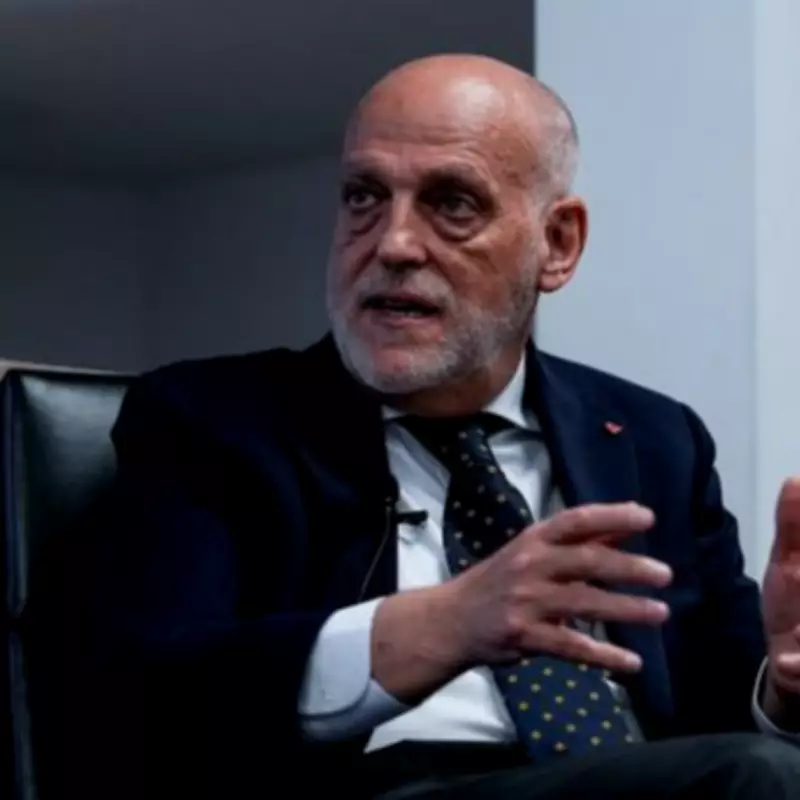
La Liga President Takes Aim at Premier League's Transfer Market Inefficiency
La Liga president Javier Tebas has launched a scathing critique of Premier League clubs' spending habits in the transfer market, highlighting what he perceives as a lack of financial prudence and strategic foresight. His comments come in the wake of a challenging week for English teams in European competition, where several high-profile exits have raised questions about the value derived from substantial investments.
Manchester United's Antony Deal Cited as Prime Example
Tebas specifically pointed to Manchester United's acquisition of Brazilian winger Antony as a glaring illustration of wasteful expenditure. Antony joined United for a fee approaching £90 million (approximately €95 million) but struggled to make an impact during his two-and-a-half-year stint at Old Trafford. He has since revitalised his career at Spanish club Real Betis, where his performances have been notably more impressive, albeit at a significantly reduced cost to the La Liga side.
"It's not me saying it, there are reports that say it," Tebas asserted when questioned about La Liga's market efficiency. "[The reports] say that the teams which are most effective in spending on players are Spanish. It is what it is."

Champions League Reality Check for Premier League Giants
The timing of Tebas' remarks coincides with a sobering week for Premier League clubs in the Champions League. While all six English entrants advanced to the knockout stages, four were eliminated this week, with three of those defeats coming at the hands of Spanish opponents. Real Madrid convincingly overcame Manchester City, Barcelona dispatched Newcastle United, and Atletico Madrid eliminated Tottenham Hotspur, with each victory achieved by considerable margins.
These results have intensified scrutiny on whether the Premier League's financial muscle translates effectively into on-pitch success in Europe's premier club competition. Tebas emphasised that La Liga's model, which places greater emphasis on youth academies and homegrown talent, offers a more sustainable and efficient approach.
La Liga's Financial and Developmental Claims
Recent financial reports released by La Liga underscore Tebas' arguments. The league has reported increased revenues and highlighted the substantial value of homegrown players within its teams. According to their analysis, La Liga clubs possess nearly £400 million more in quality from academy products compared to their Premier League counterparts.
"Our teams are competitive, and I think they will be for many years," Tebas stated, reinforcing his confidence in the Spanish football framework. He also expressed concerns about the financial sustainability of some Premier League clubs, particularly criticising what he termed 'state clubs' and questioning the enforcement of spending controls.
"I worry that spending controls aren't followed, that there isn't a financial rationale to the management," he explained. "It's a worrying model, because it generates losses, and the clubs can only be saved if they qualify for European competitions, but it creates a debt bubble."
Broader Implications for Football Governance
Tebas' comments reflect ongoing tensions between European leagues regarding financial fair play and competitive balance. His call for stricter enforcement of financial regulations and a shift towards academy-focused development models challenges the Premier League's current spending-led strategy. As debates over transfer market efficiency and club sustainability continue, the contrasting fortunes of English and Spanish teams in Europe this season provide a compelling backdrop for these discussions.






