

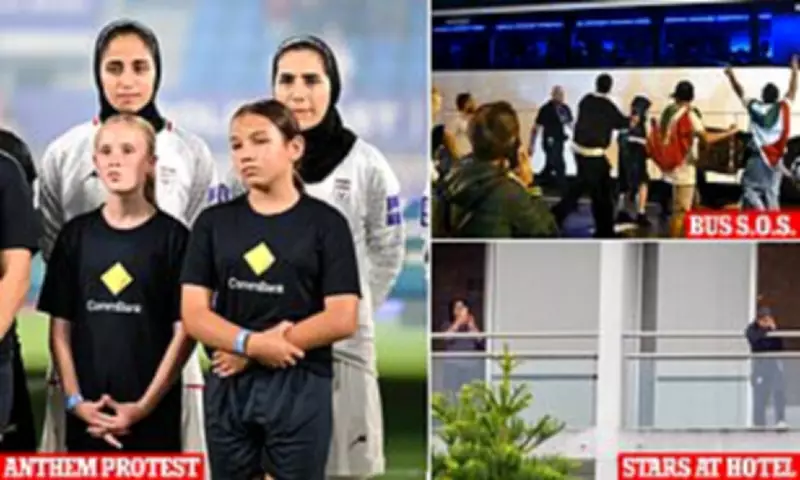
Human rights advocates are urgently calling on Australian government officials to arrange confidential meetings with the Iranian women's national football team to ensure their safety. This plea follows alarming incidents where squad members were observed making what appears to be an international 'SOS' hand signal from their team bus on the Gold Coast.
Anthem Boycott Sparks State Media Fury
Iran's state-controlled media has launched a scathing attack on the women's team, branding them as 'wartime traitors' who must face severe punishment. This condemnation came after the players refused to sing the Iranian national anthem before their opening match of the Asian Cup tournament in Australia. The silent protest has placed the athletes in immediate danger according to multiple advocacy groups.
Desperate Pleas for Government Intervention
Community organizations have formally written to Home Affairs Minister Tony Burke, imploring him to intervene on behalf of the footballers. The team is currently accommodated at the Royal Pines resort on the Gold Coast and is scheduled to depart Australia later this week following the conclusion of their Asian Cup matches.

Rana Dadpour, founder of the women's rights organization AUSIRAN, has issued a stark warning about the potential consequences. 'We need to talk with these girls away from the handlers and the regime-affiliated people who are following them right now in Australia,' she emphasized. 'If they want to stay, I think we need to provide them with every support that we can.'
The Disturbing SOS Signal
As the team left their final competition match on Sunday evening, at least one player was seen making the internationally recognized distress signal through the window of their team bus. The gesture involves raising an open palm, crossing the thumb over it, and folding the four fingers over the top. Protesters had surrounded the vehicle, with players appearing to film the crowd through the windows.
Political Figures Voice Support
Reza Pahlavi, son of Iran's former Shah and a prominent leader within the nation's resistance movement, praised the team's courageous act of defiance. However, he cautioned that this bravery would likely result in 'dire consequences' should the women return to Iran. 'I call on the Australian government to ensure their safety and give them any and all needed support,' he declared.
Opposition frontbencher Julian Leeser has publicly urged Australia to grant the athletes asylum if they request it. 'The Australian government should not turn a blind eye to the danger these women face,' he stated in an official release.
Government's Cautious Stance
Australian authorities have demonstrated extreme sensitivity regarding speculation about the players' potential movements. Officials fear that public discussion could further endanger the women should they return to Iran or potentially put their families at risk back home.
Attorney-General Michelle Rowland acknowledged the players' bravery but declined to comment on whether Australia had approached them with asylum offers. Meanwhile, a Change.org petition demanding Australian intervention had collected nearly 60,000 signatures by Monday morning.
Historical Context of Sporting Protests
The anthem boycott by Iran's women's team follows a significant precedent. During the 2022 men's World Cup in Qatar, the Iranian men's national team similarly refused to sing their national anthem and abstained from celebrating goals during their opening match against England.
That protest coincided with Iran's Revolutionary Guard conducting a brutal crackdown on women's rights demonstrations within the country. Additionally, last month, two players withdrew from the women's squad before the Asian Cup commenced, highlighting the ongoing tensions surrounding the team.
Ms. Dadpour emphasized the potential effectiveness of international pressure, noting: 'We've had many cases of execution orders that have been previously delayed or stopped only because of the international pressure and media attention.' As the team's departure looms, advocates continue their urgent appeals for protection and support for the athletes.






