

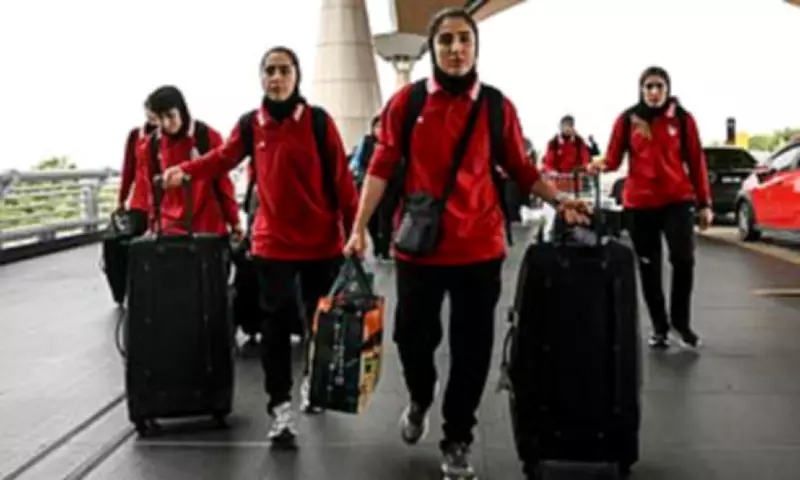
Iranian Women Footballers Return Amid Regime Pressure and Wider Gender Struggle
The majority of the Iranian women's national football team has arrived back in Tehran this week, concluding a dramatic saga that saw several players initially seek asylum in Australia during the Asian World Cup. Only two of the original seven squad members who requested to defect remain in Sydney, with the others returning via a complex route through Malaysia, Oman, Istanbul, and the Gurbulak-Bazargan border crossing.
Defiance and Retreat
The team's plight captured global attention this month after players refused to sing Iran's national anthem before their tournament opener, an act interpreted as defiance against the regime. This prompted a conservative Iranian commentator to label them 'wartime traitors' and demand severe punishment. Subsequently, six players and one staff member applied for Australian visas to stay, but five later reversed their decision and rejoined the team.
No official reasons were provided for this change of heart, but reports indicate pressure from Iranian authorities and threats against players' families influenced their return. Concerns are mounting about their reception in Tehran, especially after it emerged that one player's mother reportedly sent a warning message stating, 'Don't come back, they'll kill you,' though it arrived too late to prevent her departure from Sydney.

Broader Context of Women's Oppression
For many Iranian women, both domestically and abroad, the football team's gradual compliance represents a disheartening moment that mirrors the broader trap facing female protesters across Iran. The recent American and Israeli airstrikes on Tehran, which lasted over two weeks, initially sparked hope alongside fear, with some women envisioning potential regime change and an end to decades of oppression. However, the regime has retaliated with explicit threats, warning it has its 'finger on the trigger' against renewed protests.
Sahar, a 39-year-old professor whose family resides in Tehran, describes a city under siege: 'The sound of missiles and explosions can be heard across the city.' While food remains available, prices are rising, the internet is largely blacked out, and security forces are intimidating citizens into silence. 'Security forces stop people in the streets and check their phones. Anyone who's taken videos or photos of bomb damage can be detained. People are afraid to record anything. It's like martial law,' she explains, using a pseudonym to protect relatives in Iran.
Systemic Gender Apartheid
Since the Islamic Republic's establishment 47 years ago, a 12-man Guardian Council, led by the Supreme Leader, has controlled women's rights and bodies. Iranian law enforces systemic discrimination: inheritance laws favor sons over daughters, divorce and custody rules privilege men, and women are prohibited from singing or dancing publicly as these acts are deemed 'indecent.' Married women cannot work or travel without their husband's permission.
Every July, Iran observes the National Day of Hijab and Chastity to promote mandatory hair covering, and in 2024, a new law granted impunity to officials and vigilantes who violently attack women and girls for not wearing the hijab. Sahar notes that the current clampdown echoes past responses to women's objections, recalling anti-government protests in January where authorities used brutal force, resulting in an estimated 36,500 deaths, with 30,000 registered in civilian hospitals on January 8-9 alone.
Protests and Personal Stories
The Women, Life, Freedom movement, sparked by the 2022 death of Mahsa Amini—a 22-year-old Kurdish woman beaten after an arrest for an 'improper' hijab—galvanized mass resistance. Women took to the streets, burning headscarves and chanting slogans like 'Death to the Dictator.' Laleh, another woman from northwest Iran, participated in these protests, removing her headscarf and feeling 'so free,' but faced fines and threats. Her younger brother, Mohammed, was killed for leading protests, shot by forces under orders to 'severely confront' demonstrators.

Laleh herself was later arrested by plainclothes agents while printing photos to commemorate her brother's anniversary, enduring harassment and forced false confessions before fleeing to Iraq with media intervention. The death toll from the Woman, Life, Freedom protests is estimated at around 450, including 40 children.
Historical Repression and Hope
Sahar's personal experiences underscore the regime's long-standing repression. Between ages 19 and 24, she was arrested ten times by the Guidance Patrol for wearing prohibited clothing like jeans and bright jackets. On her 24th birthday, she was detained by the Islamic Revolutionary Guard Corps (IRGC) and taken to the Vozara detention center, where she faced predatory behavior and fears of violence. Human rights organizations have reported floggings, rapes, and executions at Vozara, particularly after the 2022 protests.
Despite the fear, hope persists among Iranian women. Sahar's father celebrated when former Supreme Leader Ali Khamenei was killed in an airstrike, distributing sweets in their alley. Sahar, now a professor abroad, reflects, 'Khamenei put so much pain in our hearts. He'd done so many bad things to women. I cried for an hour with happiness when I knew he was dead.' She and others fervently wish for the downfall of the regime that has ruled Iran for decades, seeing it as a path to liberation from gender apartheid.
The names and identifying details of interviewees have been altered to ensure their safety amid ongoing risks in Iran.





