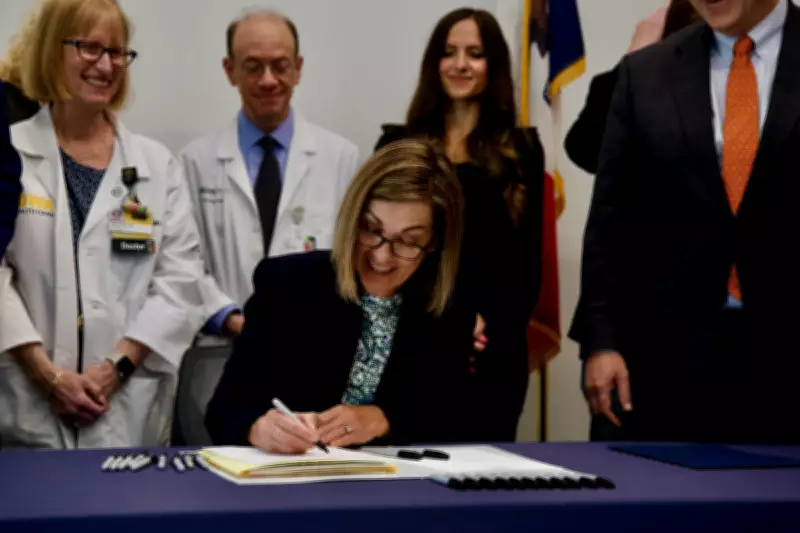
Iowa's Republican Governor Kim Reynolds has signed a bill into law that eliminates the need for health insurance companies to authorize cancer screenings after they are requested by doctors, making it easier for patients to receive timely treatment. The legislation, known as the 'Patients First Act', was signed at Monroe County Hospital in Albia and will take effect on July 1.
Addressing High Cancer Rates
The issue is particularly pressing in the Midwestern state, which has the second-highest rate of cancer diagnoses in the United States. According to a University of Iowa study published in February, 87 of Iowa's 99 counties report cancer cases significantly above the national average. While the precise reason for this remains unknown, researchers are expected to submit a report on their findings in July.
Removing Bureaucratic Obstacles
The 'Patients First Act' removes a key bureaucratic hurdle for doctors seeking to diagnose cancer. Previously, prior authorizations could take weeks to be approved or denied, delaying critical screenings. State Representative Austin Harris, a Republican who co-authored the bill, noted that the new law prohibits such delays, allowing patients to receive screenings much faster.

The bill passed the Iowa House and Senate unanimously—87-0 and 44-0 respectively—before reaching the governor's desk. In addition to streamlining the approval process, the law requires insurance companies to provide a clinical reason for denying care and sets deadlines for communication with hospitals about specific patients' claims. This aims to improve transparency and reduce administrative burdens.
“By establishing firm timelines for notifications, decisions, and appeals, insurance companies will now be required to provide clear clinical explanations when care is denied,” Governor Reynolds said at the signing ceremony. “This helps providers spend less time navigating red tape and more time with the people they serve.”
Protecting Against AI-Driven Denials
The legislation also prohibits insurers from using artificial intelligence as the sole basis for approving or denying claims. Shelly Russell, board chair for the Iowa Hospital Association, emphasized the importance of this provision. “One of the things that we have seen over time is that there has been some effort to only use AI in denials,” she said. “We didn’t want that. That’s a piece of that bill so that they couldn’t just deny it based only on AI. There has to be a human element in that.”
The 'Patients First Act' represents a significant step toward improving cancer care access in Iowa, reducing delays and ensuring that medical decisions involve human oversight.