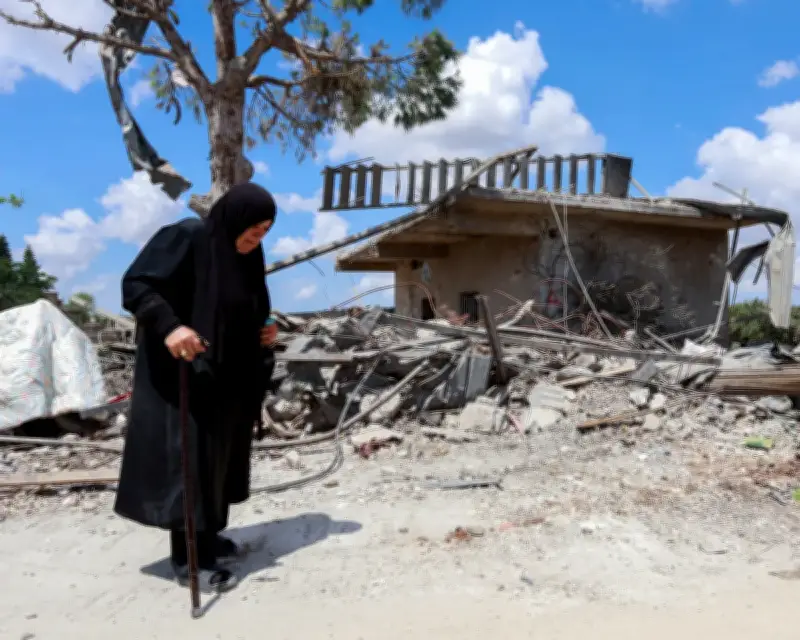
In south Lebanon, families displaced or bereaved by the war are turning to Hezbollah’s extensive social welfare system, widening the gulf between the group and the cash-strapped Lebanese state. Fatima al-Ashkar, a 26-year-old widow from Markaba, used toy soldiers to explain to her children how their father, Mohammed Ali, a Hezbollah member, was killed fighting Israel in early April.
Hezbollah’s martyr foundation soon stepped in, finding and furnishing an apartment for al-Ashkar and her children in Beirut’s southern suburbs, covering the rent in full. It continues to provide stipends for each child, pay school fees, and cover all healthcare costs. Representatives also visit for psychological support sessions. “Hezbollah is standing by us. They do everything for us,” said al-Ashkar.
State vs Hezbollah support
Many residents turned to Hezbollah because they believed in it, while others had little alternative due to the state’s absence. As the Lebanese state tries to reassert authority, it faces a challenge beyond disarming the group, including contending with its deep-rooted welfare system and persuading supporters it can provide security amid ongoing Israeli occupation and attacks.

The latest war has hardened divisions. Hezbollah supporters accuse the government of humiliating Lebanon by negotiating with Israel, while opponents blame the group for provoking the conflict by launching rockets on 2 March. Al-Ashkar said: “Honestly, I don’t care about the state. Before, we used to say: ‘They should speak, they should do something.’ Now, whether they speak, or don’t speak, it makes no difference to us.”
Rebuilding trust in pilot zones
Mustapha Hamze, a 66-year-old doctor from Nabatieh’s outskirts, said a stronger state would make a difference, but he has little faith in its ability to defend his rights. He fled his home in the early days of the war, and an Israeli drone fired on him the last time he tried to return. He has applied for safe passage through the Lebanese army but has yet to receive it.
Lebanese officials acknowledge the challenge of convincing people, particularly Hezbollah supporters, to trust the state. “This needs to be a whole-of-government approach. For supporters of Hezbollah, you are talking about three generations of social indoctrination. You have to start with the culture, then inclusion in government, and then we can talk about security,” a senior Lebanese security official said anonymously.
The government is using three “pilot zones” – areas handed back from Israeli occupation – as prototypes to rebuild trust. The army is taking charge of reconstruction, rather than the southern council tied to the Hezbollah-allied Amal movement, to make the state visible and ensure infrastructure is not used for military purposes. However, the state’s narrative is undermined by daily Israeli shelling, including the destruction of a municipal building, school, and clinic in Zawtar al-Gharbiyah.
Limits of state capacity
The cash-strapped state cannot match Hezbollah’s social services. Tia Abdalah, a displaced resident from Aitaroun, said: “We got medical treatment, free medicine, blood tests from Hezbollah and Samidoun. As for the state, we haven’t gotten anything from them.” Although not affiliated with Hezbollah, she received monthly cash stipends and aid boxes.
Lebanese officials are determined to pursue diplomacy but fear state legitimacy will collapse without Israel’s withdrawal. “The pilot zones won’t work unless there is a clear timetable for withdrawal. We want to push out Hezbollah, but we don’t want to appear as if we are playing the role of the South Lebanese Army,” the security official said, referencing Israel’s former proxy. For al-Ashkar, the state offers little promise: “Israel calls the army on the telephone and tells them: ‘Leave the village,’ so they leave the village. Then there’s nobody left defending it.”