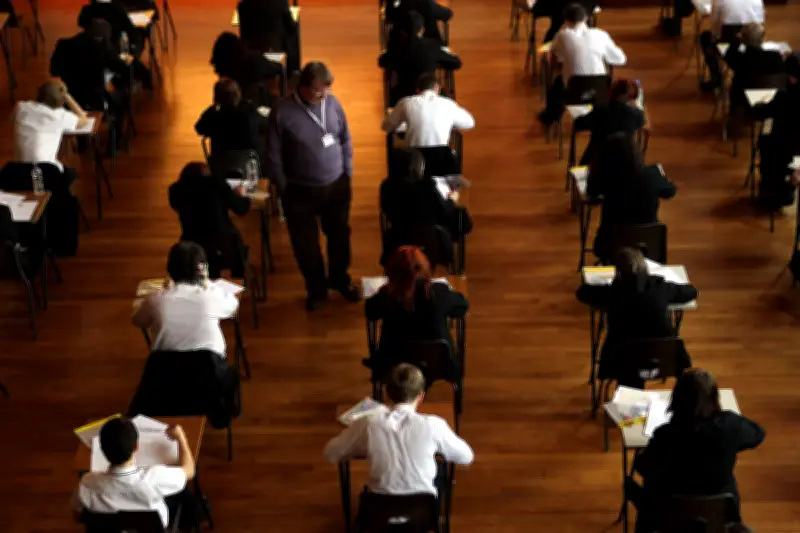
Hundreds of thousands of pupils across England, Wales and Northern Ireland are waking up to their GCSE results on Thursday, receiving grades and technical awards to help them progress to sixth form, college or training.
Gender Gap Persists at Top Grades
Education experts have reiterated concerns over the gender gap at GCSE, which sees girls consistently outperforming boys. Last year, the gap between girls and boys at the top grades narrowed.
Nearly a quarter (24.5%) of girls’ GCSE entries were awarded at least a grade 7/A compared with almost a fifth of boys’ entries (19.4%) – a 5.1 percentage point gap. In 2024, 24.7% of girls’ entries scored one of the top grades, compared to 19.0% of those from boys – a 5.7 percentage point gap.

Concerns Over Boys' Outcomes
The Centre for Policy Research on Men and Boys (CPRMB) said the disparities at GCSE level, and in education more widely, can mean boys struggle to thrive after leaving school. CPRMB research officer Martha Lucas told the Press Association: “When around a third of boys’ entries to GCSE are consistently not meeting a grade four each year, which is the standard pass level, it is a massive concern.”
“For a lot of employment, meeting that grade four in maths and English is a barrier to finding that employment. This year, the number of male Neets (not in education, employment or training) hit more than 500,000. So, boys are consistently leaving school without the qualifications nor education necessary for them to thrive in adult life – get a job, be in employment – and quite frankly that desperately needs to change.”
Ms Lucas said the gender gap starts to emerge when children are as young as five, adding that girls are “consistently outperforming boys in education”.
Expert Views on Potential Causes
In a forecast report ahead of GCSEs this year, Professor Alan Smithers, director of the centre for education and employment research at the University of Buckingham, said he has called for many years “without success” for the gender gap to be investigated. In a report last year, Prof Smithers said the talents of boys are not being developed as “fully” as they could be, but this year he questioned whether girls might have an “inherent advantage”.
“My first thought was that this was against the vibes of the time when the emphasis is on equality for women,” he continued. “Since men generally come out on top in the workplace, why bother? More recently I have been thinking the unthinkable in these days when the cancel culture is in overdrive. The sex differences in education achievement are so regular and persistent that they could be inherent differences. This should be taken on board in any inquiry.”
Lee Elliot Major, professor of social mobility at the University of Exeter, told PA: “There’s no single reason why boys do less well at school. Some of the gaps start very young, particularly around language and reading. As boys get older, things like reading habits, behaviour, engagement with school, peer pressure and attitudes about what it means to be a boy can all play a part. But it’s a big leap from that to saying boys are somehow biologically less suited to education.”
Government Response and A-Level Context
Earlier this week, a spokesperson for the Department for Education (DfE) said while girls do outperform boys at GCSE, boys do better at A-level, and it all varies by subject. Overall, 28.9% of boys’ A-level entries scored an A* or A this summer, compared with 28% of their female classmates’ entries – a gap of 0.9 percentage points. But because fewer boys took A-levels than girls, the actual numbers of the top grades awarded to male students was around 16,000 fewer than those awarded to female pupils.
“We’re already putting the right support in place to extend ambition for everyone,” the DfE spokesperson said on Monday. “As we set out last week, we are reforming key stage four to give pupils a genuine choice between academic and technical pathways.”

Prime Minister Andy Burnham announced last month that technical subjects will be available to 14-year-old pupils from September 2028. Education Secretary Lucy Powell wished those receiving results on Thursday good luck. “We will ensure every child has access to high-quality options whether that’s academic, vocational, technical, creative or a mix,” she said. “Everyone should have the chance to follow the path that’s right for them and build a successful career.”
Last year, more than a fifth (21.9%) of UK GCSE entries were awarded the top grades – at least a 7 or an A-grade – up from 21.8% in 2024 but fewer entries scored a decent pass. The proportion of entries getting at least a 4 or a C grade – considered a “standard pass” – fell from 67.6% in 2024 to 67.4% last year – a drop of 0.2 percentage points, but higher than 67.3% in 2019.
In England, Ofqual brought GCSE grading standards back in line with pre-Covid levels in 2023, and exam regulators in Wales and Northern Ireland returned to pre-pandemic grading the year after. The move came after Covid-19 led to an increase in top GCSE grades in 2020 and 2021, with results based on teacher assessments instead of exams.