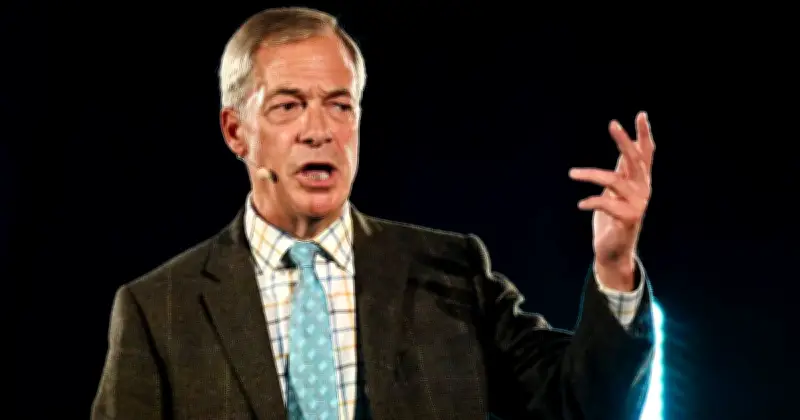
Nigel Farage has accused police chiefs of operating “two-tier” policing after female officers were warned to consider cultural sensitivities when interacting with Muslim men. The Reform UK leader condemned national guidance advising officers to take account of religious practices when speaking to members of the opposite sex in Muslim households and mosques.
Guidance on cultural sensitivities
The document, published by the National Police Chiefs’ Council (NPCC), tells officers that “cultural factors should be considered when interacting with the opposite sex”. It adds that the advice applies to both physical contact and verbal communication, suggesting that in some situations an officer of the same sex would be better placed to deal with a Muslim individual.
The guidance also tells officers to avoid entering parts of mosques or Muslim homes designated for members of the opposite sex and to dress modestly when visiting such premises. It further advises police to “avoid the use of dogs” when carrying out work in Muslim spaces.
Political reaction
Mr Farage hit out at the recommendations, telling The Telegraph: “This is outrageous and yet more proof of institutional two-tier policing. The police should not be bending over backwards to placate sexist and outdated cultures. If the police actually believed in equality before the law, the NPCC would remove this immediately and those responsible would be fired.”
Shadow Home Secretary Chris Philp also called for the guidance to be scrapped, arguing that police should treat everyone equally regardless of their religious beliefs or background. He said: “This is precisely the kind of guidance that is harming policing. The police should treat everyone the same, whatever their faith or the colour of their skin, and any document telling officers otherwise is plainly wrong.
“My pleas to the NPCC and two Labour home secretaries to scrap guidance like this were ignored until the Henry Nowak murder. Much like the Police Race Action Plan, this toolkit should be withdrawn. The dangerous ideology behind this belongs in the bin.
“We cannot continue to treat people differently because of their faith or skin colour, in policing or anywhere else, is morally wrong and ends in disaster.”
Faith Toolkit details
The recommendations form part of a wider Faith Toolkit, created by the College of Policing and the NPCC to help officers understand and work with Britain's different religious communities. It covers 23 faiths and beliefs, including Islam, Judaism, Christianity, Buddhism, Sikhism and paganism, with advice on religious practices, places of worship and the treatment of the dead.
However, the section on Islam is considerably longer and more detailed than those covering other religions. It also contains additional advice on reporting anti-Muslim hate, with no equivalent instruction specifically addressing hate crimes against other faiths.
The guidance says periods of particular vulnerability for Muslim communities can include terrorist attacks and international events such as elections. It also states that, ideally, forensic examinations of deceased Muslim women should be carried out by female officers of the same faith.
Elsewhere, officers are told that women should dress modestly when visiting Buddhist temples, while advice for Orthodox synagogues says male officers should not enter female galleries and female officers should stay out of male areas.
The toolkit was developed with contributions from several organisations representing police staff and religious communities, including the National Association of Muslim Police and the British Association for Women in Policing. An introduction by Rachel Kearton, the NPCC's chair for race, inclusion, religion and belief, says it is essential for police to understand the cultural and religious contexts in which they operate.
NPCC response
A spokesman for the NPCC said: “Policing serves and protects everyone regardless of faith, background or belief. The law applies equally to all.
“Policing operates within increasingly diverse communities. This guidance is a practical toolkit to help officers and staff to understand and engage effectively with different communities. Religious and cultural considerations do not override the law or the operational duties of police officers.”
The spokesman added that the same process had been followed for every faith group and that the toolkit covered broadly the same areas across all 23 religions and beliefs.