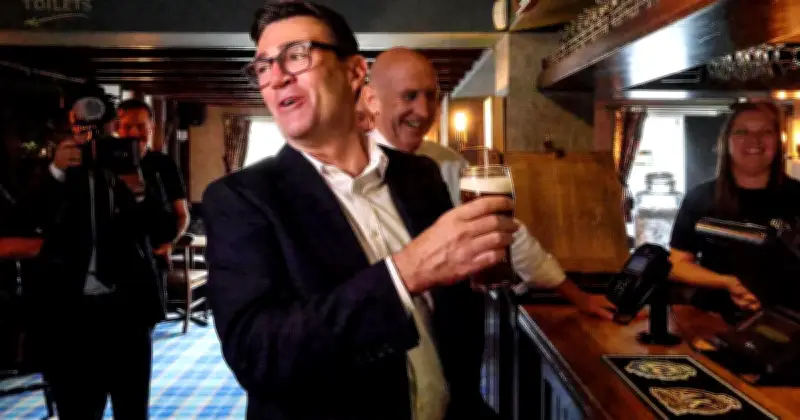
Andy Burnham's Jobs Guarantee will pay young people's wages for six months, but it is fixing a crisis the National Insurance raid helped create, argues Aaron Newbury.
How many people around the Cabinet table have ever tried to run a small business? Looking at the sorry state of the decisions they are making, I would imagine none. Starting a business is hard enough these days. Now a café owner, let us say in Andy Burnham's own constituency of Makerfield, looking to take on a teenager to help on Saturdays finds herself stung with an ever-increasing bill.
In business, but sadly not in politics, if the sums do not add up the decision is easy. Crippling taxation and the higher cost of taking on new staff have left many businesses concluding that they simply cannot afford to hire.
A Crisis the Government Created
Anyone with a calculator and a functioning brain could have told the boffins in Whitehall this months ago, when Rachel Reeves brought in her job-killing National Insurance hike. For years Britain's businesses have been sounding the alarm that they cannot expand, or in many cases keep going, as the burdens rise.
Yet somehow politicians have reacted with abject horror to learn that thousands upon thousands of Britain's young people cannot find work. Had they stepped outside SW1 even once in the past decade, they would have seen that coming a mile off.
But fear not, for the people who made the youth unemployment crisis have a solution. Pay teenagers' wages for six months! What an excellent idea. A vote winner for sure.
The Jobs Guarantee Scheme
This is the Jobs Guarantee, which our very clever Government plans to roll out alongside Alan Milburn's review of the youth jobs crisis. That review spent months confirming what we all knew in the first place, and arrived at the wrong solutions nonetheless.
Now anyone out of work, on Universal Credit and aged between 18 and 24 will be thrown a lifeline. The state will pay their wages, which ministers hope will plonk 90,000 jobless youngsters into work.
I have no doubt it will win plaudits from the chattering classes, and a bump in the polls. In truth, that is the only reason it is being done. A smiling teenager behind the counter and a minister at the ribbon-cutting. What will not be seen is the bill, or the jobs that never existed because ministers made young people too expensive to hire in the first place.
Welfare by Another Name
This is an exercise in idiocy, penned by the economically illiterate who occupy our Government.
Perhaps we should ask the obvious question: if a job is worth doing, why must the state pay for it? A real job exists because someone values the work more than it costs to perform. A job that exists only while the Government pays the wages is not a job. It is welfare by another name.
When the six months end, one of two things happens. Either the café could have afforded the worker all along, in which case your money simply padded its margins, or it could not, and the job vanishes the day the cheques stop.
Milton Friedman, the Nobel prize-winning economist, put it best. He said: "If I spend somebody else's money on somebody else, I'm not concerned about how much it is, and I'm not concerned about what I get. And that's government."
The greater folly is that the state is paying to repair damage it did itself.
Shortly after she rampaged into the Treasury, Rachel Reeves broke Labour's manifesto commitment and hiked employers' National Insurance. Then she reached for the ultimate feel-good socialist policy and pushed up the minimum wage once again.
Make something more expensive and people buy less of it. That is as true of a young worker's time as of a pint of milk. The first casualty is always the entry-level job, that vital first rung on the ladder.
Official figures show just shy of a million young people not in education, employment or training. Most businesses brave enough to stick their heads above the parapet will admit that Labour's National Insurance raid has harmed young people's job chances.
The cheaper answer is to stop taxing the jobs in the first place.
Cut the cost of hiring young people and the café owner in Makerfield will do the rest. For free.