

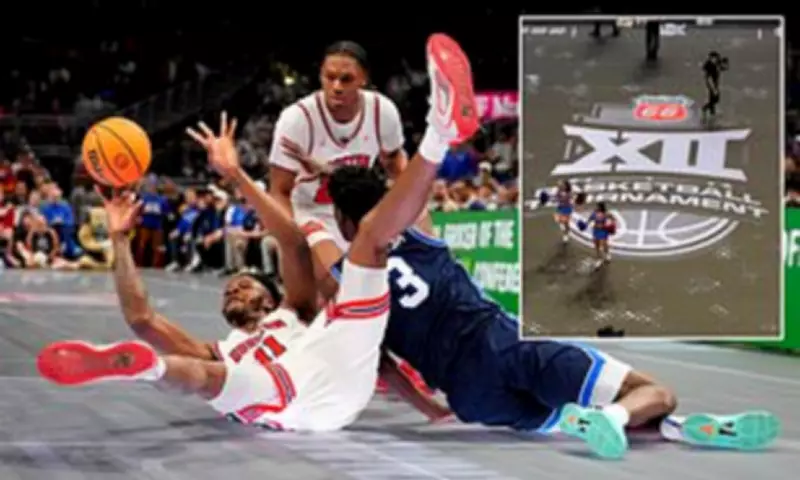
In a significant reversal, the Big 12 Conference has terminated its experiment with an all-glass LED court, opting to revert to traditional hardwood for the remainder of its basketball tournament. This decision comes after numerous players experienced slips and injuries on the innovative surface, prompting concerns over athlete safety and performance.
Commissioner's Statement on the Court Change
Big 12 Commissioner Brett Yormark announced the change late Thursday night, citing the need to prioritize student-athlete comfort on a major stage. "After consultation with the coaches of our four semifinal teams, I have decided that in order to provide our student-athletes with the greatest level of comfort on a huge stage this weekend, we will transition to a hardwood court for the remainder of the tournament," Yormark stated. He emphasized that this move ensures the continuation of basketball's 135-year tradition on hardwood surfaces indefinitely.
Player Injuries and Complaints
The glass court, installed for the conference tournament in Kansas City, has been linked to several incidents. Texas Tech guard Christian Anderson strained a muscle after slipping during a 75-63 loss to Iowa State. "Obviously, the floor is a bit slippery," Anderson remarked. "I think I just kind of mis-stepped or did a movement that caused me to slip." Other players reported similar issues, with increased squeaking from sneakers and a distinct "thudding" sound when the ball bounced, though traction remained the primary concern.

Coaches' Reactions and Decision-Making
Kansas coach Bill Self distanced himself from the decision, noting his lack of involvement. "I personally didn't have any involvement [in the decision to go to hardwood]," Self said after Kansas's 78-73 victory over TCU, the last game on the glass floor. "If the other coaches are doing it, (they) have juice and they got more than I got. Because I didn't have any involvement with that at all." However, Yormark later affirmed, "I think it's the right thing to do," highlighting the collaborative effort with coaches to address safety issues.
Technical Details and Fan Criticism
The ASB GlassFloor court, previously used at the NBA All-Star Game and in Europe but never in an official U.S. competition, features an aluminum and steel spring-action design intended to mimic hardwood flexibility. LED panels display data-driven graphics and advertising, with a ceramic coating and etched dots meant to provide grip comparable to traditional surfaces. Despite these features, fans had predicted traction problems upon the court's unveiling last week.
On social media, one fan lamented, "Too bad it's so slippery…" while others criticized the Big 12's oversight. "It was very silly of the Big 12 to think that a glass floor would work for high-level competitive basketball," a critic wrote. "If it was feasible at this point, you don't think the NBA would be using it at every arena to show ads for DraftKings and Palantir?" Another added, "Absolutely wild that the Big 12 didn't look into whether a glass LED floor would be slippery before using it for real games. They beta-tested it at the risk of players' ligaments and learned that yes, glass is more slippery than hardwood."
Historical Context and Future Implications
The Big 12's announcement last month to use the glass court for both men's and women's tournaments marked a bold step, but the swift return to hardwood underscores the challenges of integrating new technologies in sports. This incident may influence future decisions regarding court materials in collegiate and professional basketball, emphasizing the balance between innovation and athlete welfare.






