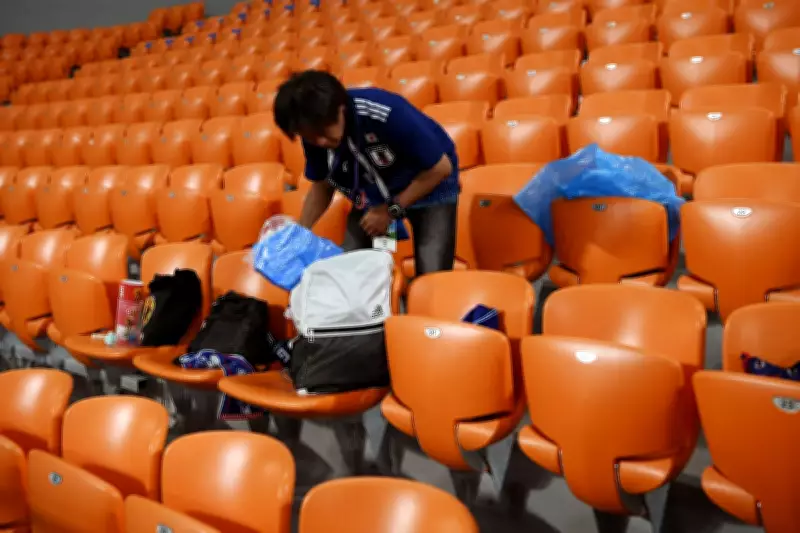
Japanese football fans have earned global admiration for their habit of cleaning stadiums after matches, a practice that began at their first World Cup in 1998 and continues to impress at tournaments worldwide. This tradition was notably observed at the 2022 World Cup in Qatar and is expected to continue when Japan plays in Arlington, Texas, and Monterrey, Mexico, during upcoming group games.
Cultural Roots of the Cleanup
The behavior stems from early education in Japan, where children are taught from elementary school to maintain cleanliness in all environments. Koichi Nakano, a professor at Sophia University, explained to The Associated Press that Japanese fans behave at world events much as they learned in school sports. The ethos is captured in the phrase "Tatsu tori ato wo nigosazu," meaning "A bird leaves nothing behind," or more simply, "Return it the way you found it."
Many Japanese elementary schools have no janitors; students clean their own classrooms and playgrounds. This practice continues into adulthood, with office workers tidying their workspaces. Additionally, Japan has few public waste bins, so people take their rubbish home, reducing costs and pests.

Socialization and Moral Education
Barbara Holthus, deputy director of the German Institute for Japanese Studies, noted that Japanese people are socialized differently. The concept of "meiwaku" discourages causing inconvenience to others, and leaving rubbish would be considered bothersome. In high-density areas like Tokyo, consideration for others is essential for coexistence. Holthus contrasted this with Western emphasis on individual rights, where public services are expected to clean up.
Jeff Kingston, a history professor at Temple University Japan, added that media praise has reinforced the behavior, turning it into a point of national pride. Fans now display these values proudly at events.
Beyond the World Cup
This tradition extends beyond the World Cup. At the 2018 World Cup in Russia, Japanese players cleaned their dressing room after a defeat and left a thank-you note in Russian. In 2022, fans wrote thanks in Arabic, English, and Japanese on rubbish bags. The practice was also seen at the Under-20 World Cup in Chile and after a friendly at Wembley, where Japan beat England 1-0. Toshi Yoshizawa, who led the cleanup in Chile, affirmed, "It’s one of our traditions. We grew up with the teaching that we should leave a place cleaner than when we arrived."
Football vs. Other Sports
William Kelly, an emeritus professor at Yale University, suggested this tradition is more pronounced in football, possibly linked to the J-League's establishment over 30 years ago. The league emphasized community embeddedness, making fans feel more part of the club and its stadium compared to baseball.
While some caution against idealizing Japan, the cleanup habit remains a powerful example of cultural values in action, fostering respect and consideration in public spaces.