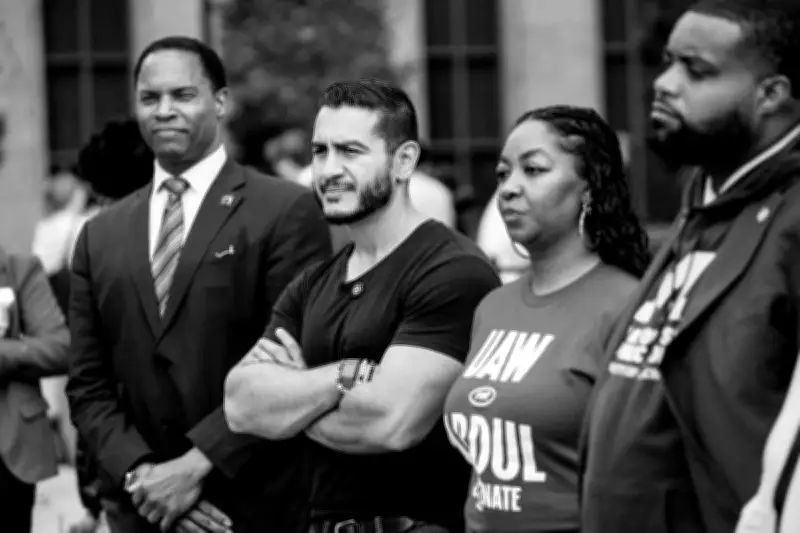
Abdul El-Sayed, the Democratic candidate for US Senate in Michigan, is running a campaign that deliberately avoids direct appeals to specific constituent groups, a strategy that may be costing him support among Black voters despite his progressive credentials and competitive poll numbers.
El-Sayed, a 41-year-old Rhodes scholar, former Columbia University epidemiology professor, and former executive director of the Detroit health department, has embraced a post-corporate uniform of fitted black T-shirt, slim jeans, and sneakers. His disciplined message, “Money Out of Politics, Money in Your Pocket, Medicare for All,” resonates with liberals, but his support is softer than overall Democratic sentiment, particularly among Black voters.
Polling gap and campaign response
A Washington Post-Schar School poll released last month found that 83% of likely Black voters wanted Democrats to control the Senate, yet only 67% backed El-Sayed. His campaign attributes some of this gap to a heavily financed onslaught of negative ads in the primaries and is trying to undo the harm.
El-Sayed’s approach is political universalism, focusing on common issues rather than the specific interests of groups under the Democratic tent. “Democratic politics too often tries to pander to folks on their differences rather than to bring us together across our similarities,” he said. “I want to campaign on those things that all of us need and deserve in our lives.”
Website omissions and rally turnout
His campaign website’s “Priorities” section does not mention minority groups or the words “racial” and “racism.” References are oblique: women and LGBTQ+ Michiganders are mentioned only in a healthcare freedoms section, and immigration is discussed without mentioning “Hispanics” or “Latinos,” despite a Detroit Metro Times report that most people arrested by federal immigration agents in Michigan were from Latin America. The site invokes the Flint water crisis without mentioning Black people or racism, instead promising a “federal water guarantee” of 50 gallons of clean water per person per day. The closest it gets to mentioning Black people is the acronym HBCUs in a list of education institutions.
At a rally on 3 October in Flint, a city of roughly 80,000 people, the majority of whom are Black, only about one in 10 of the 400 seats appeared filled by Black people. The stump speech stuck to the central platform without acknowledging constituent groups. When attenders asked questions, Michele Kelly, a 67-year-old grandmother and lifelong Flint resident, asked how to get “that demographic riled up and encouraged to come out.” She later said she was referring to Black people, and “if I hadn’t raised my hand, there wouldn’t have been no conversation about Blackness.” In his answer, El-Sayed referred to “those folk” and “people like that” without directly addressing Black people.
Outreach and high-profile surrogates
After winning the primary without winning the Black vote, his campaign issued a press release outlining legislation for Black communities, but it is buried on his site’s “News” section. The campaign said El-Sayed has made more than two dozen visits to Black churches and participated in upwards of 100 events with Black officials and leaders. At a private meet-and-greet in Flint, attorney Christopher Burtley, chair of the state’s Black leadership advisory council, said the overwhelming feeling toward El-Sayed is “unfamiliarity.” Phyllis Sykes, cohost, added, “People were on the fence. I don’t think he has really been plugged into the African American network.”
Former vice-president Kamala Harris campaigned with El-Sayed last month, and former president Barack Obama is scheduled to do so on 24 October, the first day of in-person early voting. Obama has a strong track record in Michigan, but El-Sayed has publicly criticized both Harris and Obama, including a HuffPost essay after Obama’s 2012 re-election: “Obama’s reelection last night was no victory. It was the rock we chose over the hard place.”
Islamophobia and polling concerns
El-Sayed, who is Muslim, would be the first Muslim in the US Senate. The Washington Post poll found four in 10 likely Michigan voters would not consider voting for a Muslim candidate for president, and his support among that group is six percentage points lower than for Jocelyn Benson, the Democratic gubernatorial candidate. When asked about an anti-Muslim Bradley effect, he said, “I’m worried about everything.” El-Sayed underperformed polling in the primary, which the New York Times noted showed him with a “commanding lead” but he “eked out a narrow victory.” He said, “I don’t trust polls; I trust what I’m seeing on the ground.”
His closing pitch is to operate as a single identity, betting on Michiganders’ willingness “to take a bet on a politics that is good for all of us.” It remains unclear whether an emerging blue wave and public strain over affordability will lift him to victory without more direct appeals, but not doing so is a large gamble on principle.