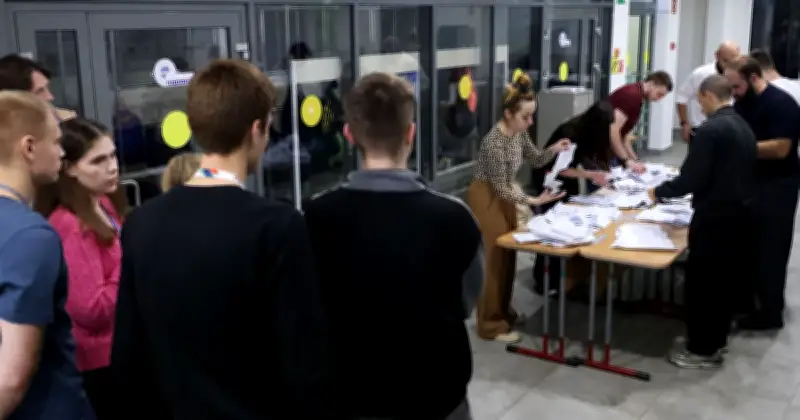
Early results from Russia's first wartime parliamentary election indicate that the main Kremlin party, United Russia, is dominating the vote. The results were released by the country's election commission early on Monday, after voting began on Friday for 111 million eligible voters and ended on Sunday.
Kremlin's Tight Control
The tightly controlled balloting was virtually devoid of opposition to President Vladimir Putin's policies. The balloting included residents of four Ukrainian regions which Moscow illegally annexed after the war began, but does not fully control. Also included are regions in Crimea, the Black Sea peninsula that was illegally annexed by Russia in 2014. Kyiv has denounced this move as illegal and the European Union described it as a “blatant violation of international law”.
Results and Seats
With 58% of the precincts counted, United Russia had nearly 58% of the vote for the 225 deputies apportioned by party lists, according to Russia's Central Election Commission. Another 225 members will be chosen in single-seat races and United Russia was poised to win most of those.

Showcase of Support
The Kremlin has sought the parliamentary election — the first since the start of the full-scale invasion of Ukraine in 2022 — to showcase popular support for the war and legitimize its action. It has also sought to avoid political risks by stamping out any dissent. A massive state media campaign and tight control over the election in the absence of genuine opposition all but assure the Kremlin will keep tight control of Russian politics amid mounting economic costs and increasing Ukrainian drone attacks deep inside the country.
Voters cast two separate ballots, filling half of the Duma's 450 seats by selecting political parties listed on the ballot. The rest are contested in single-seat constituencies, with voters choosing individual candidates. The early results showed four other parties that almost always vote for Kremlin initiatives returning to the State Duma.