

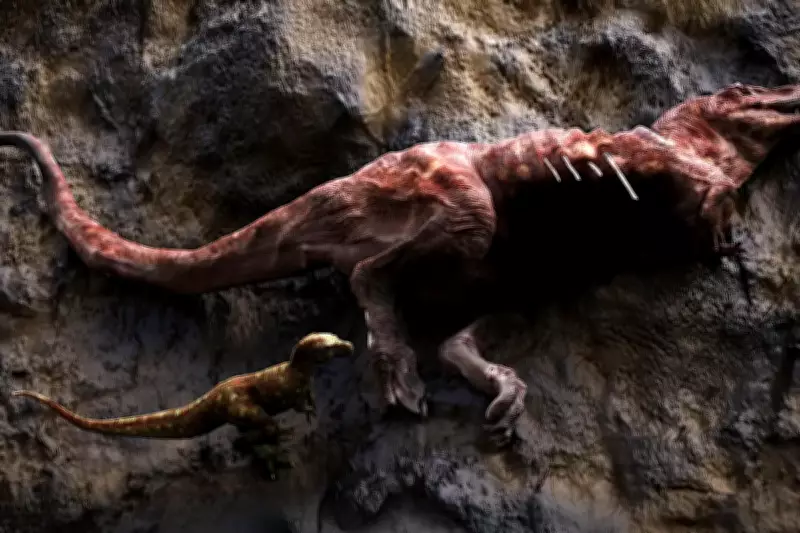
A groundbreaking fossil discovery has unveiled a darker side of the iconic tyrannosaurus, showing that these apex predators were not above scavenging on the remains of their larger relatives. Researchers at Aarhus University in Denmark have identified precise bite marks on a massive foot bone, indicating that a smaller tyrannosaur fed on the corpse of a larger relative approximately 75 million years ago.
Discovery Details
The study, published in the journal Evolving Earth, analyzed 16 distinct bite marks on a 10-centimeter-long fossil bone. The bone belonged to a tyrannosaur that likely reached 10-12 meters in height and weighed several tonnes. It was discovered by an amateur collector in the Judith River Formation in Montana, USA, an area renowned for preserving a rich record of a 75-million-year-old ecosystem.
Josephine Nielsen, a Master's student in geoscience at Aarhus University and lead author of the study, constructed a digital model of the fossil bone and analyzed a 3D-printed version. “By creating a digital version, I've been able to zoom in on very small details,” she said, adding that it was “far too risky” to send the real bone by mail to Denmark. “It has been like solving an ancient murder mystery.”

Bite Mark Analysis
Nielsen explained, “I have analysed the depth, angle, and placement of the marks in a virtual 3D environment and can document that these bite marks did not occur by chance. They are precise impressions from the teeth of a smaller tyrannosaur that fed on a larger relative.” There were no signs of healing on the bone, indicating that the bite marks were from late-stage carcass consumption. The study noted, “The small size and spacing of the marks indicate that they were produced by a small tyrannosaurid, most likely scavenging on the carcass of a significantly larger conspecific or closely related taxon.”
Implications for Tyrannosaur Behaviour
This discovery challenges the long-held belief that tyrannosaurs were exclusively powerful predators. The name “Tyrannosaurus,” meaning tyrant lizard, was coined in 1905 by American palaeontologist Henry Fairfield Osborn, reflecting the dinosaur's large size and role as an apex predator. However, the new findings reveal that tyrannosaurs also took advantage of opportunities to scavenge, sometimes on the carcasses of their larger relatives.
The bite marks were located on the foot, where there is very little meat, suggesting that the scavenger was “cleaning up” and eating the last remains of an old carcass. Nielsen noted, “Since the marks are located on the foot, where there’s very little meat, it suggests that the dinosaur was 'cleaning up' and eating the last remains of an old carcass.” This indicates that tyrannosaurs didn't let resources go to waste, consuming even tough bones with little decaying meat.
Modern Techniques in Palaeontology
The study highlights how modern techniques can reveal crucial information about dinosaur behaviour from even small traces preserved in fossils. By using digital modeling and 3D printing, researchers can analyze minute details that might otherwise be overlooked. This approach opens new avenues for understanding the complex behaviours of these ancient creatures.
The findings add a new layer to the story of tyrannosaurs, showing that these iconic dinosaurs were opportunistic feeders, capable of both hunting and scavenging. As Nielsen put it, “It has been like solving an ancient murder mystery.”






