

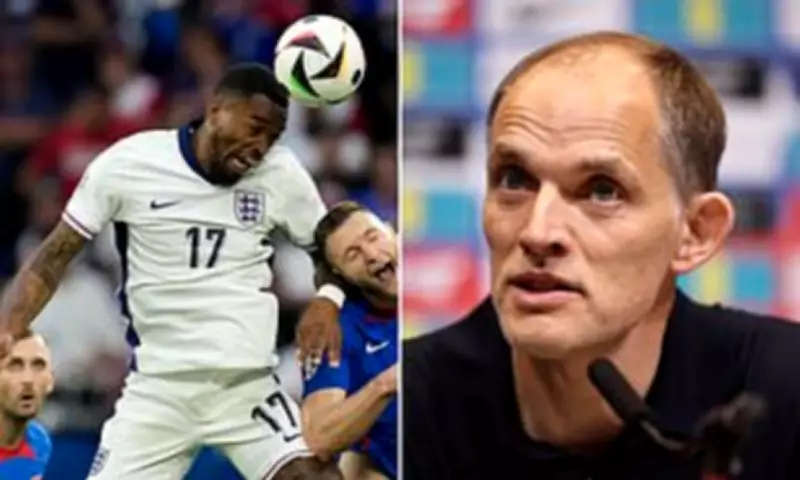
Thomas Tuchel has spoken about this being a World Cup of big moments, and now the first one has come and gone. This is not the World Cup squad many people would have expected or selected. A 26-man party without Trent Alexander-Arnold, Cole Palmer, and Phil Foden would have been unthinkable when England returned home from the European Championships as beaten finalists less than two years ago.
However, to those who have followed Tuchel's England through qualifying, this is a national coach adhering to patterns, beliefs, and benchmarks he established on his very first day in the role. Whether the football public agrees with him is an entirely different matter.
Culture. Behaviour. Set pieces. Steadfastness. Athleticism. This is Tuchel's version of England. He stated it would be this way when he sat before us for the first time at Wembley in the autumn of 2024, and this World Cup squad is the manifestation of that vision.

It is a group capable of progressing deep into the latter stages of this tournament—if not necessarily winning it—provided form and fitness are favourable. It is not a squad built to play expansive football simply because Tuchel does not envisage this World Cup being won in that manner.
No, this is an England selection pointing towards clean sheets, durability, and the ability to edge close games towards the end. If that sounds rather functional and even a little dull, then that may be how it has to be. Thomas Tuchel remained steadfast in his beliefs and benchmarks when naming his England World Cup squad.
Tuchel's Blueprint for Success
Tuchel's response to Ivan Toney's selection revealed much about his blueprint for World Cup success. Leaving Phil Foden and Cole Palmer at home shows this England team will be more about Premier League pace and power than European culture.
Discussing his decision to call up centre forward Ivan Toney, Tuchel said: 'We started talking more deeply about the team and began discussing different scenarios and what would be the most offensive lineup if we are 1-0 down with 15 minutes to play and in ten minutes plus extra time we need a goal. We are pushing. We are around the box. Balls are flying into the box. What are the scenarios? Would he be a player you would like the ball to fall to if there is a ricochet in the box? Yes. Absolutely. We try to build a strong set-piece squad. He can have his role there, defensively and offensively, and of course he is a world-class penalty taker.'
There, in a handful of paragraphs, is Tuchel's route map to World Cup success. Other approaches are available, of course. Jude Bellingham and Bukayo Saka demonstrated that with crucial goals against Slovakia and Switzerland in Germany two summers ago.
But the game-breakers are being left at home: Foden, Palmer. This England team will rely more on Premier League pace and power than European culture. It will require some very big performances from its spine to get anywhere near its goal. Jordan Pickford in goal, Declan Rice and Elliot Anderson ahead of the back four, and, of course, captain Harry Kane.
Demands on the Squad
This England squad will need very big performances from its spine to get near to its goal. Beyond that, Tuchel will ask for impacts. If they win their group—which is not a given with Croatia first up in Dallas—England's schedule will be onerous: four games in twelve days if England are to reach the last eight. England will not have faced questions like that at a summer tournament for a long time.
This plays to Tuchel's obsession with squad harmony once again, and it is understandable. His predecessor Gareth Southgate built that, and Tuchel would have been a fool not to cherish and seek to embellish it. Even so, why a squad with senior players mentioned above needs Dan Burn and Jordan Henderson to look after the atmosphere is baffling. When Tuchel said he has not chosen his best players, he was correct.
He sees this World Cup not as a festival but as a long, attritional war. If this selection proves to be wrong, bullets with his name on them will follow him home.






