

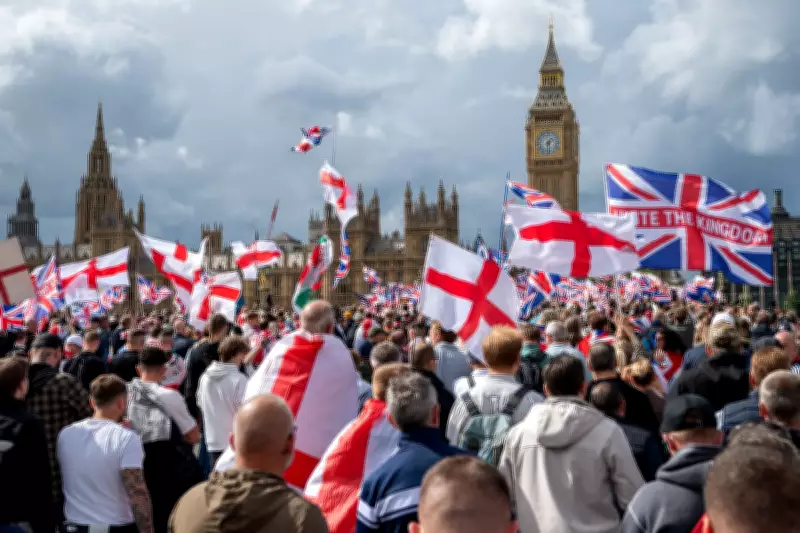
As the Unite the Kingdom march takes to the streets of London for a second time, Zoe Beaty examines the echoes of the racist National Front marches of the 1970s and why there has been hesitation to call it what it is.
Background of the March
In September last year, London's Trafalgar Square became a stage for Tommy Robinson. Crowds chanted 'Enough is enough' and 'Stop the invasion,' with St George's crosses draped over shoulders. Protesters claimed to protect 'free speech' and demanded deportation of 'illegals.' Elon Musk appeared on a video screen, warning of 'massive uncontrolled migration' and stating, 'Whether you choose violence or not, violence is coming to you.'
An estimated 110,000 to 150,000 people attended that march, with tens of thousands expected today. The exact number is almost irrelevant; the mobilisation of such a large crowd by an extreme group and the reframing of once-unacceptable rhetoric as 'controversial' is the real danger.

Historical Parallels
Placards denouncing 'illegals' could have been lifted from pro-fascist movements of nearly half a century ago. The National Front (NF) and the British Movement openly stirred racial hatred against immigrants and Black Britons. In August 1977, the NF tried to force through a multiracial community in south London in the 'Battle of Lewisham,' with placards reading 'Stop the muggers' as a euphemism for Black immigrants.
Attendees of Robinson's marches often claim they are 'not racist' but want Britain to be 'predominantly white.' Their rhetoric mirrors NF rallies, but now it is echoed by men in tweed, Silicon Valley billionaires, and serious politicians. French far-right politician Éric Zemmour addressed last year's rally, speaking of 'the great replacement,' similar to NF chair John Tyndall's 1974 warning of 'coloured immigration flooding our shores.'
Expert Analysis
Diane Abbott noted that Britain has seen anti-immigrant politics for generations, with the only differences now being a toxic social media ecosystem and US billionaires supporting successors of the Teddy Boys. Nick Lowles of Hope not Hate stated, 'We are in a far more dangerous position now than we were in the late 1970s,' with far-right groups increasingly confident and aggressive.
Abbott felt threatened at the September rally, where many railed against multiculturalism in an atmosphere hostile to those not born here or of another faith. The same happened at NF rallies in the 1970s and 1980s, but communities united to call it out as racism and defeated it.
Normalisation of Racism
One of the most frightening developments is that brazen, unapologetic racism increasingly goes unchallenged. Fifty years ago, the far right was loud but marginal. In 1999, the British National Party dropped its policy of compulsory repatriation as too extreme. Now, what would once be called racism is reframed as 'legitimate concerns.' The internet has played a huge role, with livestreams, algorithms, and Telegram channels spreading misinformation.
Shame has evaporated. Reform UK can propose deporting 600,000 people to war zones without backlash. Lowles warns, 'what was really extreme 20 years ago is now controversial at best, or simply accepted.' The idea that 'everyone is entitled to an opinion' shields racial hatred under 'free speech.'
Need for Action
In the 1970s, a vibrant counterculture of musicians, football fans, and trade unions powered anti-fascist movements. Today, years of austerity, Brexit divisions, and post-pandemic isolation have fragmented youth culture. Local press has been overtaken by the internet's chaos. Lowles says, 'People are beaten down. But the risk is if we don't do something, it will come back to haunt us.'
The lesson of the Battle of Lewisham is that fascism must be defeated again and again. Ordinary people fought for their right to live in a multicultural society against the National Front. Lowles adds, 'It's not somebody else's job. It's about us.'
Racists hiding behind Tommy Robinson and 'free speech' need to be called out. This is not a movement of 'common people.' Its logic is familiar: appeal to threatened people, claim a treacherous government favours those who 'look different,' and blame them for what you lack.

Decent, moderate, fair-minded people define the nation. Tommy Robinson and his agitators do not. Communities have risen to stop racism before and can do it again. This will continue only as long as we forget our own power to stop it.





