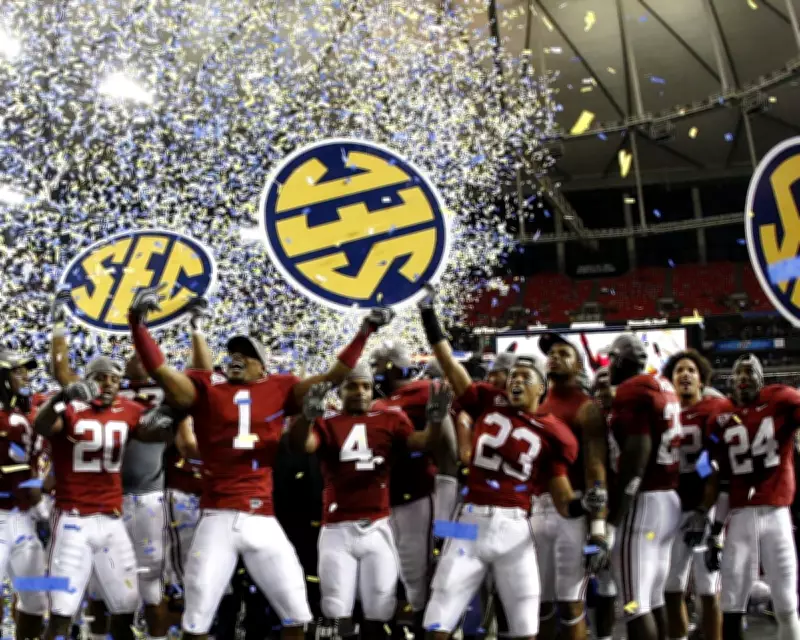
The National Association for the Advancement of Colored People (NAACP) has issued a call for Black athletes to boycott programs within the Southeastern Conference (SEC), widely regarded as the most dominant football conference in the United States. This appeal comes at a time when Black Americans face coordinated attacks on their rights from the highest levels of government, including the presidency, the Supreme Court, and legislative bodies at both state and federal levels.
A Comprehensive Assault on Black America
Six years after the nation underwent a so-called 'racial reckoning,' Black America finds itself under systematic assault. The president has, from his re-inauguration, openly espoused the belief that white people are the true victims of racial discrimination. Policies have been codified that frame the achievements of Black individuals as products of unfair diversity initiatives rather than merit. Additionally, the administration recently announced plans to allow 10,000 white South Africans entry into the US as an 'emergency response' to alleged anti-white discrimination, a move reported to cost taxpayers approximately $100 million.
The judicial branch has also dealt severe blows. The Supreme Court gutted the landmark Voting Rights Act of 1965, arguing that protecting Black voting rights is discriminatory rather than restorative. This decision ignores the countless Black Americans who were killed for attempting to vote, their graves marked and unmarked across the South.

Legislative efforts at both state and federal levels threaten to erase much of the Black political representation gained over the past six decades. Massive redistricting initiatives in Southern states mirror the segregationist laws passed in 1902, which quickly led to the separation of all public accommodations by race.
Corporate America Follows Suit
Corporations have moved in lockstep with government hostility, reducing or eliminating initiatives aimed at hiring Black professionals. From sports to retail, education to entertainment, anti-Black sentiment is as bold and aggressive as it has been in 75 years.
The NAACP Turns to Sports
In response, the NAACP has turned to sports, calling for Black athletes to boycott public universities in the SEC. This conference is not only the most powerful in college football but also the greatest incubator of Black athletic talent. The NAACP aims to leverage the cultural and economic significance of college football, particularly in the South, to mount a social and economic counterattack.
Black athletes represent a disproportionately influential segment of American culture. They are the most successful, visible, and impactful Black employees the country has ever produced. A sustained, coordinated movement of Black athletes against hostile states could have profound effects on both sports and politics.
Historical Precedent for Athlete Activism
Black athletes have successfully used their power before. In 2015, a University of Missouri protest led to the resignation of the school's president and system chancellor after Black football players threatened to boycott games. In the 1960s, the exodus of Black high school talent from the South forced Southern universities to integrate. History proves that boycotts work.
Today, Black college football and basketball players have more power than ever. Name, Image, and Likeness (NIL) deals allow them to be compensated, and the transfer portal provides freedom to change schools without sitting out a year.
Potential Impact of an SEC Boycott
A boycott of the SEC would immediately affect states like Florida (where Governor Ron DeSantis has led book bans on Black authors), Louisiana (origin of the Supreme Court case that weakened the Voting Rights Act), South Carolina, Alabama, Tennessee, and Texas, all of which are engaged in massive disenfranchisement of Black voters through redistricting. The NFL, whose workforce is roughly 70% Black, recently awarded Tennessee the 2030 Super Bowl.
Black players could flex their political muscle by making themselves available to northern, midwestern, and west coast powerhouses. NIL money combined with political conscience and strategy represents a powerful response. The NAACP’s target is the SEC, but the Atlantic Coast Conference (ACC) also has schools in Florida, Virginia, North Carolina, and South Carolina.

The Role of Sports Media
Sports media has largely muted the Black political voice, reducing athletes to neutered laborers who entertain predominantly white audiences. While the Trump presidency receives focus, the broader culture of compliance and racism remains intact. Sports media, responding to white audiences who want uncomplicated entertainment, has engaged in a simplistic con. Black faces appear on television, but they often lack depth and coverage of major national stories. ESPN’s response to the NAACP boycott was a wire story that disappeared within a day.
It is in the interest of rights holders to convince Black athletes that their only value is to play and be grateful. The NAACP is asking players and their parents to be interested in more than the bouncing ball.
A Call to Action
The NAACP action reminds Black athletes of their power if they choose to use it. They are inextricably linked to the future of Black America due to the economic profits they generate and their cultural cachet. As an economic bloc, they can shift the fortunes of the institutions they inhabit. There is plenty of money for sports in America; if Alabama or LSU can pay a wide receiver, so can Oregon, USC, or Michigan.
After a decade of activism in the 2010s, athletes have been largely silent since the Floyd protests in 2020. They did not mobilize after January 6, even though the insurrection was populated by the same political base that criticized their anthem protests. The players returned to playing, but anti-Blackness only intensified. Yet, they remain part of a Black athletic heritage that laid down its life for the comforts now being erased. A new generation is being asked to pay their share, to recognize that they have received and now must contribute.