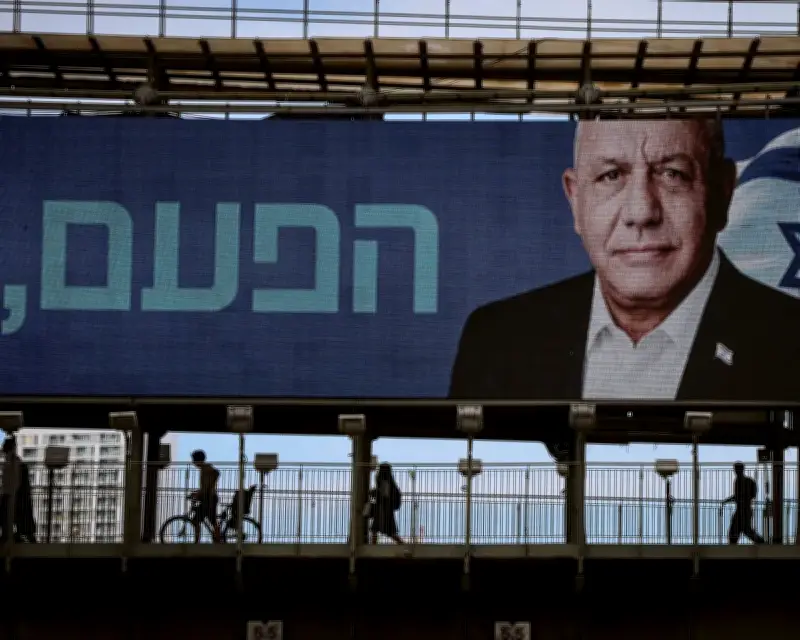
Gadi Eisenkot, a former general and the main opposition candidate in Israel's elections this month, has been described as everything Prime Minister Benjamin Netanyahu is not. He is unpolished where Netanyahu is slick, and his crumpled appearance contrasts with Netanyahu's controlled media image. In the words of Israeli commentator Anshel Pfeffer, Eisenkot is the anti-Bibi among a roster of wanna-Bibis.
Eisenkot only entered politics four years ago. His party is named Yashar, which means "straight" or "honest" in Hebrew. In an era of Israeli politics marked by betrayals and smears, his brand is rectitude. He is pushing for a full investigation of the intelligence failures that allowed Hamas's deadly 7 October 2023 attack.
Appeal and Background
For many voters, Eisenkot's appeal is less about ideology than his character. Dahlia Scheindlin, an Israeli pollster and political analyst, highlighted his "very modest background." While Netanyahu is the son of a Polish-born academic, Eisenkot's family were Mizrahi Jews from Morocco. He joined the army as an infantryman and rose through the ranks to become the Israeli military's chief of staff.
"The fact that he's from a working-class background, from a peripheral area, contributes to an overall sense that voters see in him somebody who is more with the people," Scheindlin said. "He's seen as empathetic. He's seen as straightforward." Mairav Zonszein, a senior analyst for the International Crisis Group, noted, "He's not sleek. He's not corrupt. I think he's going to be looking more inwards than outwards. Because he's a military guy, he's interested in calming the waters."
Policy Stances and Ambiguity
On domestic issues, Eisenkot supports ending the military draft exemption for the ultra-Orthodox, a long-standing source of friction. On the biggest issues, including a two-state solution that would create a Palestinian state, he remains ambiguous. "I've never said that the solution is two states for two peoples," Eisenkot said on the campaign trail. "There is a very deep religious-national conflict here, and anyone who thinks an agreement can be reached now is gravely mistaken."
He opposes the planned E1 settlement block in the West Bank, seen as a potential obstacle to a future Palestinian state, but supports settlement in general. He has said he would immediately "reverse" Netanyahu's decision to put far-right minister Bezalel Smotrich in charge of the occupied West Bank, and put the army back in charge.
Military Philosophy and Gaza
Eisenkot is not a dove on military force. As Israel's northern front commander during the 2006 second Lebanon war, he was the architect of the Dahiya doctrine, which promised "disproportionate power" against enemies. On Gaza, he has been a military realist, insisting two years ago that Israel was unlikely to win "total victory" over Hamas, and calling for a strategy prioritising the lives of hostages. His son Gal Meir Eisenkot, 25, died of wounds in late 2023 after an operation in Gaza.
Eisenkot criticised Netanyahu for saying Israel needs to become a "super-Sparta." Observers say an Eisenkot administration would likely crack down on settler violence, but question if it would go further. "I think that is the low-hanging fruit and about half of Israeli society feels it would be good to crack down more [on violent settlers]," said Scheindlin. Prof Yossi Mekelberg of Chatham House said, "He would not be a prime minister who is facing corruption allegations [like Netanyahu]. I see it potentially as a government of containment."
Shai Bazak, a former Israeli diplomat and adviser to Netanyahu, argued Eisenkot's main selling point may be that he will not take dramatic action. "After a very charismatic and dominant leader, people deliberately choose someone less charismatic because they simply want peace and quiet," he told Politico. "They do not want all the drama any more."