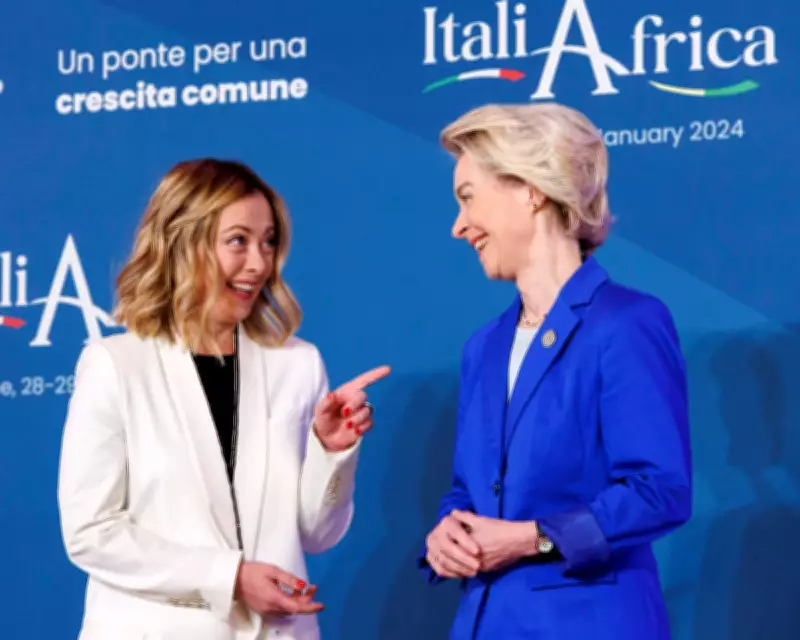
Italian Prime Minister Giorgia Meloni welcomed Ursula von der Leyen to an Italy-Africa summit in Rome in January 2024, a meeting aimed at stemming migration flows. This image, captured by Roberto Monaldo, underscores a broader trend: Viktor Orbán may have left the stage, but his prejudices are now baked into the European political mainstream.
The Normalisation of Fringe Narratives
For years, Viktor Orbán, with his anti-migrant and white Christian nationalist rhetoric, offered European counterparts the comforting fiction that racism in the EU was the preserve of a few unsavoury individuals. However, Shada Islam, a Brussels-based commentator, argues that this is far from the truth. Racism is not the work of one person; it is structural. Racial logic is woven into laws, political systems, economic structures, and social frameworks. It shapes access to jobs, housing, education, and justice, and informs policing practices, border controls, and foreign policy choices.
Structural Racism in Policy
Racialised biases are even being stamped into AI tools. A major scandal in the Netherlands arose when algorithms used to process childcare benefits wrongly flagged thousands of Dutch parents as fraudsters. This form of racial profiling disproportionately impacted ethnic minority or migrant heritage families, leading to severe debt, forced evictions, and wrongful prison terms. Many victims are still struggling to recover.

Divisive “us and them” narratives are consistently reinforced by political and media conversations that frame diversity as a challenge. Discrimination in Europe today is rooted in age-old anxieties. Racial hierarchies evident in EU migration policies—such as the different treatment of black and brown refugees compared with white Ukrainian counterparts—hark back to the “superior white race” arguments pervasive during European colonialism and the trade in enslaved people.
From Fringe to Mainstream
The fear that Europe’s population will be “replaced” by those from the global south is no longer confined to fringe conspiracy theorists. It is reflected in calls from German Chancellor Friedrich Merz for “very large-scale” deportations of “irregular” migrants. Danish Prime Minister Mette Frederiksen, often cited as a model for “progressive” migration control, insists on limiting “non-western” migration and frames Muslims as an existential threat, stating that sharia “must never, ever become Danish.”
Ursula von der Leyen’s migration policies have normalised deportations and deterrence through technocratic language of “risk management,” “burden sharing,” and “returns.” Underlying these actions is an unspoken moral panic that borrows from the “great replacement” conspiracy theory. A similar fear of demographic change inspires EU efforts to fortify borders and externalise migration control through cash-for-migration-control deals with Tunisia, Libya, and Mauritania.
Cloaked Exclusion
The difference is that while Orbán and his far-right allies openly champion whiteness, the EU’s politics of exclusion are cloaked in terms such as “social cohesion,” the defence of “European values,” and debates on the “integration” of European Muslims. Such framing enables and amplifies deeply prejudiced narratives regarding who “true” Europeans are and whose identity and belonging must be constantly questioned and challenged.
In foreign policy, von der Leyen has promoted “us and them” narratives. She praised Ukrainian women as “heroes” and “leaders” while remaining silent on the struggles and political agency of Palestinian women. Such choices dehumanise some groups while elevating others, making them appear more deserving of compassion.
Beyond Diversity Training
This is why diversity training, action plans, and even improved representation of minority groups, while important, are not enough. Orbán’s non-participation in EU policymaking will not create an anti-racist Europe, make the EU a better partner for Africa, more sympathetic to the plight of Palestinians, or more active in stopping the illegal US-Israeli war on Iran. Even without Orbán urging them on, EU leaders will keep reproducing racial hierarchy through border controls, policing, citizenship rules, and foreign policy.

Changing this dynamic is not easy. A deeper study of colonialism must be made part of our collective memory to ensure a shared reckoning of how Europe’s wealth, borders, and ideas of civilisation were built through empire and racial hierarchy. These truths need to be embedded in education systems and cultural institutions, not merely mentioned as footnotes in history books or explored in temporary exhibitions.
Acknowledging the Past
Hadja Lahbib, the European commissioner for equality and herself the child of Algerian migrants, recently acknowledged that racism “hides in habits, in assumptions, in systems we no longer question.” However, the EU institutions that she and António Costa, the EU Council president of Goan and Mozambican heritage, run are overwhelmingly Eurocentric and white.
Over many years as a reporter in Brussels, Shada Islam was told that the EU was colour blind. After 9/11, when she questioned the surge in Islamophobia across Europe, the response was that the EU did not “do religion.” In 2020, after the killing of George Floyd, senior EU officials insisted that unlike the US, the EU was not racist.
Today, questions on the EU’s legacy of colonialism and exploitation are brushed off as a distraction. Yet without acknowledging Europe’s past, we will not be able to safeguard and futureproof liberal democracy in the face of external dangers and the dangerous whims and hallucinations of other Orbáns and Trumps—and the mainstream politicians who amplify their message.