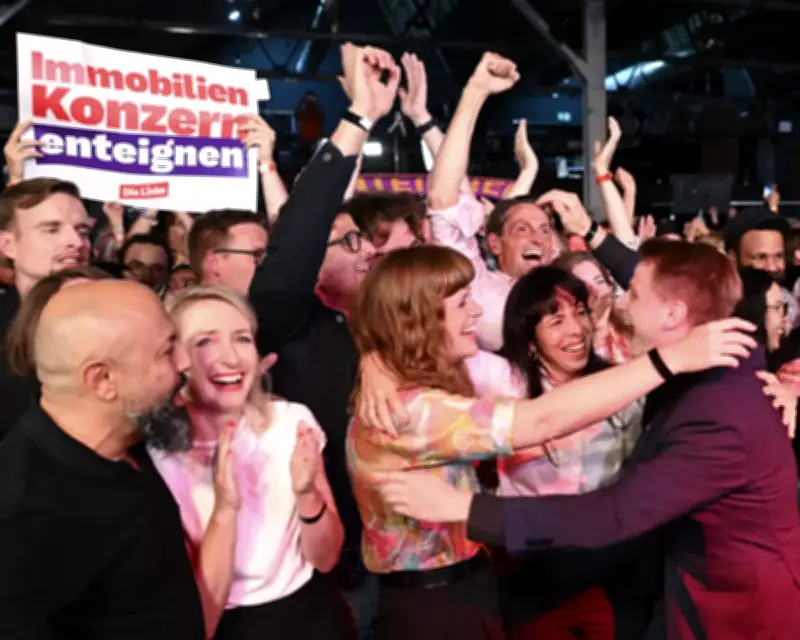
Germany's three regional elections this month have been widely reduced to a narrative of an embattled mainstream threatened by an emboldened far right, but a closer look reveals that voter dissatisfaction is also benefiting the left. In Berlin, the Left party (Die Linke) scored a stunning victory, gaining almost twice as many new votes as the far-right Alternative for Germany (AfD), which came in only third. Berlin will most likely now be governed by a Left-Greens-SPD coalition, headed by Elif Eralp, the daughter of Turkish political refugees.
Far-Right Gains Overshadowed by Left Success
The Saxony-Anhalt election on 6 September was a global news event, with international media speculating for months about an outright majority for the AfD. The party came close, setting a record score with 43.8%, but it has so far failed to form a government, despite the amenable position of the "left-conservative" Sahra Wagenknecht Alliance. Two weeks later, the AfD came in first again in Mecklenburg-Vorpommern with 38.2% of the vote, but international media interest was less pronounced, likely because the party was not close to reaching a majority.
The far-right success was overshadowed by the dramatic defeat for the Christian Democratic Union (CDU) of Chancellor Friedrich Merz. For the first time in the history of the Federal Republic of Germany, the party did not make it into a state parliament. The relatively modest loss of the governing Social Democratic Party (SPD) was barely discussed.
Leftwing Governments in Two of Three States
In Berlin, a clear majority of young women (54%) voted for the "far-left" party, representing a broader leftwing trend among young women that continues to be ignored by most media and politics representatives. Mecklenburg-Vorpommern, a state much more like Saxony-Anhalt than Berlin, will most likely also be governed by a Left-Left-Green government, a striking fact that has gone largely undiscussed.
Cas Mudde, the Stanley Wade Shelton UGAF professor of international affairs at the University of Georgia and author of The Far Right Today, argues that reducing the complexities of contemporary politics to an "embattled mainstream threatened by emboldened far right" narrative ignores significant developments, including transformations within major cities where multicultural electorates are moving left rather than right. This narrative also strengthens the far-right's populist portrayal of politics as a struggle between "the elite" and "the people."
Media Should Not Adopt 'Horseshoe' Theory
Some media have adopted the "horseshoe" theory of politics, used by Merz, in which the liberal-democratic mainstream is squeezed from both sides by the far right and far left. This conflates two very different challenges. While established parties are challenged by newer parties, particularly as younger voters vote less for the established right and left, this includes liberal democratic parties like the Greens. While the far right threatens liberal democracy, and the AfD even threatens democracy per se, the so-called far left rarely does. Most parties considered "far left" are former communist parties that have become significantly more moderate over time, presenting an ideology that reflects the social democracy of the 1970s.
Surveys continue to show evidence of what US political scientist Robert Dahl termed "a democratic paradox": very high support for the system of democracy combined with very high dissatisfaction with the state of real, existing democracy. By highlighting the complexities of contemporary politics, particularly the frustration of young women looking for liberal democratic alternatives, the far-right populist binary of "establishment versus far right" and the defeatist "end of democracy" narrative are weakened. This could give space to liberal democratic parties to mobilise and represent different groups of dissatisfied democrats.