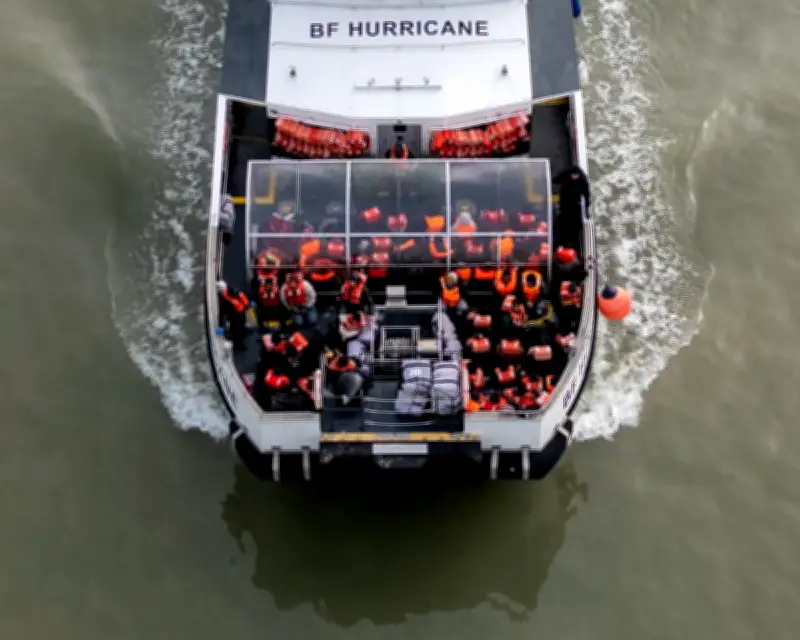
The UK government has quietly scrapped its "one in, one out" asylum deal with France, a partnership that lasted just 423 days and was supposed to eliminate small boat crossings by deterring asylum seekers from making the treacherous journey across the world's busiest shipping channel. The deal, beset with problems and with negligible impact, now joins a long list of policies that have tried and failed to address highly visible, often tragic small boat crossings.
Deal's Collapse and Its Impact
Earlier this month, the government ended the scheme, which was announced in a joint press conference between Keir Starmer and Emmanuel Macron in July last year. The policy was designed to render small boat crossings pointless: a person arriving in a small boat to the UK could be forcibly returned to France in exchange for another person who would be brought legally to the UK. In effect, asylum seekers were "used as reluctant human shields to protect our borders from others in the same predicament."
The scheme was always limited in scale; of the 40,000 people who arrived in small boats while it was active, just 1,500 – roughly 4% – were returned to France. A report by British Future, a thinktank that championed the policy, recognised that it would have to be expanded twenty-fold to close down routes as a viable way to claim asylum. But it's doubtful that, even at this far larger scale, it would have ever been effective. Nearly 50 asylum seekers deported under the scheme returned to the UK a second time, and an unknown number arrived undetected.
Humanitarian Concerns and Security Measures
The deal was partially founded on a recognition of the need for safer routes to claim asylum in Britain. Starmer acknowledged when announcing it that "it is right that we offer a haven to those in most dire need." But this flicker of humanitarianism was outweighed by the scheme's arbitrary cruelty. Nearly 100 children were misidentified as adults and wrongly detained under the scheme, while some asylum seekers deported back to France were beaten by people smugglers. "I've been writing about asylum seekers for 25 years and I've never seen as much suffering caused to refugees by a UK government policy," says Diane Taylor, a specialist reporter.
The deal was also accompanied by the government's fortification of security measures along the French border. To some extent, these security measures help to explain the drop in small boat crossings this year, together with an overall reduction in arrivals of asylum seekers to Europe. But they have also encouraged people to make even more unsafe crossings. The increased police presence in northern France has led to more trips in larger "mega-dinghies," as smugglers attempt to transport more people in single crossings. Increased security has also encouraged people to take longer routes across the channel, sailing from Normandy and Belgium rather than Calais.
Why Crossings Persist and What Comes Next
The right frames small boat crossings as a failure to control immigration. Crucially, though, they're a manifestation of ever-more draconian attempts to crack down on people trying to claim asylum in the UK. Before people crossed the channel in dinghies, they hid in lorries, or took flights to the UK using false passports. "When I first started reporting in Calais in 2014, it was still possible for refugees to stow themselves away on lorries without paying smugglers for access," recalls Daniel Trilling, author of If We Tolerate This. "But the more security that was placed around ports, the harder that became, and the more refugees had to rely on smugglers who could get access to secure lorry parks."
Part of the calculation behind the government's latest decision to double the number of riot police in northern France is that, now the deal has ended, it has limited time in which to strengthen its partnership with the French government. If Marine Le Pen is elected in April next year, it's plausible that her government could refuse to take any asylum seekers from Britain, further politicising the issue and causing a rise in crossings that would play into the hands of the far right here. Yet the decision is also yet another manifestation of the tendency to treat migration as a security issue rather than a reflection of an increasingly unstable world. "As long as we have wars, instability and persecution, people will be displaced, and we need to work out ways to respond to that, rather than pretending that a policy tweak here or extra security measure there will simply make it disappear," Daniel says. "At some point, you have to make a political argument for why asylum isn't just an act of generosity, but a necessary response to the world as it is."