

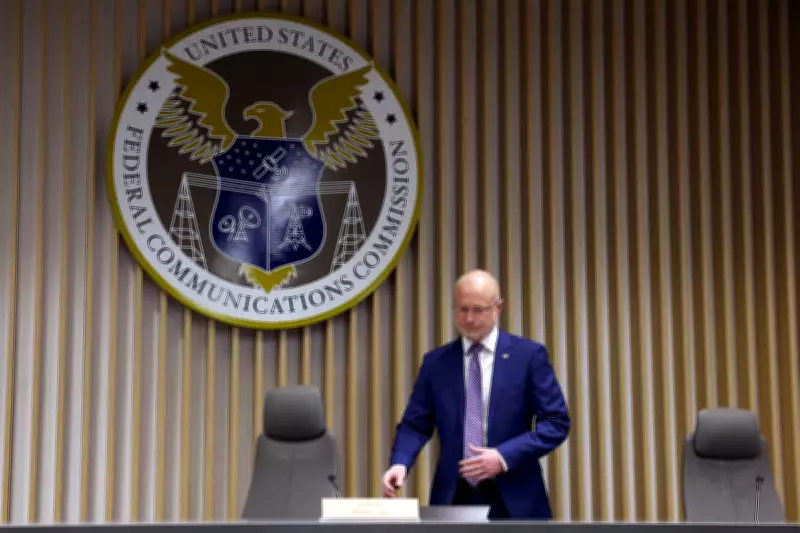
FCC Chair's License Threat Over Iran War Reporting Sparks Constitutional Outcry
Federal Communications Commission Chair Brendan Carr is confronting intense backlash following his public warning to broadcasters regarding their coverage of the Iran war, with prominent Democrats and free speech advocates denouncing the move as a severe threat to press freedoms.
Administration's Warning to Media Outlets
In a social media post on Saturday, Carr explicitly stated that broadcasters disseminating what he termed "hoaxes and news distortions" must "correct course" before their license renewals approach. He emphasized that the law mandates broadcasters operate in the public interest, with non-compliance risking license revocation.
"Broadcasters that are running hoaxes and news distortions — also known as the fake news — have a chance now to correct course before their license renewals come up," Carr wrote. "The law is clear. Broadcasters must operate in the public interest, and they will lose their licenses if they do not."

His statement included a screenshot of former President Donald Trump's Truth Social rant criticizing legacy media outlets for their reporting on the Iran conflict, which has now entered its third week. This warning represents the latest in a series of administrative threats against news organizations since Trump's return to the White House, following repeated presidential complaints about unfavorable coverage.
Democratic Lawmakers and Advocates Respond Forcefully
Several Democratic officials immediately challenged Carr's position. California Governor Gavin Newsom characterized the warning as "flagrantly unconstitutional," while Senator Mark Kelly labeled it an "overreach by the FCC." Representative Ted Lieu delivered a particularly blunt rebuke, telling Carr to "take your fascist s*** and shove it."
Lieu further warned on social media: "If you implement your flagrantly anti First Amendment actions, you will be sued and you will lose. And legal discovery will be awesome. Because the American people can then find out what the Administration keeps hiding."
Senator Chris Murphy accused the administration of effectively "telling news stations to provide favorable coverage of the war or their licenses will be pulled," describing the situation as "a truly extraordinary moment." He added: "We aren't on the verge of a totalitarian takeover. WE ARE IN THE MIDDLE OF IT. Act like it."
Free Speech Organizations Condemn 'Authoritarian' Stance
The Foundation for Individual Rights and Expression, a prominent free speech advocacy group, issued a strong statement asserting that Americans "demand uncensored news about the men and women serving in our armed forces." The organization condemned Carr's warning as "authoritarian" and "outrageous," arguing that "when the government demands the press become a state mouthpiece under the threat of punishment, something has gone very wrong."
Broader Context of FCC Enforcement Actions
This controversy emerges shortly after Carr confirmed that the FCC is investigating potential enforcement action against ABC's The View concerning the equal time rule, which requires broadcasters to provide equivalent airtime to competing political candidates upon request. Simultaneously, Carr criticized late-night host Stephen Colbert, who claimed CBS prevented him from airing an interview with a Democratic Senate candidate from Texas.
Carr clarified to Fox News host Laura Ingraham last month: "CBS was very clear that Colbert could run the interview that he wanted with that political candidate. They just said, 'you may have to comply with equal time,' which would have meant potentially giving air time to Jasmine Crockett and another candidate. But instead of doing that, they claimed that they were victims." The network later stated Colbert was not prohibited from running the interview but was advised it might trigger equal time requirements.

The escalating conflict between regulatory authorities and media organizations highlights deepening tensions over press freedom and governmental oversight during a period of international military engagement, with constitutional principles and broadcast licensing hanging in the balance.





