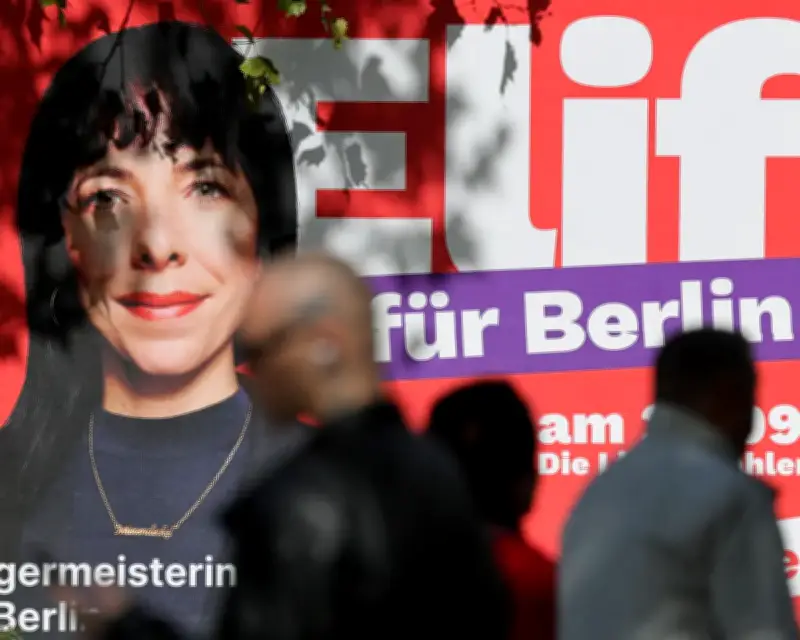
Die Linke won Berlin’s state election last Sunday with 25.7%, becoming the strongest party in the city for the first time. The result came after a campaign centred on the housing crisis, with lead candidate Elif Eralp promising lower rents and more public housing. Eralp could become Berlin’s first mayor from the left since Germany’s reunification in 1990, and the city’s first mayor ever with a migration background.
Housing at the heart of the campaign
Eralp, the 45-year-old daughter of Turkish socialists who fled following the military coup in Turkey in 1980, put housing at the centre of her campaign. For weeks, Berlin was flooded with giant portraits of her wearing a nameplate necklace with the word Mietendeckel (rent freeze). Her programme was clear from the start: lower rents, more public housing, and the implementation of Berlin’s 2021 referendum in which a majority voted for more public ownership of housing.
The housing crisis is urgent in Berlin, where 85% of residents live in rented accommodation. Rents have risen by almost 70% in the past 10 years, despite a rent control law in effect since 2015. Loopholes and illegal practices have allowed property owners to keep pressure on the housing market, affecting not just low-earners and single-parent households but vast parts of the middle class.
A historic turning point in Germany
The Berlin result came on the same day as a state election in Mecklenburg-Western Pomerania, where the far-right Alternative für Deutschland (AfD) emerged as the largest party with 38%. Two weeks earlier, the AfD had secured victory in Saxony-Anhalt with almost 44%. While centrist parties have tried to mimic the AfD’s ideas and rhetoric on migration, Die Linke set an example by listening to people’s worries and working on ideas to improve their lives sustainably, instead of scapegoating.
Coalition negotiations and challenges
Winning an election is one thing, but governing is another. Die Linke lacks a majority to run the state on its own. Eralp must negotiate with other parties, particularly the Social Democrats (SPD) and the Greens. Berlin’s Greens have spoken in favour of a progressive coalition, but the SPD is deeply divided.
Die Linke’s top priority is a radical ambition: the compulsory purchase of housing portfolios exceeding 3,000 apartments held by large private real estate companies, and their transfer into a democratically controlled non-profit public body. The SPD’s approach is to regulate the housing market more strongly, expand public housing, and potentially introduce a rent cap.
Die Linke enters negotiations under a microscope. Political opponents question whether the party’s positions are compatible with democratic values, and controversies surrounding antisemitism and parts of the party’s political culture have become a major subject of public debate. Antisemitism is a problem inherent in German society, one that also exists within Die Linke and should be combated more decisively. However, the uproar about antisemitic rappers and an organised crime member spotted at Die Linke’s election party seem like sham debates that overshadow actual conflicts of interest.
Christian Democratic Union (CDU) chancellor Friedrich Merz has stated that a federal law could be passed to prevent the expropriation of privately owned housing. Markus Söder, leader of Bavaria, announced financial consequences for Berlin if the “extremist”, “antidemocratic” and “antisemitic” Die Linke were to govern the capital. No such measures were announced for potential AfD-governed states.
More and more Social Democrats are also putting pressure on their party not to form a coalition with Die Linke. Eralp now has to do something harder than naming a problem: she has to find coalition partners and compromise, without making her voters feel betrayed.