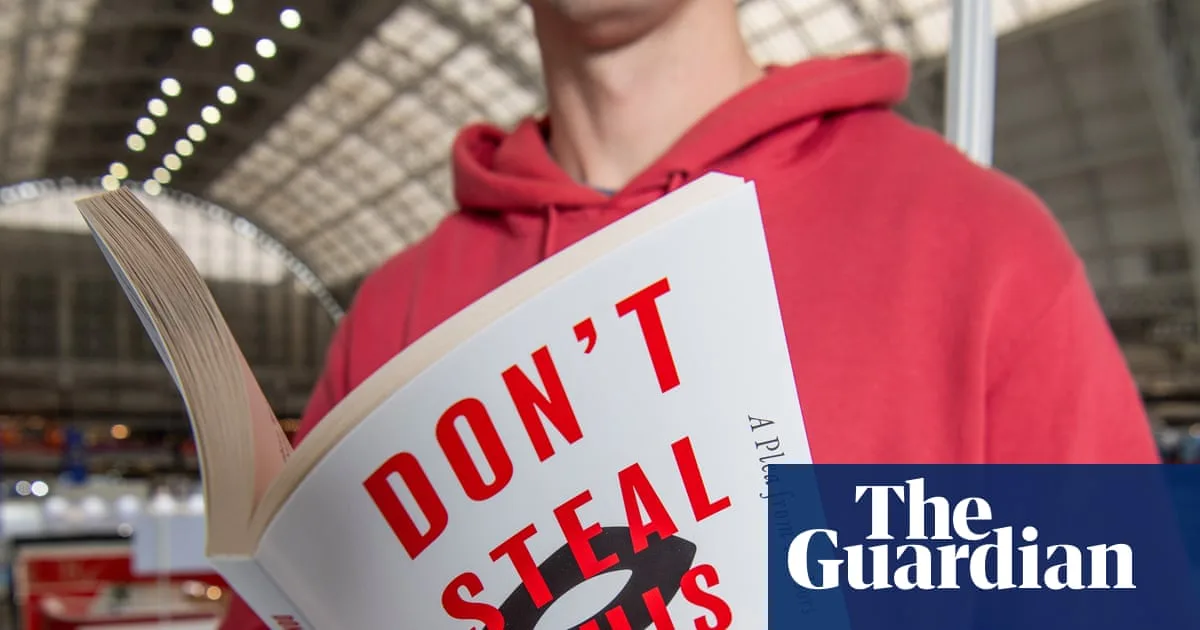
In a striking display of resistance, authors are voicing their fury over the theft of their work by artificial intelligence companies, employing 'Human Authored' logos and distributing empty books to make their point. This protest unfolded at the London Book Fair, where the Society of Authors introduced a labelling scheme described as a crucial temporary measure to safeguard and promote human creativity amidst the rising tide of AI-generated content in the marketplace.
Blank Books and Bold Statements
Visitors to the fair received copies of an anthology titled 'Don't Steal This Book', featuring contributions from approximately 10,000 writers, including Nobel laureate Kazuo Ishiguro, Malorie Blackman, Jeanette Winterson, and Richard Osman. The pages of this book are entirely blank, with the back cover delivering a powerful message: 'The UK government must not legalise book theft to benefit AI companies.' This symbolic act underscores a growing consensus among writers that they have reached their limit with unauthorized use of their intellectual property.
Government Proposals Spark Outrage
The timing of the fair is particularly significant, as it precedes a government progress report on AI and copyright, due next week. Last year, proposals to relax existing copyright laws ignited widespread anger. Novelist Philippa Gregory likened the suggested 'opt-out' policy, which requires writers to actively refuse permission for their work to be scraped by AI, to placing a sign on one's front door asking burglars to move along. This analogy highlights the perceived inadequacy of such measures in protecting creators' rights.
According to a University of Cambridge study from last autumn, nearly 60% of published authors believe their work has been used to train large language models without their consent or any form of reimbursement. Furthermore, almost 40% reported a decline in their income due to generative AI or machine-made novels, evoking comparisons to Orwell's Versificator from 'Nineteen Eighty-Four'. This digital threat is reshaping the literary landscape, with factual books appearing most vulnerable to tools like ChatGPT.
Nonfiction Sales and Human Stories
While fiction sales are on the rise, largely driven by the popularity of romantasy novels, nonfiction sales dropped by 6% last year compared to 2024, marking the lowest point since 2014. However, three nonfiction books by women defied this trend: 'Nobody's Girl' by Virginia Giuffre, a posthumous memoir of abuse by Jeffrey Epstein; 'A Hymn to Life' by Gisèle Pelicot, detailing her ordeal with an ex-husband; and 'Careless People' by Sarah Wynn-Williams, an exposé of working at Facebook. The success of these first-person testimonies demonstrates the enduring power of authentic human narratives beyond the publishing world, emphasizing the need for readers to trust in the genuineness of these voices.
Call for Legislative Action
Author Sarah Hall recently requested that her publisher, Faber, imprint a 'Human Written' stamp on her latest novel, 'Helm'. She remarked, 'AI might mimic the words more rapidly, but ... it hasn't bled on the page. And it doesn't have a family to support.' This sentiment echoes broader concerns that writers' livelihoods are being jeopardized in the name of economic growth. The UK's creative industries contributed £124 billion to the economy in 2023, with publishing alone accounting for £11 billion. The Society of Authors is advocating for consent and fair payment for the use of work, along with transparency regarding how a book was produced. These demands are not radical but are increasingly essential in an era plagued by fake news and AI-generated slop.
Two Possible Futures
A House of Lords report released last week outlines two potential scenarios for the UK: one where it becomes a global leader in responsible, legalized AI development, and another where it drifts toward tacit acceptance of large-scale, unlicensed use of creative content. The former protects UK artists, while the latter primarily benefits global tech corporations. To prevent a future dominated by hollow, AI-produced material, the choice is evident. Writers require more than temporary fixes; they need robust legislation to secure their rights and sustain the integrity of human creativity.






