

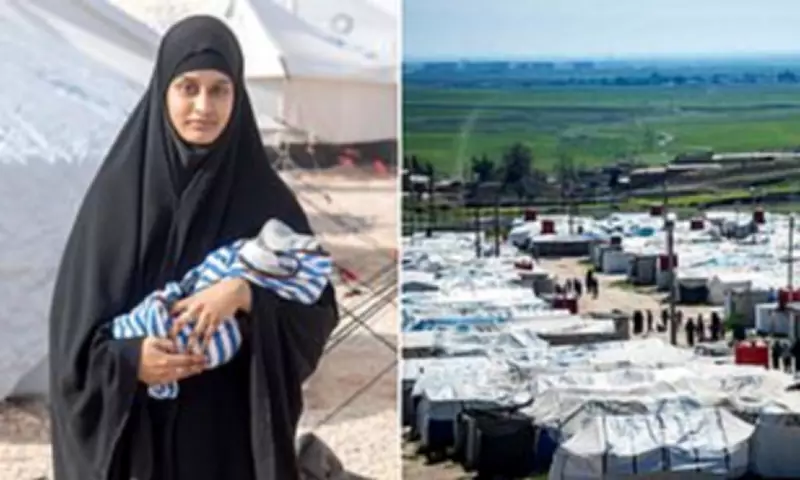
British families linked to the so-called Islamic State could be allowed back into the UK from Syrian detention camps, according to the independent reviewer of terrorism legislation. Jonathan Hall KC, the Government's independent reviewer of terrorism legislation, stated that the fall of Syria's former regime and the arrival of a new government have opened up 'further possibilities' for British nationals still held in camps in the country's north-east.
Potential Returns Due to Regime Change
Speaking to BBC Radio 4's Today programme, Hall warned that if the new Syrian authorities no longer wish to guard thousands of women and children linked to ISIS, British nationals could end up returning to the UK because 'that's their right'. It is understood there are British men, women, and children still being held in the camps, alongside people stripped of their citizenship and children born to former British nationals.
Hall said: 'With the change of regime, which the government recognises, and the possibility that the regime says, 'we don't want to carry on guarding these women and children for a long time', I suppose it opens up further possibilities. Either people will be able to get out of the camps more easily, and if they're Brits, they can come back to the UK, that's their right. Or potentially, it even opens up the route to deportation or removal between two states, between the new Syrian regime and the UK.'

Australian Repatriation Sets Precedent
His comments came after four IS-linked women and nine children were flown back to Australia on Thursday from the detention camps in north-east Syria. The women and children had been held in the same camp as Shamima Begum, who travelled from Bethnal Green in east London to ISIS-controlled territory in 2015 at the age of 15 before being 'married off' to an ISIS fighter. Begum was stripped of her British citizenship in February 2019.
Hall said the Australian repatriation 'doesn't change things fundamentally, but it gives it a nudge'. The leading lawyer also admitted it 'hasn't been comfortable' that children born to British or formerly British women have remained trapped in the camps for years, despite concerns over the potential security risk of allowing some of them back into Britain.
Security Risks and Prosecution Challenges
Hall acknowledged that there are 'decent arguments' for some of the women who came out when they were very young. Regarding children born in the camps, he said: 'My view has long been that, even though I think have to accept there will be a degree of risk by some of the children coming back, particularly in their late teens, having been brought up in a heavily Islamic State-dominated area, they were complete innocents.'
However, Hall noted that prosecuting anyone for crimes committed overseas will be difficult. He said: 'I think one of the problems is that I don't think anyone could, hand on heart, say to the Prime Minister: 'All of these people will be taken into custody for five years, where they will be assessed and released only after a strict process of assessment and de-radicalisation'. That won't happen, because in many cases, there just won't be the evidence. And even if there is intelligence or some evidence, the rules of evidence that apply in the UK and the rules that we have about criminal liability mean that it's actually very difficult in practice to prosecute people for doing things a long way away. So there's no guarantee they will come into custody, and that does mean that there will be a degree of risk.'
He added that the UK has 'a lot of quite powerful and effective ways of managing risk' and that it 'should be able to absorb the risk'. 'No-one in the sort of security world would thank me for saying that, because the last thing they want to do is to have any person who might present a risk who they've got to keep eyes on,' he said.

Human Rights Perspective
Maya Foa, director of the human rights group Reprieve – which works with families and lawyers of Britons and others detained in north-east Syria – described the Australian repatriation as a 'really significant development'. Speaking to the Today programme, she said: 'What it shows is that the new Syrian government doesn't want to have to maintain these camps forever. They don't want to be responsible for tens of thousands of women and children, and we must remember, the majority of people in the camps are children – lots of them, of course, foreign children. The Syrian government doesn't want to hold these camps indefinitely. And why would they, really? So what I think we can derive from that is that governments who have nationals or people they have stripped of citizenship who were previously nationals in the camps need to rethink how they're approaching this problem.'
Foa added that the women and children have been 'held indefinitely for some of them nearing 10 years, nearly a decade, without any kind of trial, any kind of due process'. She concluded: 'It's already outrageous that they've been left so long.'





