
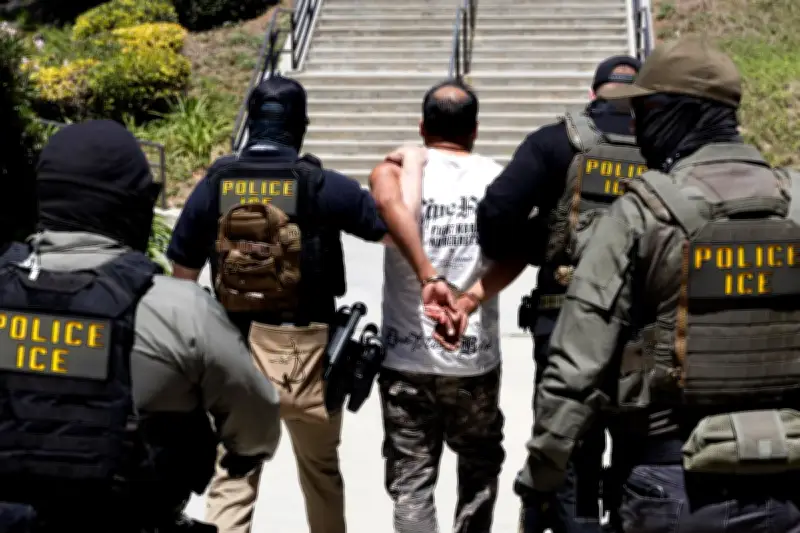
After federal agents fatally shot US citizen protesters Alex Pretti and Renee Good in Minneapolis in January during the nation's largest immigration-enforcement operation ever, the second Trump administration pivoted from mass raids to a quieter but no less aggressive crackdown. Today, arrests and deportations are at record levels, with federal agents detaining people in homes, cars and airports rather than on city streets.
From street theatrics to quiet enforcement
In his second term, Donald Trump sparked outrage with federal immigration officers descending en masse on Democratic-run cities including Los Angeles, Chicago, Charlotte, New Orleans and Minneapolis. Lines of masked and armored officers conducted street arrests, ambushed day workers in Home Depot car parks, and swept through neighborhoods. Adults and children were detained, and protests met with chemical spray, teargas, fists and batons.
The killings in Minneapolis marked a turning point. Public opinion broadly turned against the violence, and a change of personnel followed. The administration flagged a switch to a "quieter" approach to immigration enforcement, but less visible enforcement is no less aggressive on the ground today and continues to ramp up in multiple ways.
Key dates in the ICE pivot
On 26 January, two days after Pretti was killed by Customs and Border Protection (CBP) officers and 19 days after Good was shot dead by an ICE agent, the president announced that "border czar" Tom Homan would deploy to Minnesota, while Gregory Bovino, the border patrol's confrontational commander-at-large, stood aside.
On 5 March, Kristi Noem became the first cabinet secretary fired during the second Trump administration, losing her role at the Department of Homeland Security (DHS). She was tainted by scandals over her relationship with senior adviser Cory Lewandowski and a $220m advertising campaign, and had repeated a false narrative that Pretti "brandished" a gun at federal agents. Weeks later, Bovino retired, telling the New York Times: "I wish I'd caught even more illegal aliens."
On 24 March, Markwayne Mullin, formerly a first-term senator from Oklahoma with "mixed martial arts fighter" on his résumé, was confirmed as the new DHS secretary. At his confirmation hearing, he said of immigration-enforcement officials: "My goal in six months is that we're not in the lead story every single day."
Local police and court pressure
In the spring, the DHS "supercharged" efforts to work with local and state law enforcement via so-called 287(g) agreements. From January 2025, these deals mushroomed from 142 to 2,315, deputizing local and state officials to enforce immigration laws during regular police work. By spring, this collaboration acted as a force multiplier for arrests while allowing federal agents to avoid the spotlight.
In May, attorneys and researchers noticed immigration court dates being scheduled for unusually large groups of people with little notice, a tactic to increase deportation orders without individualized hearings. These mass court dates ballooned in June, affecting many thousands of people, with children a particular target.
On 9 June, after the longest DHS shutdown ever, congressional Republicans used a partisan process to provide the department with an additional $70bn, funding it for the rest of Trump's second term. The DHS has received roughly a quarter of a trillion dollars in funding since Trump retook the White House.
Supreme court and record arrests
On 25 June, the US supreme court ruled in favor of the administration's bid to strip temporary protected status (TPS) from hundreds of thousands of Haitians and Syrians. When Trump took office, 17 countries had active TPS designations covering roughly 1.3 million people. Under his second administration, more than a million people have already lost their TPS permissions, facing deportation to countries as dangerous as Afghanistan, Haiti and South Sudan. "We're going after them right now," Mullin said of Haitians. "These individuals can either self-deport or we'll arrest you and send you back. It's that simple."
In the summer, ICE significantly increased collaboration with the Transportation Security Administration (TSA) to detain immigrants with expired visas at airports. In July, the DHS reported 49,571 immigration arrests, a new monthly record, with a majority having no criminal history. About 66,000 people were in custody by the end of the month. On 13 July, an ICE officer killed Joan Sebastián Durán Guerrero, 26, in Biddeford, Maine, making him the 11th person fatally shot by federal immigration officials during Trump's second term. The DHS briefly paused most ICE traffic stops until Trump intervened, posting online: "We CANNOT give up one of I.C.E.'s most important and effective Crime Fighting tools, THE TRAFFIC STOP!"
In August, federal officials reached 1,000 new 287(g) agreements since 26 January, and all visas for people applying to immigrate to the US were paused while officials undergo training around new "public charge" policies. On 1 September, Mullin retroactively announced Operation Rotten Apple, which from 27 July to 29 August quietly rounded up nearly 2,200 immigrants across New York state.
On 1 August, the federal government ended its contract providing more than 20,000 unaccompanied immigrant children with legal representation. In September, the Guardian revealed that Stephen Miller, White House deputy chief of staff, had been leading a drive to accelerate the removal of undocumented immigrant children, using tactics critics say are cruel and racist.
Taken together, these policy changes are less showy but have ramped up arrests, detentions and deportations, putting millions more at immediate risk. Many of these people have legal status or ongoing cases, but are being rounded up with little access to due process. This latest iteration of Trump's mass deportation campaign is no longer defined by federal agents patrolling cities with smoke canisters in hand; it's more insidious but also more ruthless and effective – and it's happening everywhere.




