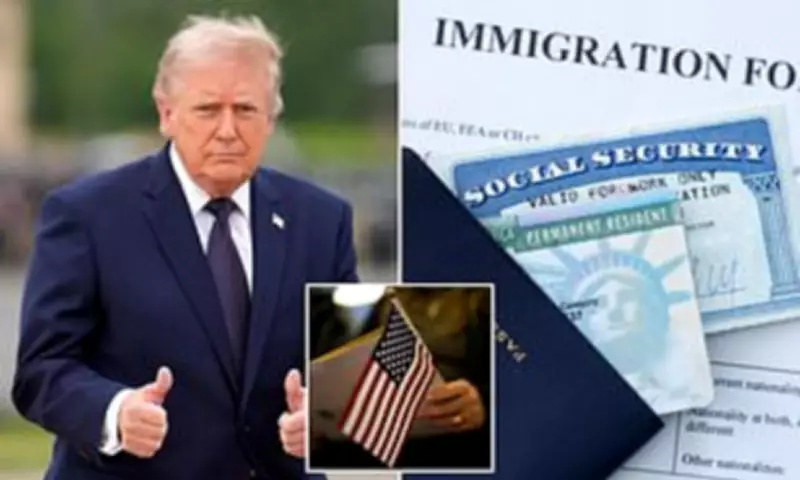
The Trump administration has announced that foreign Green Card applicants will be forced to 'self-deport' while their applications are processed. The dramatic change means that those looking to obtain lawful permanent residency—such as people here on visas and work permits or through marriage—can no longer do so from inside the United States. Around 1.2 million legal immigrants are thought to be affected by the shift.
New Policy Details
Only those who can prove they have 'extraordinary circumstances' will be exempt from the new system, it was revealed Friday. The memo from US Citizenship and Immigration Services (USCIS) announced that applicants would be required to go through consular processing outside of the United States.
'This policy allows our immigration system to function as the law intended instead of incentivizing loopholes,' Zach Kahler, a USCIS spokesperson, declared in a statement to the Wall Street Journal. 'When aliens apply from their home country, it reduces the need to find and remove those who decide to slip into the shadows and remain in the US illegally after being denied residency.'

The change is expected to have a drastic effect on hopeful residents, including students, spouses of US citizens, and foreign workers on the path to permanent residency, as the process can be costly and take months or years to complete.
Impact on Nonimmigrants
'Nonimmigrants, like students, temporary workers, or people on tourist visas, come to the US for a short time and for a specific purpose,' the memo said. 'Our system is designed for them to leave when their visit is over. Their visit should not function as the first step in the Green Card process.'
Sarah Pierce, a former policy analyst at Citizenship and Immigration Services, told the New York Times: 'Our consular processing system through which they would have to apply is already overburdened. So that means we could have families separated for months or years.'
Extraordinary Circumstances and Parole
It remains unclear what exactly would meet the criteria for 'extraordinary circumstances.' The memo continued: 'Aliens may be paroled into the United States "temporarily" on a case-by-case basis for "urgent humanitarian reasons or significant public benefit." Paroled aliens, "when the purposes of such parole shall, in the opinion of the Secretary of Homeland Security, have been served" are expected to depart the United States or return to the custody of DHS. Such aliens are generally expected to pursue an immigrant visa and admission from outside the United States if they wish to reside permanently in this country.'
The new policy marks Trump's latest attempt to restrict immigration, as the administration is also aiming to impose another policy allowing officers to deny applicants who may, one day, use welfare. The public charge rule would see any applicant that, in the opinion of the immigration officer, lacks assets or education and may benefit from welfare in the future be denied.
Broader Immigration Restrictions
Officers have also been pushed to weaponize applicants' social media should it feature 'anti-American' values, which include anti-Israel views, the Journal reported. The administration also imposed a $100,000 fee on H-1B visa applications as well as a weighted lottery system that makes qualifying incredibly difficult, particularly for college graduates with little experience.
Those denied permanent residency status abroad will also have no legal grounds to appeal the decision, the Journal reported.
Doug Rand, a former senior advisor at USCIS, told the Associated Press: 'The goal of this policy is very explicit. Senior officials in this administration have said over and over that they want fewer people to get permanent residency because permanent residency is a path to citizenship and they want to block that path for as many people as possible.'
Uncertainty and Concerns
Much of the memo gave little information on when the policy would come into effect, whether applicants would be required to remain out of the country for the entire process, or whether the policy impacts ongoing applications. The agency told the outlet that applicants who provide 'economic benefit' or 'national interest' would likely be able to stay in the country, and others would be forced to apply abroad.

World Relief, a humanitarian and refugee resettlement organization, said: 'If families are told that the non-citizen family member must return to his or her country of origin to process their immigrant visa, but immigrant visas are not being processed there, it’s a Catch-22. These policies will effectively create an indefinite separation of families.'
Immigration lawyers have said the memo sent many of their clients and offices into a panic, given the lack of information.
'USCIS is trying to upend decades of processing of adjustment of status,' Shev Dalal-Dheini, senior director of government relations at the American Immigration Lawyers Association, said. 'This applies very broadly to anyone seeking a green card.'
Lawyers pointed out current issues worldwide that have sparked fears, such as those who cannot return home over safety concerns or whose home country does not have an embassy for them to apply at. The US Embassy in Afghanistan, as one example, has been closed since the US troop withdrawal in August 2021.
Jessie De Haven, a senior staff attorney with the California Immigration Project, said: 'It's really hard to tell how this is going to be applied. I do think it might have a chilling effect on people applying.'
In 2024, 1.4 million green cards were granted, and more than 820,000 were approved for people inside the country through 'adjustment of status,' according to data from the Department of Homeland Security. The Daily Mail reached out to the USCIS and the White House for comment.