

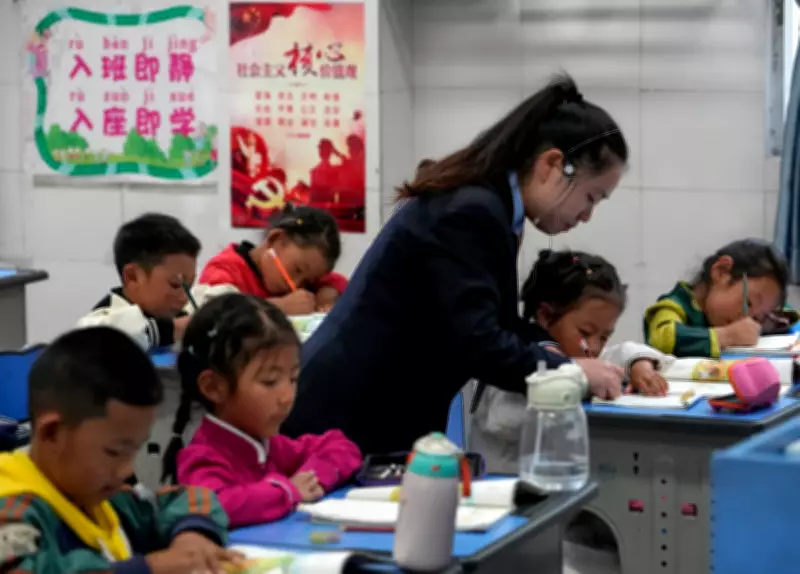
Since 2021, the Chinese government has mandated that Mandarin be the sole language of instruction in all Tibetan preschools, a policy that critics say is systematically eroding the Tibetan language and culture from early childhood. According to a new report by Human Rights Watch (HRW), this requirement is part of a broader effort to forcibly assimilate Tibetans, beginning with the youngest generation.
One mother recounted that after just weeks in a Mandarin-only preschool, her five-year-old daughter had completely stopped speaking Tibetan. Nine months later, the child could still understand Tibetan but would only respond in Mandarin, occasionally offering single-word answers in Tibetan. The girl now insists she is Chinese, not Tibetan, repeating what she is taught at school. Researchers say this case reflects a widespread pattern across Tibet, which has been under Chinese control since 1950.
HRW researcher Maya Wang stated that children are being indoctrinated to identify with the Chinese Communist Party and the People's Liberation Army (PLA), viewing themselves as part of the Chinese nation. Recent videos from Tibet show young children unable to pronounce their own names in Tibetan, instead using Chinese pronunciations. This breaks the link between children and their language, culture, and families, according to Lhadon Tethong of the Tibet Action Institute.

Tenzin Rabga Tashi of Free Tibet described the policy as a machine that pulls out toddlers' mother tongues, engineering language loss before children can understand what is being taken. The 2021 Ministry of Education directive requires Mandarin to take precedence over minority languages like Tibetan, Uyghur, and Mongolian in all schools. Kindergartens are also urged to pressure families to speak Mandarin at home, with Mandarin promoted as civilized and Tibetan implied as inferior.
Parents and elders strive to teach Tibetan before children start school, but fear that Mandarin-medium preschools will eradicate their language. Some have organized holiday language classes, but authorities have cracked down on unsanctioned schools. Wang noted that children become reluctant to speak Tibetan even at home, and since grandparents often speak only Tibetan, language loss disrupts family communication and cultural transmission. A Tibetan official involved in cultural policy implementation said that by age six, children from Tibetan families often think they are Chinese.
In 2024, a kindergarten in Gertse county staged a reenactment of the Chinese Red Army resisting Japanese forces, further promoting Chinese identity. Tibetan parents face a dilemma: Chinese education improves employment prospects, but it associates Chinese with opportunity and Tibetan with disadvantage. HRW argues that Tibetans should have the right to educate their children in their own language, culture, and religion.






